Model Answer:
Sociologically, developmental planning in India represents state-led “directed social change” (M.N. Srinivas) aimed at modernizing a post-colonial agrarian society through structural differentiation and equitable resource allocation.
Sociological Critiques of Developmental Planning
- Marxist Perspective: A.R. Desai argued that Indian planning merely masked capitalist development, consolidating the rural bourgeoisie rather than aiding the proletariat.
- Agrarian Reality: In India’s Changing Villages, S.C. Dube noted that the top-down Community Development Programme ignored local cultures and was hijacked by dominant castes, strengthening the “caste-class nexus” (Andre Beteille).
- Subaltern Critique: Walter Fernandes highlights how state-led mega-projects caused “development-induced displacement,” disproportionately marginalizing Adivasis into an ecological proletariat.
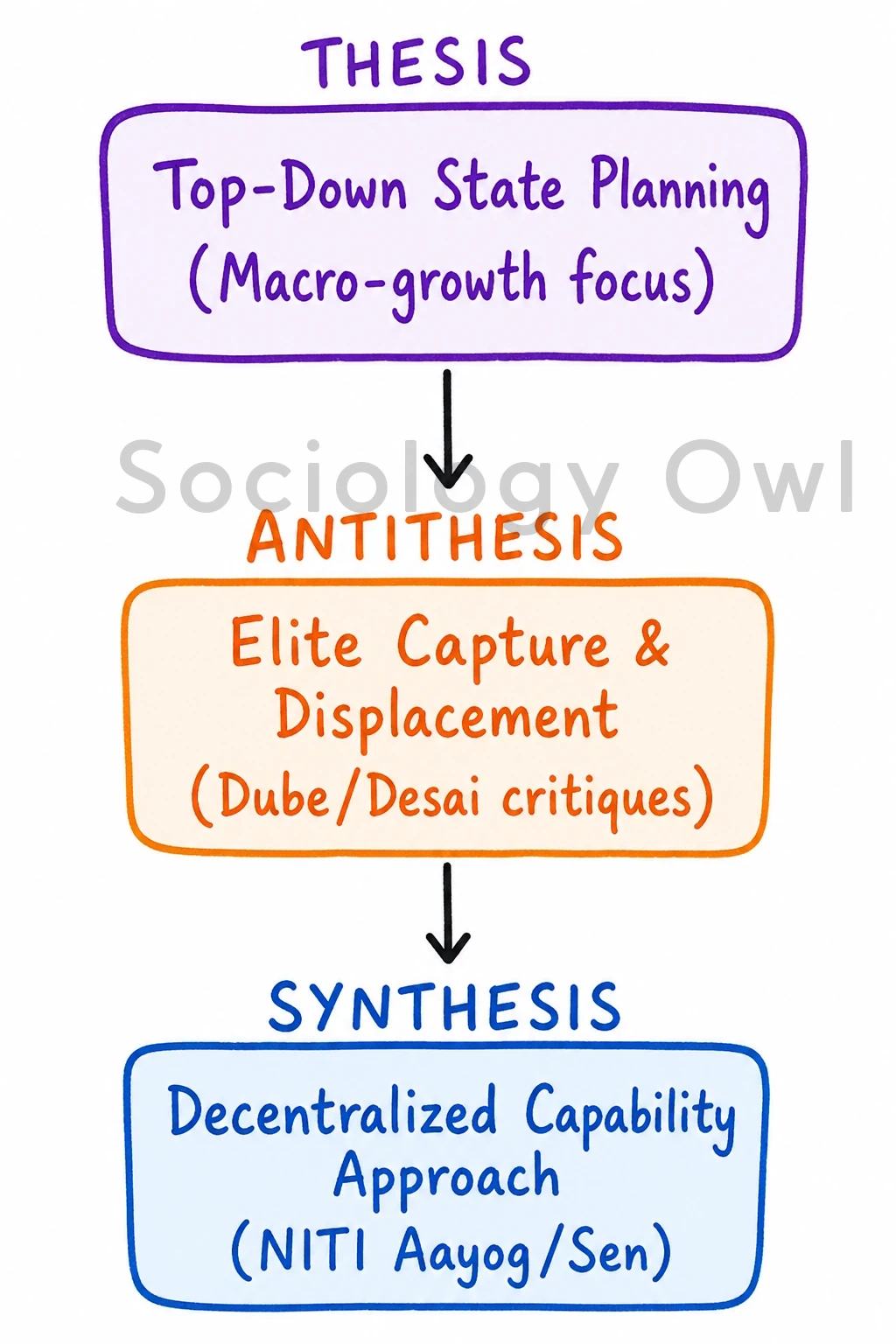
The shift from the Planning Commission to NITI Aayog marks a neoliberal transition towards cooperative federalism. Consequently, Amartya Sen advocates the “capability approach” to prioritize grassroot human development over mere macroeconomic growth.
Conclusion
To overcome historical elite-biases, modern planning must embrace decentralized, bottom-up governance—empowering Gram Sabhas through schemes like MGNREGA—to ensure inclusive rural transformation and genuine social equity.