Model Answer:
Non-positivistic Methodology
The debate on whether non-positivistic methodology is ‘scientific’ hinges on the definition of science itself. While positivists equate science with the nomothetic (natural science) model, non-positivists argue that studying conscious human beings requires an idiographic, interpretive epistemology focused on subjective reality.
Scientific Merit of Non-Positivism
- Rigorous Conceptual Tools: Max Weber introduced Ideal Types alongside Verstehen as objective heuristic tools to systematically study subjective social action, drawing causal explanations in his seminal work, The Protestant Ethic and the Spirit of Capitalism.
- Prioritizing Validity: Non-positivism pursues deep validity over mere reliability (replicability). William Foote Whyte’s participant observation in Street Corner Society uncovered facts about gang structures that standardized positivist surveys would inherently miss.
- Systematic Experimentation: Harold Garfinkel’s ethnomethodology utilized “breaching experiments” to systematically uncover hidden, everyday social rules.
- Objectivity through Reflexivity: Alvin Gouldner’s “Reflexive Sociology” mandates researchers to acknowledge their positionality, ensuring scientific transparency and addressing subjectivity biases.
Epistemological Critiques
- Falsifiability: Karl Popper argues that non-positivist interpretations often evade strict Falsification, making them unscientific by strict positivist standards.
- Paradigm Plurality: Countering this, Thomas Kuhn asserts that sociology is a multi-paradigmatic science where interpretivism functions as a distinct, valid scientific Paradigm.
Modern qualitative research proves non-positivism’s ongoing scientific utility. In Evicted, Matthew Desmond employs rigorous ethnography to map the hidden dimensions of urban poverty. Similarly, non-positivist studies of gig-economy workers capture “algorithmic alienation,” revealing subjective precarities entirely invisible to purely quantitative income surveys.
Conclusion
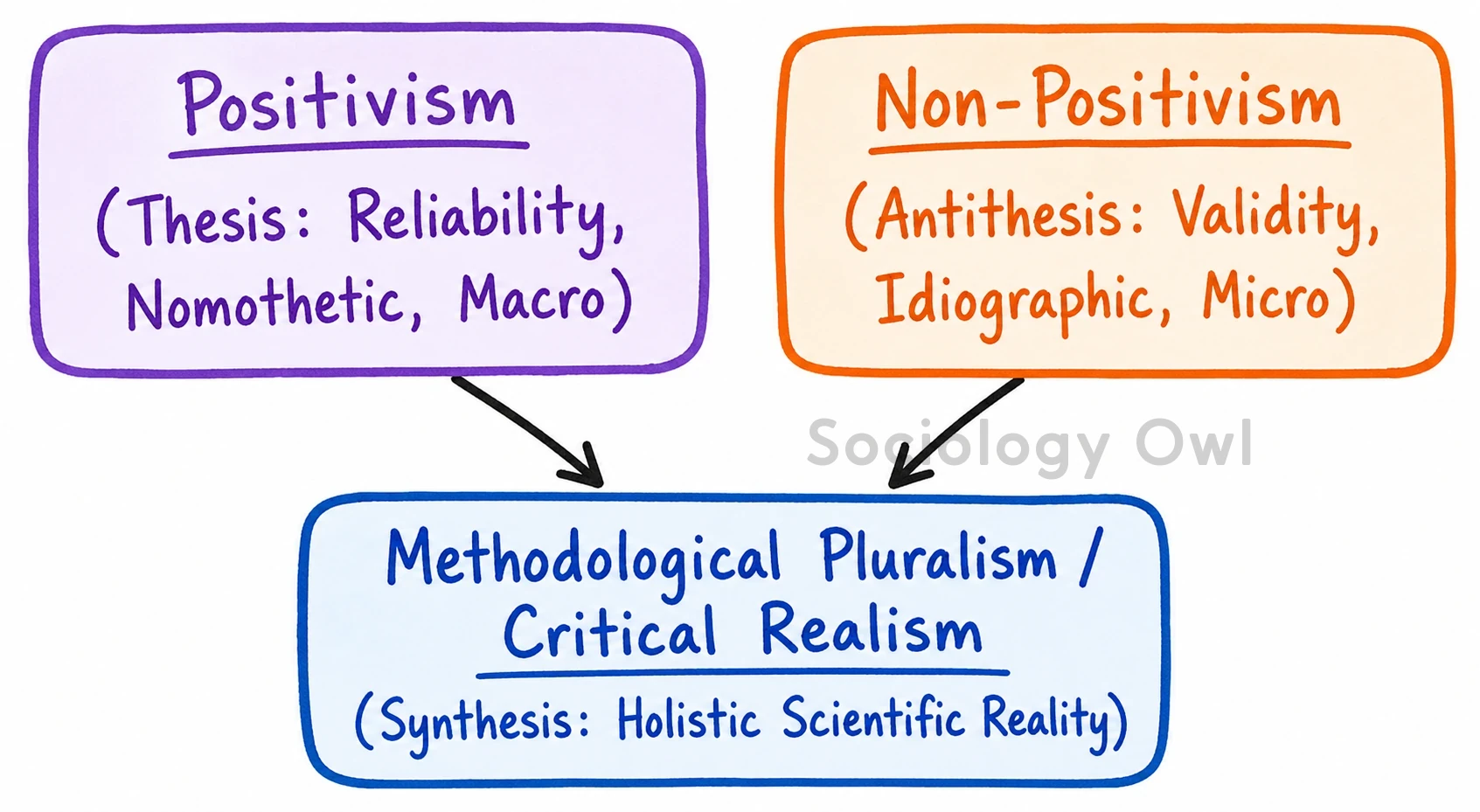
Ultimately, non-positivism expands the boundaries of science beyond mere quantification. Contemporary sociology resolves this debate through Methodological Pluralism (Alan Bryman) and Critical Realism (Roy Bhaskar), effectively synthesizing objective structural data with subjective meanings to capture a holistic and scientifically rigorous social reality.