
2026 Paper 2
Sociology Optional 2026 Paper 2 Solution
Master UPSC Sociology Paper 2 with our detailed 2026 model answers. We break down every question from this year’s exam, showing you how to seamlessly integrate Indian thinkers, empirical case studies, and contemporary socio-political issues into high-scoring answers.
Sociology 2026 Question Paper 2 PDF Download
Click on Question to see Model Answer
SECTION-A
1. Answer the following questions in about 150 words each: (10×5=50)
निम्नलिखित प्रश्नों में से प्रत्येक का उत्तर लगभग 150 शब्दों में दीजिए :
(a) In what respect is M. N. Srinivas’ study of Indian village society based on structural and functional perspective? Analyse.
एम० एन० श्रीनिवास के भारतीय ग्रामीण समाज का अध्ययन किस अर्थ में संरचनात्मक तथा प्रकार्यात्मक उपागम पर आधारित है? विश्लेषण कीजिए।
(b) According to you, which social reform had long-lasting impact on a specific section of society? Support your answer with suitable example.
आपके अनुसार, कौन-से सामाजिक सुधार का समाज के एक विशिष्ट भाग पर दीर्घकालीन प्रभाव पड़ा है? अपने उत्तर की उचित उदाहरण द्वारा पुष्टि कीजिए।
(c) In the context of women’s movements and laws do you think that matriarchy is the need of the hour? Discuss in detail.
महिला आन्दोलनों एवं कानूनों की पृष्ठभूमि में क्या आप सोचते/सोचती हैं कि मातृसत्तात्मकता समय की माँग है? विस्तार से विवेचना कीजिए।
(d) Discuss the debates on the concepts ‘duty’ and ‘worship’ while understanding religion in India.
भारत में धर्म को समझने के लिए ‘कर्तव्य’ तथा ‘पूजा’ की अवधारणाओं पर होने वाले वाद-विवाद की विवेचना कीजिए।
(e) How does the concept ‘secular’ go beyond any religion in plural society like India? Analyse.
भारत जैसे बहुलवादी समाज में ‘पंथनिरपेक्ष’ की अवधारणा किस प्रकार किसी भी धर्म के परे जाती है? विश्लेषण कीजिए।
2. (a) Indological approach, advocated by G. S. Ghurye, focuses on the study of Indian society through Indian texts. How can Indological approach be useful in the study of other society? Comment in detail. (20)
जी० एस० घुर्ये द्वारा प्रतिपादित भारतीय विद्या उपागम, भारतीय ग्रन्थों के अध्ययन के माध्यम से भारतीय समाज के अध्ययन पर केन्द्रित है। अन्य समाज के अध्ययन में भारतीय विद्या उपागम किस प्रकार उपयोगी हो सकता है? विस्तार से टिप्पणी कीजिए।
(b) Examine how Indian Nationalism was a result of ‘Akhand Bharat’/Indian Subcontinent’s socio-cultural and political consciousness. (20)
परीक्षण कीजिए कि भारतीय राष्ट्रवाद किस प्रकार से ‘अखण्ड भारत’/भारतीय उपमहाद्वीप की सामाजिक-सांस्कृतिक तथा राजनैतिक चेतना का परिणाम था।
(c) How does A. R. Desai argue that Indian social classes must be studied through the colonial mode of production? Elucidate. (10)
ए० आर० देसाई यह तर्क कैसे देते हैं कि भारतीय सामाजिक वर्गों का अध्ययन, औपनिवेशिक उत्पादन-रीति के द्वारा किया जाना चाहिए? स्पष्ट कीजिए।
3. (a) Examine the challenges of applying micro-level village studies to macro-level village structure of Indian society. (20)
भारतीय समाज के बृहत्-स्तरीय ग्राम संरचना में सूक्ष्म-स्तरीय ग्राम अध्ययन को प्रयोग करने में आने वाली चुनौतियों का परीक्षण कीजिए।
(b) Explain the emergence of middle class in agrarian society in India. What have been the socio-structural implications of the emergence of this middle class? (20)
भारत में कृषक समाज में मध्य वर्ग के उद्भव की व्याख्या कीजिए। इस मध्य वर्ग के उद्भव के सामाजिक-संरचनात्मक प्रभाव क्या रहे हैं?
(c) When land reform was a paradigm shift, then what type of land reforms would you recommend to make India a more equitable society? (10)
जबकि भूमि सुधार एक प्रतिमानात्मक स्थानान्तरण था, तब आप भारतीय समाज को अधिक न्यायसंगत बनाने के लिए किस प्रकार के भूमि सुधारों की अनुशंसा करेंगे/करेंगी?
4. (a) How does the Constitution of India promote education? Do you think that education can be a major instrument of social change? Clarify. (20)
भारतीय संविधान किस प्रकार शिक्षा को प्रोत्साहित करता है? क्या आप सोचते/सोचती हैं कि सामाजिक परिवर्तन के लिए शिक्षा एक प्रमुख यंत्र हो सकती है? स्पष्ट कीजिए।
(b) Draw the current population pyramid of India. What policy measures would you recommend for population dynamics to achieve sustainability? (20)
भारत की वर्तमान जनसंख्या का पिरामिड बनाइए। धारणीयता प्राप्त करने के लिए आप जनसंख्या में परिवर्तन लाने के कौन-से नीतिगत उपायों की अनुशंसा करेंगे/करेंगी?
(c) Compare G. S. Ghurye’s and A. R. Desai’s approaches used in understanding Indian society. (10)
जी० एस० घुर्ये तथा ए० आर० देसाई द्वारा भारतीय समाज को समझने के लिए प्रयुक्त उपागमों की तुलना कीजिए।
SECTION-B
5. Answer the following questions in about 150 words each: (10×5=50)
निम्नलिखित प्रश्नों में से प्रत्येक का उत्तर लगभग 150 शब्दों में दीजिए :
(a) Discuss the challenges faced by the aged people in receiving ‘elder care’.
वृद्धों द्वारा ‘वृद्ध-देखभाल’ प्राप्त करने में आने वाली चुनौतियों की विवेचना कीजिए।
(b) Examine the transiting social movements from physical movements to virtual movements in 21st century India.
21वीं शताब्दी के भारत के सामाजिक आन्दोलनों में भौतिक आन्दोलनों से आभासी आन्दोलनों की ओर परिवर्तनों का परीक्षण कीजिए।
(c) Clarify how the family planning programmes have taken a political ‘U’-turn in present India.
स्पष्ट कीजिए कि परिवार नियोजन कार्यक्रमों ने वर्तमान भारत में किस प्रकार एक राजनैतिक ‘U’-मोड़ (टर्न) लिया है।
(d) How do Louis Dumont and André Beteille differ in their approaches in understanding caste system in India? Explain.
भारत में जाति-व्यवस्था को समझने में लुई ड्यूमो तथा आन्द्रे बेतेई अपनी पद्धतियों में किस प्रकार भिन्न हैं? व्याख्या कीजिए।
(e) Bring out the debates of ‘insiders’ and ‘outsiders’ approaches in understanding Indian society.
भारतीय समाज को समझने के लिए ‘इनसाइडर’ तथा ‘आउटसाइडर’ उपागमों पर होने वाले वाद-विवाद का विवरण दीजिए।
6. (a) Differentiate between protests and movements. Discuss some of those movements which changed the fabric of Indian agrarian society during the colonial period. (20)
विरोध (प्रतिवाद) तथा आन्दोलन में अन्तर कीजिए। कुछ उन आन्दोलनों की विवेचना कीजिए, जिन्होंने उपनिवेश काल में भारतीय कृषक समाज के ढाँचे को परिवर्तित किया था।
(b) Synchronise the developmental programmes and social change in India, and describe them through visible and lived experiences. (20)
भारत में विकास कार्यक्रमों तथा सामाजिक परिवर्तन को समक्रमित कीजिए तथा उनका प्रकट और जीवित अनुभवों द्वारा वर्णन कीजिए।
(c) Why was the category of ‘criminal tribe’ created by law during the colonial period in India? Discuss its implications. (10)
भारत में उपनिवेश काल में कानून द्वारा ‘अपराधी जनजाति’ की श्रेणी क्यों निर्मित की गई थी? इसके प्रभावों की विवेचना कीजिए।
7. (a) Urbanisation in Independent India has been characterized by over-urbanization and rural push. Explain with demographic and sociological dimensions. (20)
स्वतंत्र भारत में नगरीकरण को अत्यधिक नगरीकरण तथा ग्रामीण आघात के रूप में विशेषीकृत किया जाता है। इसकी जनसंख्यात्मक तथा समाजशास्त्रीय आयामों से व्याख्या कीजिए।
(b) Give a sociological explanation of violence against women in India. What suggestions would you give to mitigate these violences? (20)
भारत में महिलाओं के प्रति हिंसा की समाजशास्त्रीय व्याख्या कीजिए। इन हिंसाओं को कम करने के लिए आप क्या सुझाव देंगे/देंगी?
(c) Examine the process of formalisation of informal sector to safeguard the interests of marginalised sections of the society. (10)
समाज के सीमान्त वर्गों के हितों की रक्षा करने के लिए अनौपचारिक क्षेत्र का औपचारिक क्षेत्र में परिवर्तन करने की प्रक्रिया का परीक्षण कीजिए।
8. (a) How has colonial rule transformed Indian society? If it (Indian society) had not undergone colonial rule, then what type of Indian society would have been there? Elaborate. (20)
औपनिवेशिक शासन ने भारतीय समाज को किस प्रकार परिवर्तित किया है? यदि भारतीय समाज ने उपनिवेश शासन का अनुभव नहीं किया होता, तब यह (भारतीय समाज) किस प्रकार का होता? विस्तार से उत्तर दीजिए।
(b) How have the women’s movements made the presence of women in every moment felt and more women participation in various fields? Discuss. (20)
महिला आन्दोलनों ने किस प्रकार प्रत्येक क्षण में महिलाओं की उपस्थिति का अनुभव कराया और महिलाओं को विभिन्न कार्य-क्षेत्रों में अधिक सहभागी बना दिया है? विवेचना कीजिए।
(c) Where would you locate the tribal community in the Varna system of India? Discuss. (10)
भारत की वर्ण-व्यवस्था में, जनजाति समुदाय को आप कहाँ स्थित करेंगे/करेंगी? विवेचना कीजिए।
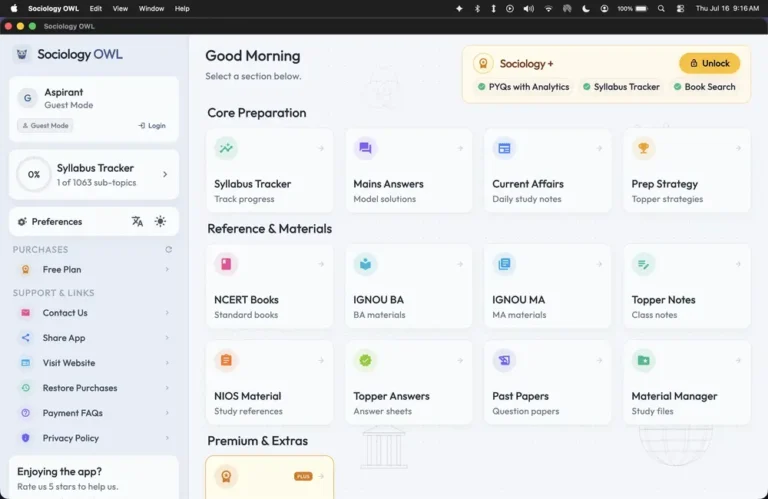
Get Model Answers for 2026 to 2013, Syllabus, NCERT Books, IGNOU Books, Topper Notes & Answer Sheet. हिंदी में भी.