Model Answer:
The social organisation of work has transitioned from the physical, Fordist factory regime of industrial capitalism to the algorithmically mediated, hyper-flexible infrastructure of platform capitalism.
Structural Shifts in the Organisation of Work
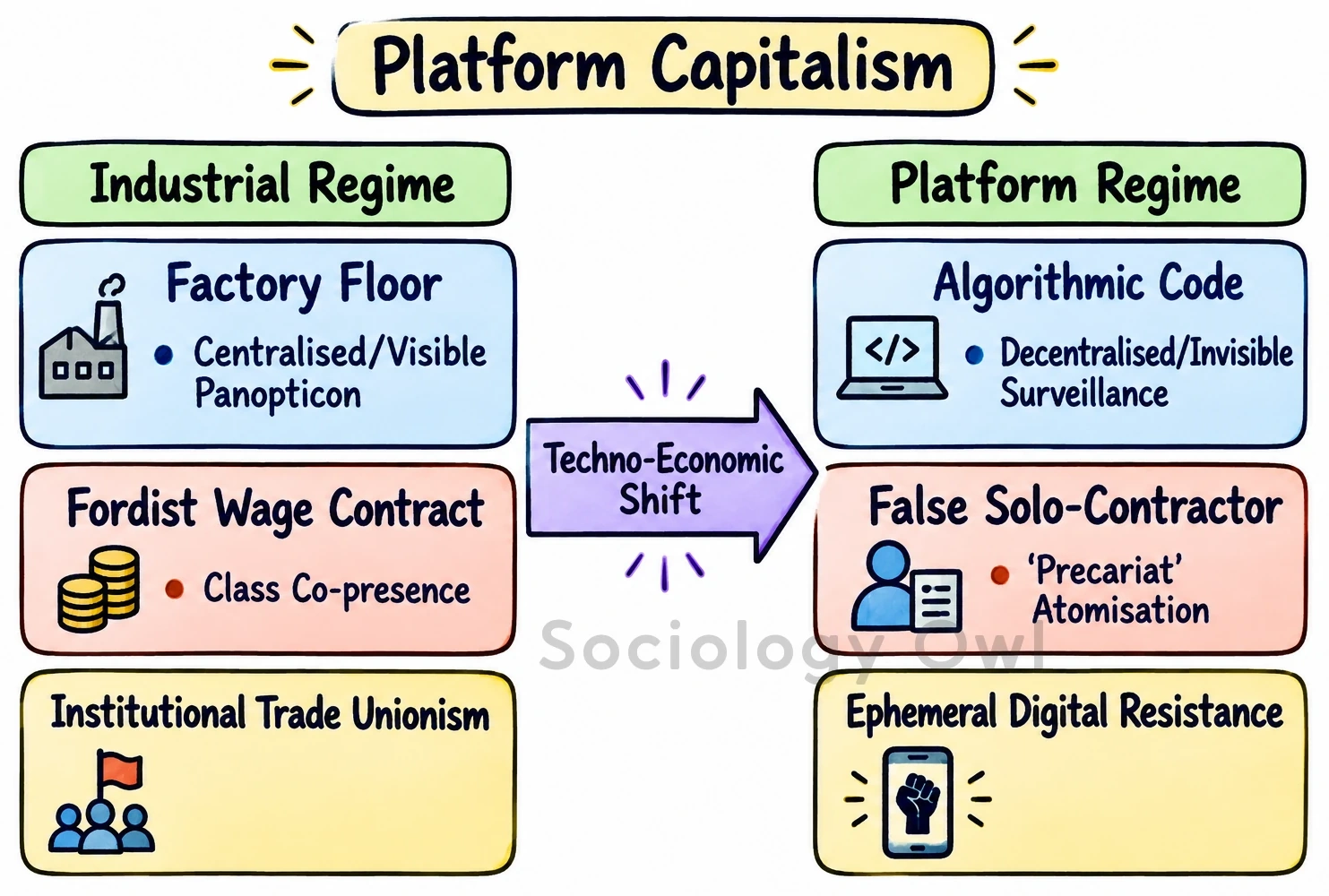
- Spatial-Temporal Architecture: Industrial capitalism relied on centralised factories and standardised temporal shifts (Fordism); platform capitalism decentralises production into on-demand, fluid, and boundaryless spatial-temporal networks.
- Employment Relations & Status: Clear wage-labour contracts and direct managerial hierarchies are replaced by disguised employment, misclassifying workers as “independent contractors” and expanding the precariat (Guy Standing).
- Managerial Control & Surveillance: Bureaucratic supervision and Taylorist scientific management have evolved into automated algorithmic management, where surveillance operates through digital tracking, rating systems, and opaque dispatch rules.
- Division of Labour: Classical technical division and factory deskilling (Harry Braverman) give way to hyper-fragmented micro-tasks coordinated by proprietary platforms, dissolving fixed craft identities.
- Labour Mobilisation & Solidarity: Physical shop-floor co-presence generated conventional trade unionism and collective class consciousness (Karl Marx); platform labour atomises workers, compelling novel, decentralised forms of app-based resistance.
- Forms of Alienation: Industrial alienation stemmed from detachment from the product; platform workers face hyper-alienation via total isolation from peers and subordination to algorithmic codes.
While industrial capitalism disciplined bodies through physical factories, platform capitalism extracts surplus value by algorithmically colonising personal time and assets.