Model Answer:
Cooperative Movements in India
Sociologically, the cooperative movement is an institutionalized social movement envisioned for structural transformation and distributive justice. However, instead of realizing Gandhian egalitarianism, it has often become a site for reproducing deep-rooted rural inequalities.
Sociological Challenges of the Cooperative Movement
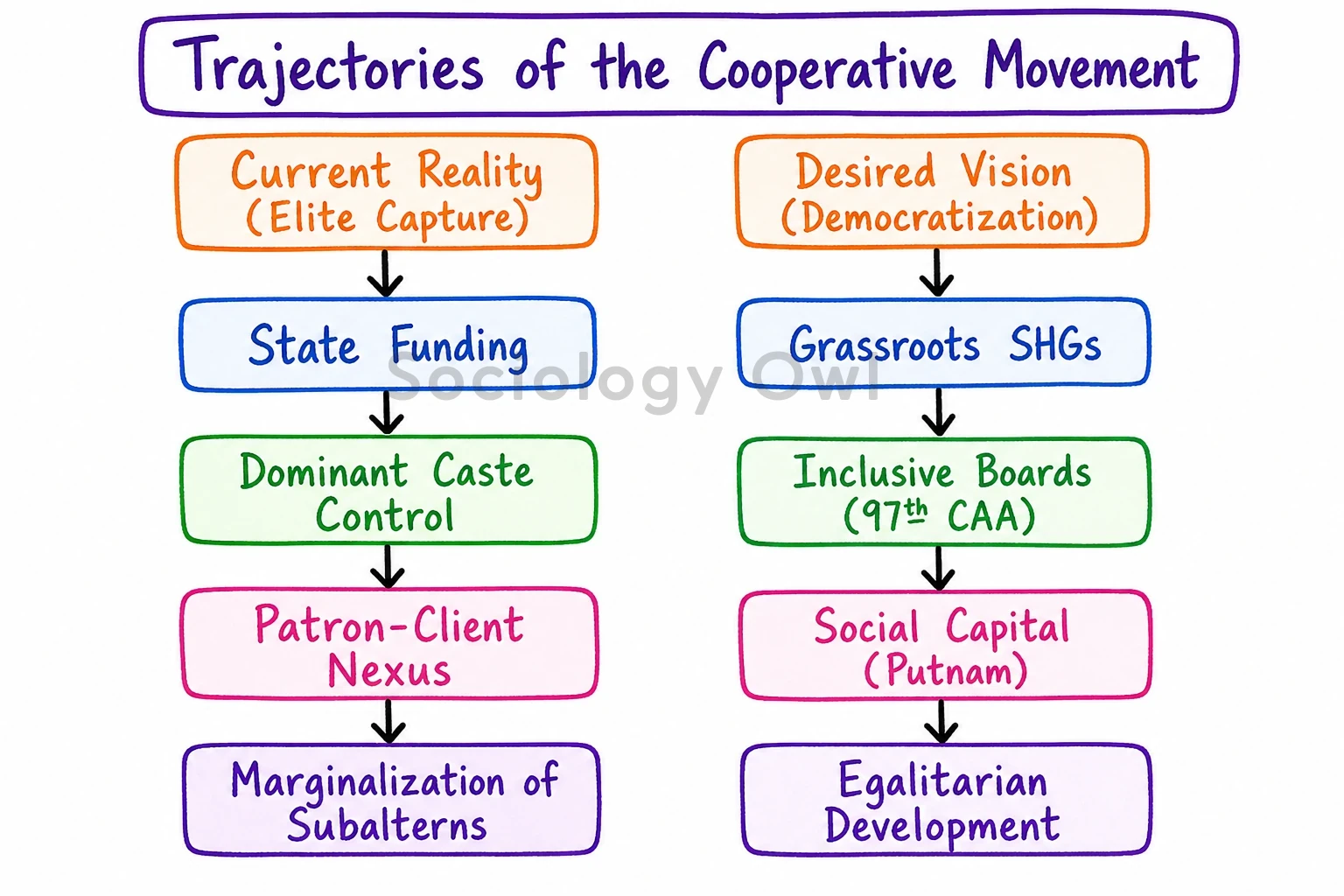
- Elite Capture: B.S. Baviskar, in his study of Maharashtra’s sugar cooperatives, argued they are frequently hijacked by the Dominant Caste (e.g., Marathas), who use them as springboards for political power, creating patron-client relationships.
- Caste-Class Nexus: Utilizing a Marxist framework, A.R. Desai highlighted that state-sponsored cooperatives primarily benefit the “rural bourgeoisie” (rich farmers), further marginalizing landless laborers and lower castes.
- Gender Blindness: Despite women performing the bulk of grassroots agricultural and dairy labor, cooperative boards remain entrenched in systemic patriarchy.
- Bureaucratization: Viewed through a Weberian lens, excessive state control has stripped cooperatives of their grassroots “social movement” character, reducing them to rigid, top-down bureaucratic apparatuses.
Measures for Grassroots Strengthening
- Democratization: Strict enforcement of the 97th Constitutional Amendment Act (2011), which mandates board reservations for SCs, STs, and women, is essential to dismantle dominant caste monopolies.
- Building Social Capital: Invoking Robert Putnam’s concept of “social capital,” grassroots solidarity must be rebuilt via homogenous self-help groups (SHGs) feeding into macro-cooperatives.
- Institutional Support: The new Ministry of Cooperation’s vision of “Sahkar se Samriddhi” must actively prioritize bottom-up structural reforms over centralization.
SEWA (founded by Ela Bhatt) represents a highly successful subaltern, women-led cooperative integrating trade unionism. Similarly, the AMUL model demonstrates how economic interdependence can successfully transcend traditional caste barriers.
Conclusion
To reconcile Gandhi’s vision of cooperative self-reliance with B.R. Ambedkar’s skepticism of Indian villages as “dens of localism,” the movement must transition from being a “cooperative of the privileged” to a genuine “cooperative of the subaltern.”