Model Answer:
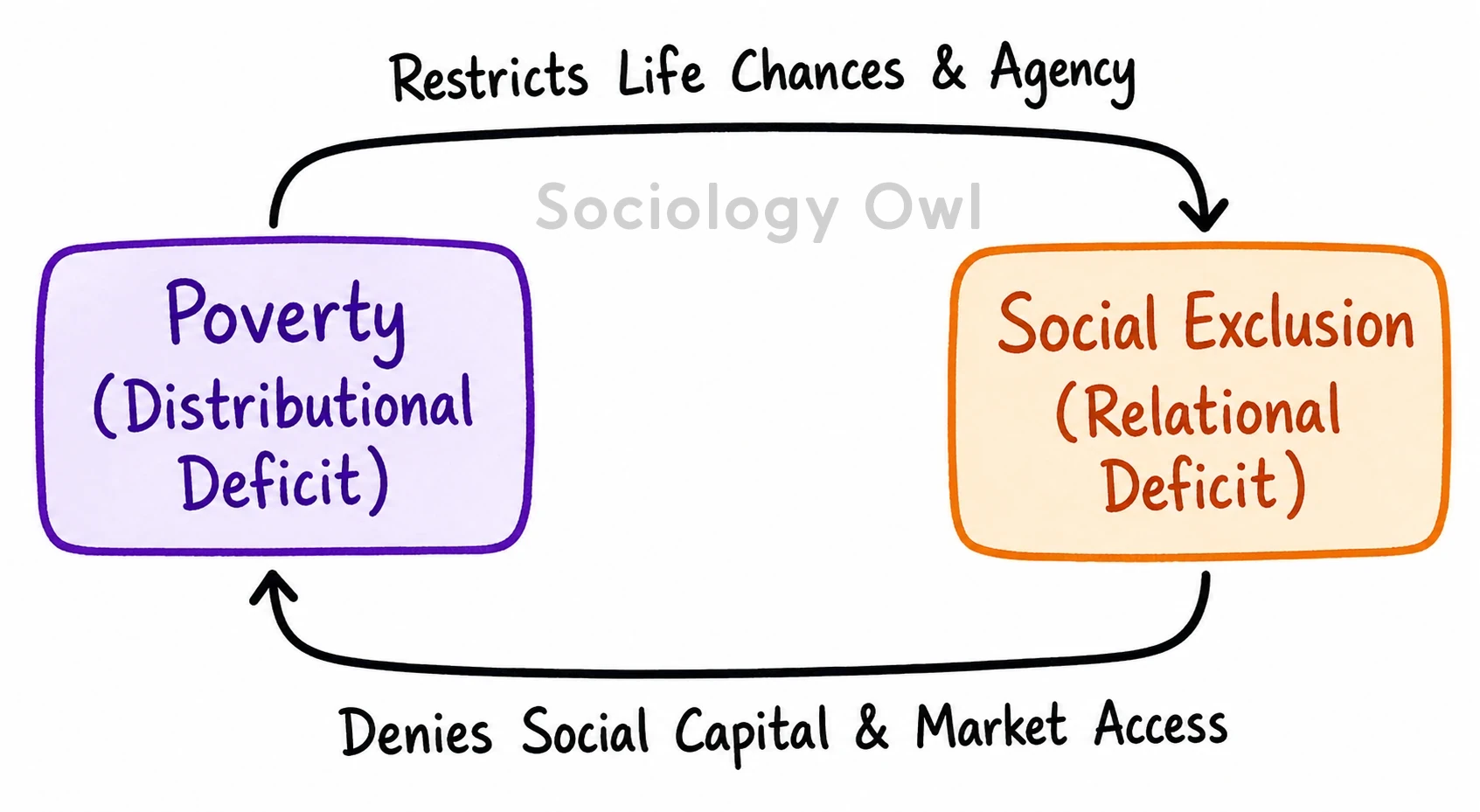
Poverty is fundamentally a distributional deficit of resources, while Social Exclusion, coined by Rene Lenoir, is a relational deficit alienating individuals from mainstream society. Peter Townsend’s concept of Relative Deprivation bridges both, explaining how lacking customary societal resources inherently excludes the poor from ordinary social participation.
Mechanisms of Exclusion
Poverty systematically diminishes what Max Weber termed “Life Chances”. Financial deprivation severely restricts market capacity, denying individuals access to institutions, civic participation, and networks, thereby creating a structurally excluded “Underclass” (William Julius Wilson).
- Spatial Dimension: Extreme poverty manifests geographically. Loïc Wacquant describes this as Advanced Marginality, where territorial stigmatization (like ghettos or slums) physically isolates the poor.
- Socio-Cultural Dimension: The poor systematically lack beneficial Social Capital (Pierre Bourdieu). Additionally, Oscar Lewis in Culture of Poverty argued that chronic deprivation breeds an exclusionary subculture, isolating communities from mainstream norms.
- Political/Economic Dimension: Amartya Sen’s Capability Approach illustrates how poverty severely restricts individual agency and freedom, rendering the poor politically voiceless.
The Causality Debate
Sociologists debate the direction of causality. Ruth Lister highlights that entrenched social exclusion (e.g., casteism or racism) often precipitates poverty. Alternatively, Herbert Gans, in The Uses of Poverty, argues that structural exclusion functionally benefits the affluent by guaranteeing a reserve army of cheap labor.
Global spatial exclusion is starkly visible in the French Banlieues. Modern poverty also fuels a Digital Divide, while the gig economy’s “working poor” face institutional exclusion from basic labor rights and healthcare networks despite being employed.
Conclusion
Poverty and social exclusion are interconnected and mutually reinforcing. Addressing them requires transcending mere economic redistribution to proactively dismantle the structural and relational barriers that impede true societal integration.