Model Answer:
Deciphered by James Prinsep (1837), Ashoka’s edicts—composed in Prakrit, Greek, and Aramaic—provide the earliest authentic epigraphic records for reconstructing the political, fiscal, and ethical matrix of the Mauryan Empire.
Key Historical Dimensions Reconstructed
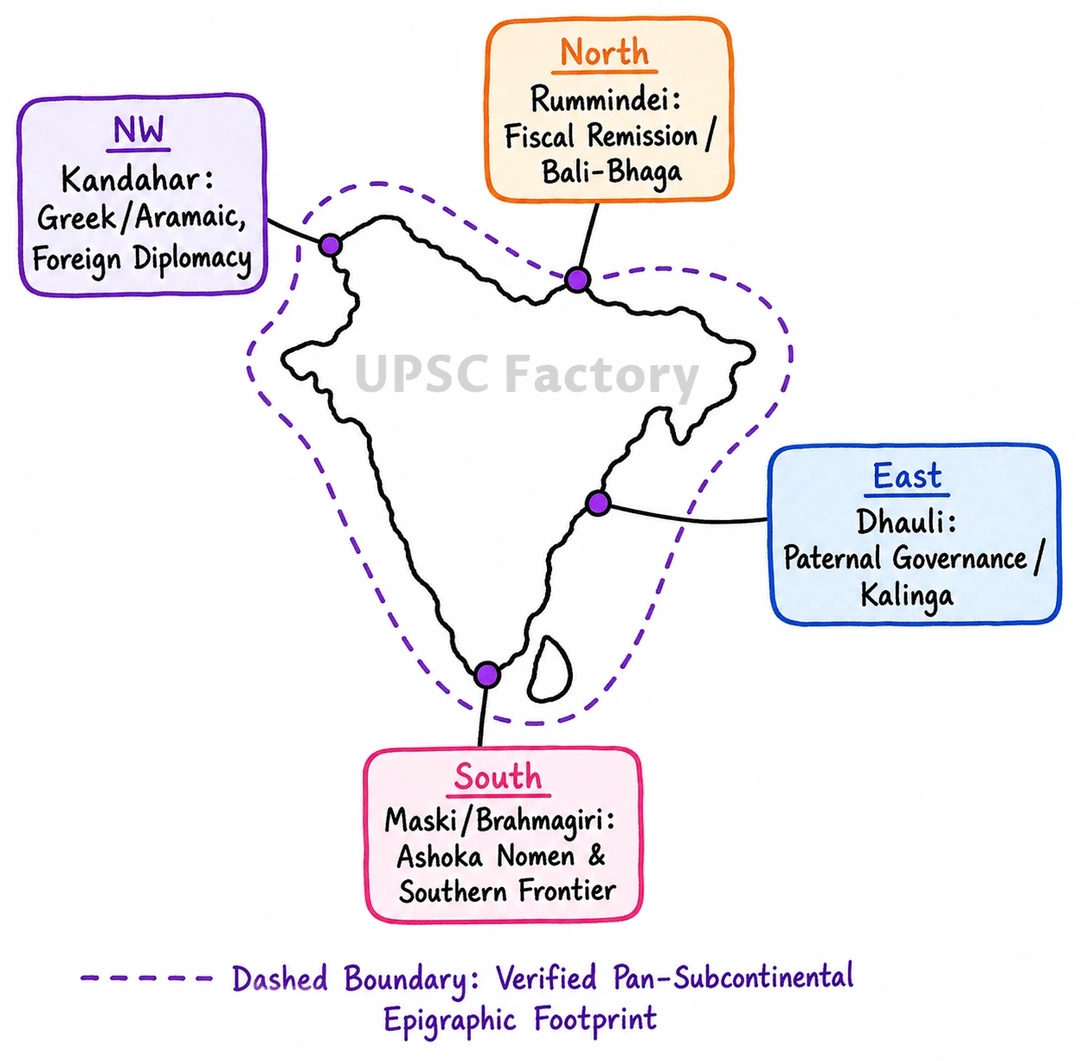
- Geographical Extent & Foreign Relations: Defines imperial frontiers (Kandahar to Karnataka) and external Hellenistic diplomacy with rulers like Antiochus II (Major Rock Edict XIII).
- Administrative Hierarchy: Documents administrative tiers (Yuktas, Rajjukas) and specialized welfare cadres (Dhamma-mahamattas) enforcing administrative equity (Major Rock Edict III & V).
- Fiscal Architecture: Provides concrete evidence of agrarian tax structures and royal remissions (Rummindei Pillar: Bali exempted, Bhaga reduced to 1/8th).
- Ideology & Governance: Articulates a paternalistic state model (“All men are my children”) and non-sectarian ethical code of Dhamma (Separate Kalinga Edicts).
Historiographical Limitations
- Normative Idealism: Portrays top-down imperial self-representation and moral aspirations rather than ground-level administrative realities.
- Contextual Voids: Omits operational details on urban guild systems, military logistics, and ordinary social stratifications, requiring literary corroboration (Arthashastra, Megasthenes’ Indica).
Despite imperial subjectivity, Ashokan epigraphs remain the primary empirical anchor that transitions Mauryan historiography from textual tradition into verifiable chronological history.