Model Answer:
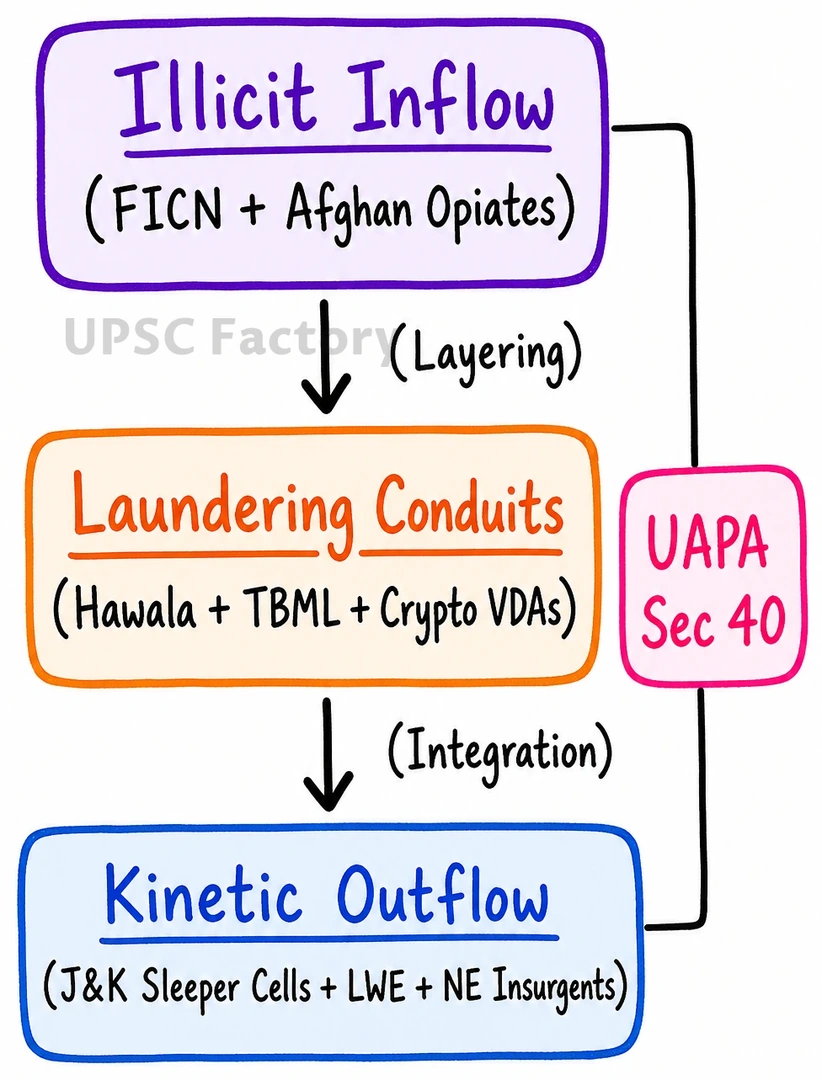
Terror financing via Fake Indian Currency Notes (FICN) and Money Laundering (ML) undermines economic sovereignty, sustaining cross-border terrorism, Left-Wing Extremism (LWE), and insurgent networks in India.
FICN and Money Laundering: Fueling Terror Networks in India
- State-Sponsored Subversion: High-quality FICN infused through porous borders (e.g., Nepal, Bangladesh) subsidizes logistical networks and recruits (NIA probes).
- Hawala & Underground Banking: Bypasses formal financial scrutiny to facilitate covert operational funding for sleeper cells and separatists (UAPA Sec 40).
- Trade-Based Money Laundering (TBML): Exploits under/over-invoicing in cross-border trade to transfer illicit value for terror infrastructure (Cross-LoC trade suspensions).
- Narco-Terrorism Pipelines: Drug syndicates launder Afghan opiate revenues through front businesses to finance Northeast insurgents and maritime smuggling.
- Fintech and Crypto Exploitation: Utilization of decentralized Virtual Digital Assets (VDAs) and mule accounts to mask beneficial ownership.
International Actions Against Terror Financing
- UN Sanctions Regimes: Binding resolutions (UNSCR 1267, 1373) enforce global asset freezes and arms embargoes on designated terror entities.
- Multilateral Intelligence Sharing: Egmont Group facilitates real-time cooperation among 170+ Financial Intelligence Units (FIU-IND).
- International Conventions: 1999 UN Terror Financing Convention mandates global mutual legal assistance and criminalization of cross-border terror funds.
Role of FATF and Compliance Architecture
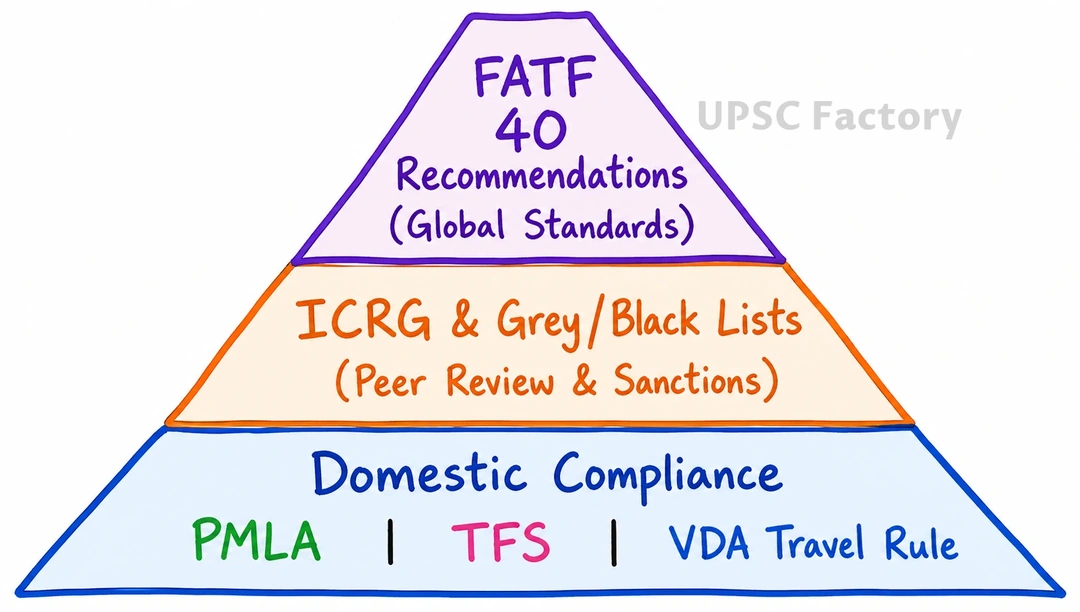
The Financial Action Task Force (FATF) sets global AML/CFT standards through its 40 Recommendations, utilizing its International Cooperation Review Group (ICRG) to monitor compliance via Mutual Evaluations and strategic lists (Grey/Black lists).
Methods of Compliance by Member States
- Legislative Harmonization: Enacting domestic laws criminalizing terror financing and ML (e.g., India’s PMLA, 2002; UAPA).
- Targeted Financial Sanctions (TFS): Implementing real-time asset-freezing mechanisms without delay against designated individuals.
- Beneficial Ownership Transparency: Mandating corporate registries to eliminate shell entities and untraceable overseas holdings.
- VDA Regulation (“Travel Rule”): Compelling crypto exchanges to collect and share originator/beneficiary data during digital asset transfers.
- Risk-Based Supervision: Rigorous oversight of Designated Non-Financial Businesses and Professions (DNFBPs) like real estate and non-profits.
Dismantling terror-financing architectures requires continuous domestic enforcement under PMLA alongside seamless multilateral compliance with evolving FATF standards to secure global financial integrity.