Model Answer:
Dalit Movements
Dalit movements represent a shift from Sanskritization (emulation) to anti-Brahmanical assertion. Sociologist Ghanshyam Shah frames them as anti-systemic subaltern struggles against the institutionalized inequalities of purity and pollution (Louis Dumont).
Historical and Social Origins
- Colonial Modernity: Introduction of Western education, secular legal frameworks (equality before the law), and Christian missionaries created spaces for Dalits to question their marginalized status.
- Ideological Shift: Thinkers like Jyotirao Phule and B.R. Ambedkar departed from reformist/assimilationist approaches, demanding instead an alternative structural transformation and the complete “annihilation of caste.”
- Relative Deprivation: M.S.A. Rao argues that systemic educational and civic deprivation, when contrasted with new egalitarian ideologies, catalyzed collective mobilization.
- Caste-Class Nexus: A.R. Desai notes that Dalits were predominantly landless agricultural laborers. Thus, their movements originated as struggles against agrarian class exploitation.
- Political Awakening: Eleanor Zelliot’s study of the Mahar movement highlights how early Dalits utilized political mobilization to secure fundamental human rights.
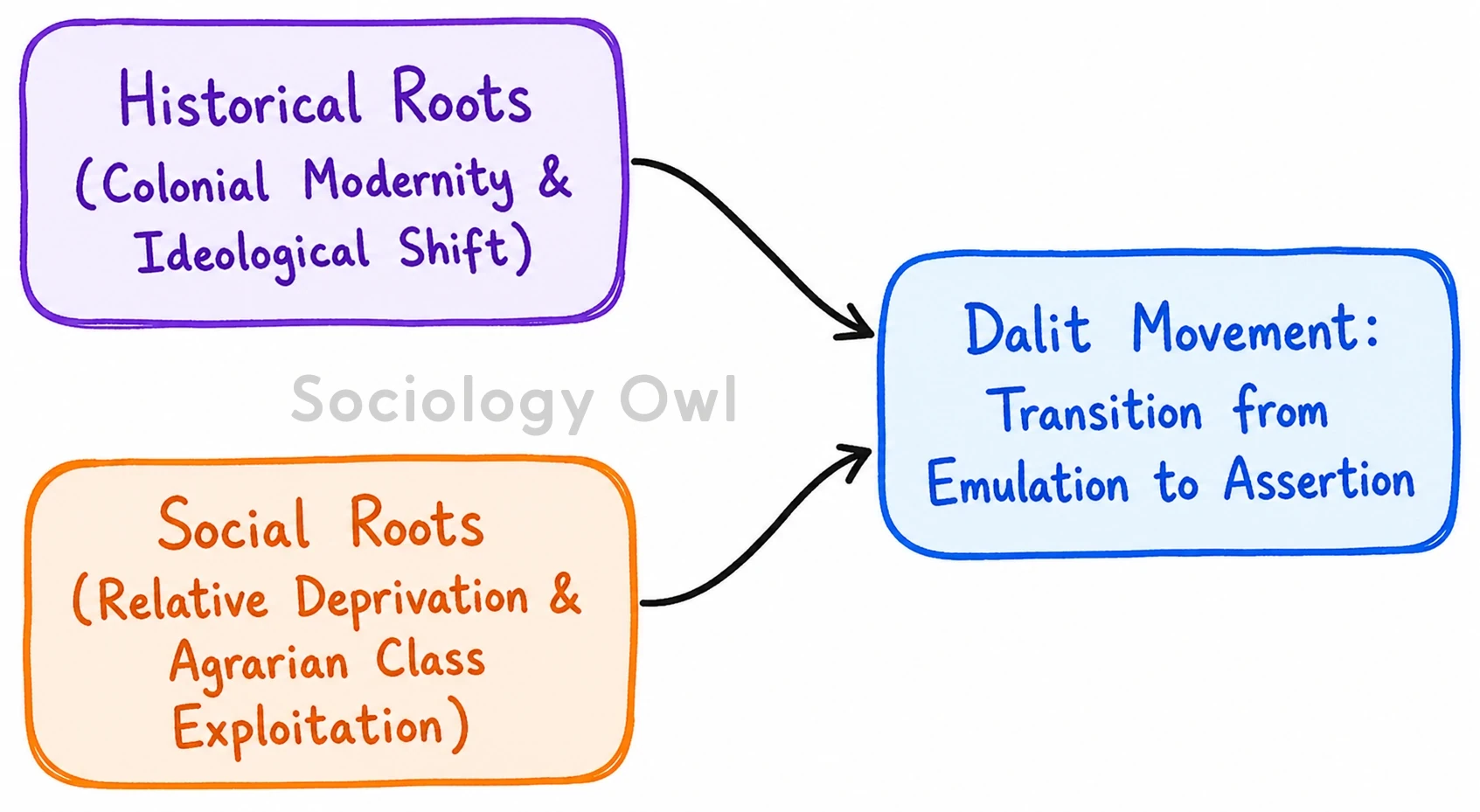
These historical roots enabled the politicization of caste (Rajni Kothari), utilizing caste not as a ritual identity but as a tool for political bargaining, visible in the rise of parties like the BSP and modern Dalit capitalism.
Conclusion
Originating at the intersection of ritual marginalization and class exploitation, Dalit movements have dynamically evolved from struggles for basic civic dignity into sophisticated assertions of socio-cultural identity, fundamentally reshaping modern Indian democracy.