Model Answer:
Women constitute a cross-cutting demographic rather than a socio-religious minority, requiring affirmative action grounded in substantive equality (Article 15(3)) rather than compensatory backwardness.
Conceptual Shift: Cross-Cutting Category vs. Backward Class
- Universal Intersectionality: Women span all caste, class, and religious divides, requiring horizontal rather than vertical, communal reservation.
- Democratic Parity: Focuses on overcoming structural political exclusion to achieve equal citizenship, not socio-economic backwardness alone.
Evolutionary Trajectory: From Grassroots to Parliament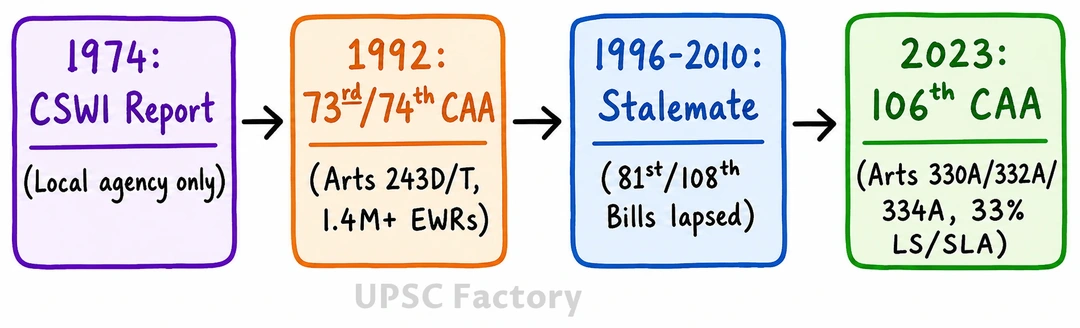
- CSWI Report / Towards Equality (1974): Rejected legislative quotas fearing political ghettoisation, but recommended reservation in local bodies to build grassroots agency.
- 73rd and 74th Constitutional Amendments (1992):
- Mandated ≥33% reservation in Panchayats and ULBs (Articles 243D and 243T).
- Created over 1.4 million elected women representatives; 21 states expanded this to 50% (e.g., Bihar, 2006).
- Decades of Legislative Stalemate (1996–2010): The 81st (1996) and 108th (2008) Amendment Bills lapsed due to demands for sub-quotas (OBC/minority representation).
- 106th Constitutional Amendment Act (2023):
- Enacted the Nari Shakti Vandan Adhiniyam, inserting Articles 330A, 332A, and 334A.
- Mandates 33% horizontal reservation in the Lok Sabha and State Legislative Assemblies for 15 years, operational post-delimitation.
Extending quotas from local bodies to Parliament shifts women’s role from grassroots proxy politics (Sarpanch Pati) to direct, institutional national policymaking.