Model Answer:
Golden Period of Village Studies in Indian Sociology: The 1950s
The 1950s marked a paradigm shift in Indian Sociology from the text-based Indological “Book-View” to an empirical “Field-View”, dismantling the colonial myth of Indian villages as isolated “little republics.”
Emergence of the “Field-View”
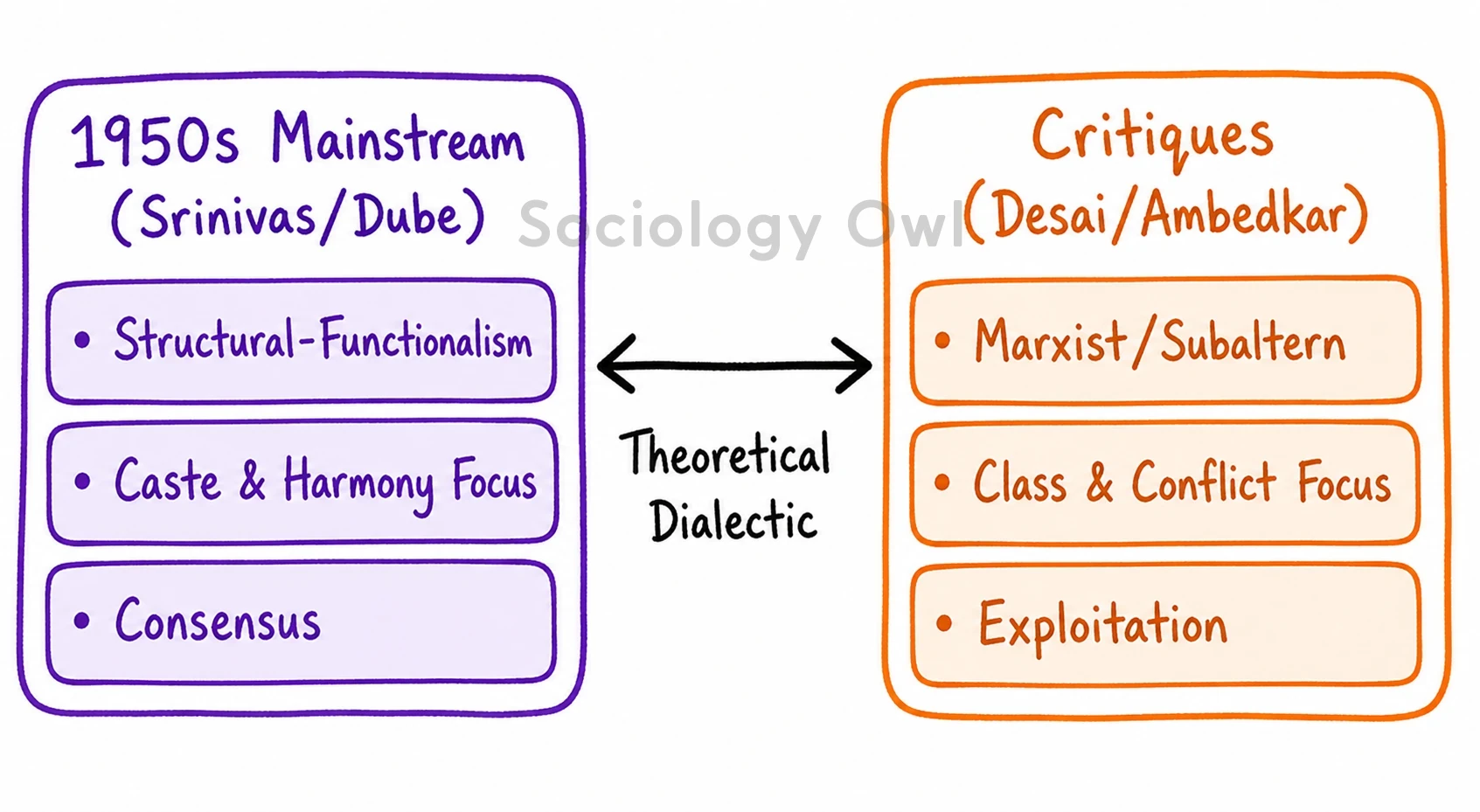
- Methodological Shift: Scholars adopted structural-functionalism and participant observation to study villages as microcosms of larger Indian civilization.
- Landmark Works: S.C. Dube’s Indian Village (1955) and M.N. Srinivas’s edited volume India’s Villages (1955) pioneered holistic rural ethnography.
- Theoretical Innovations: Foundational concepts like Sanskritization and Dominant Caste (M.N. Srinivas) were conceptualized during this era.
- Policy Linkage: The state sponsored these village studies to aid post-independence nation-building and the Community Development Programme (1952).
Critiques of the 1950s Studies
- Marxist Critique: A.R. Desai criticized the over-emphasis on caste and harmony, arguing it ignored agrarian class conflicts and land ownership disparities.
- Subaltern Perspective: B.R. Ambedkar starkly rejected the romanticized sociological view, terming the Indian village a “sink of localism” and a den of exploitation.
The ethnographic foundation laid in the 1950s remains vital today for analyzing modern rural transformations, such as shifting power dynamics within Panchayati Raj Institutions and the impact of reverse migration.
Conclusion
While the 1950s studies occasionally exhibited a structural-functional harmony bias, they successfully institutionalized rigorous empirical fieldwork, permanently establishing sociology as a scientific discipline in India.