Model Answer:
The Sociological Imagination
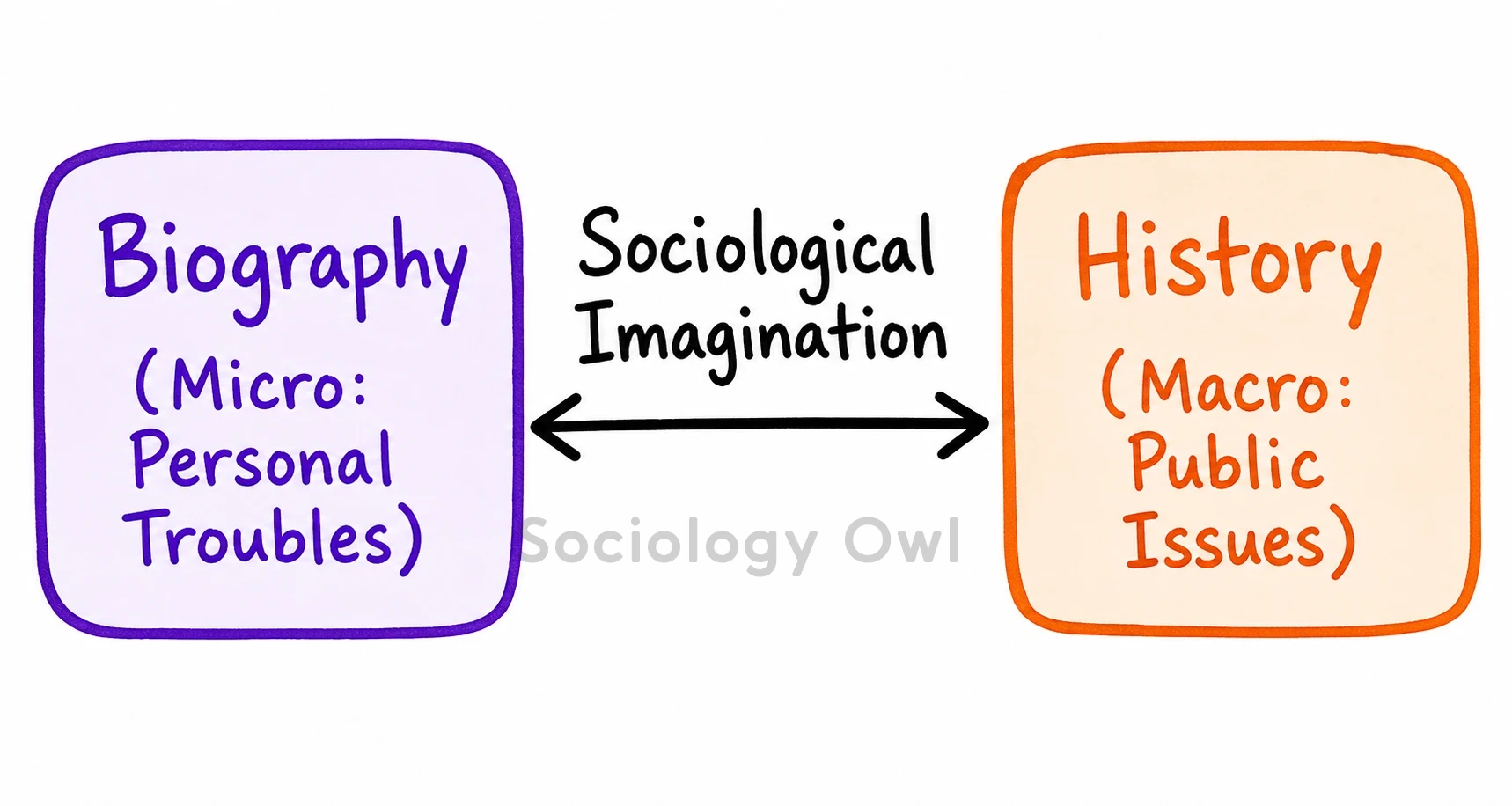
In The Sociological Imagination (1959), C.W. Mills offers a framework to bridge the micro-macro divide and the agency-structure debate. Rejecting both Talcott Parsons’ overly abstract “Grand Theory” and Paul Lazarsfeld’s micro-focused “Abstract Empiricism”, Mills envisioned a politically engaged sociology that connects individual experiences (biography) with broader structural forces (history).
Biography, History, and the Micro-Macro Link
- Biography: Represents the micro-level, encompassing an individual’s personal experiences, character, and immediate milieu.
- History: Represents the macro-level, including broad economic, political, and cultural transformations shaping society over time.
- The Nexus: Mills argued that human lives are intricately woven into historical epochs. Individual choices (agency) are fundamentally constrained or facilitated by historical context (structure).
Personal Troubles vs. Public Issues
The core mechanism of sociological imagination is distinguishing:
- Personal Troubles of Milieu: Occur within the individual’s immediate, private life.
- Public Issues of Social Structure: Transcend local environments, rooted in institutional crises.
- Mills’ Examples: If one person in a city is unemployed, it is a personal trouble. If 15 million are unemployed nationwide, it is a structural public issue. Similarly, mass divorce rates indicate macro-institutional shifts, not merely micro-level marital failure
Theoretical Linkages and Critiques
- Emile Durkheim demonstrated this imagination in Suicide, linking an intensely personal act (biography) to macro-social currents of regulation (history).
- Anthony Giddens’ Structuration Theory echoes Mills by analyzing how human agency and structures mutually reproduce.
- Critique: Postmodernists like Jean-François Lyotard reject grand historical narratives, asserting that contemporary society lacks a singular “History” connecting to fluid biographies. Furthermore, critics warn that emphasizing historical structure risks structural determinism, underplaying human free will.
Contemporary Relevance
In the era of AI automation, a freelance coder losing their job might perceive it as personal inadequacy (biography). However, the sociological imagination reframes this as a consequence of globalized platform capitalism and technological displacement (history).
Conclusion
Ultimately, Mills provided more than an analytical tool; he offered a democratic, emancipatory vision. By developing a sociological imagination, individuals transcend being passive victims of historical currents, becoming active, self-aware citizens capable of driving structural social change.