Model Answers
Q: What are the various forms of untouchability in India ? Critically examine.
Question asked in UPSC Sociology 2021 Paper 2. Download our app for last 20 year question with model answers.
Model Answer:
Type of Untouchability in India
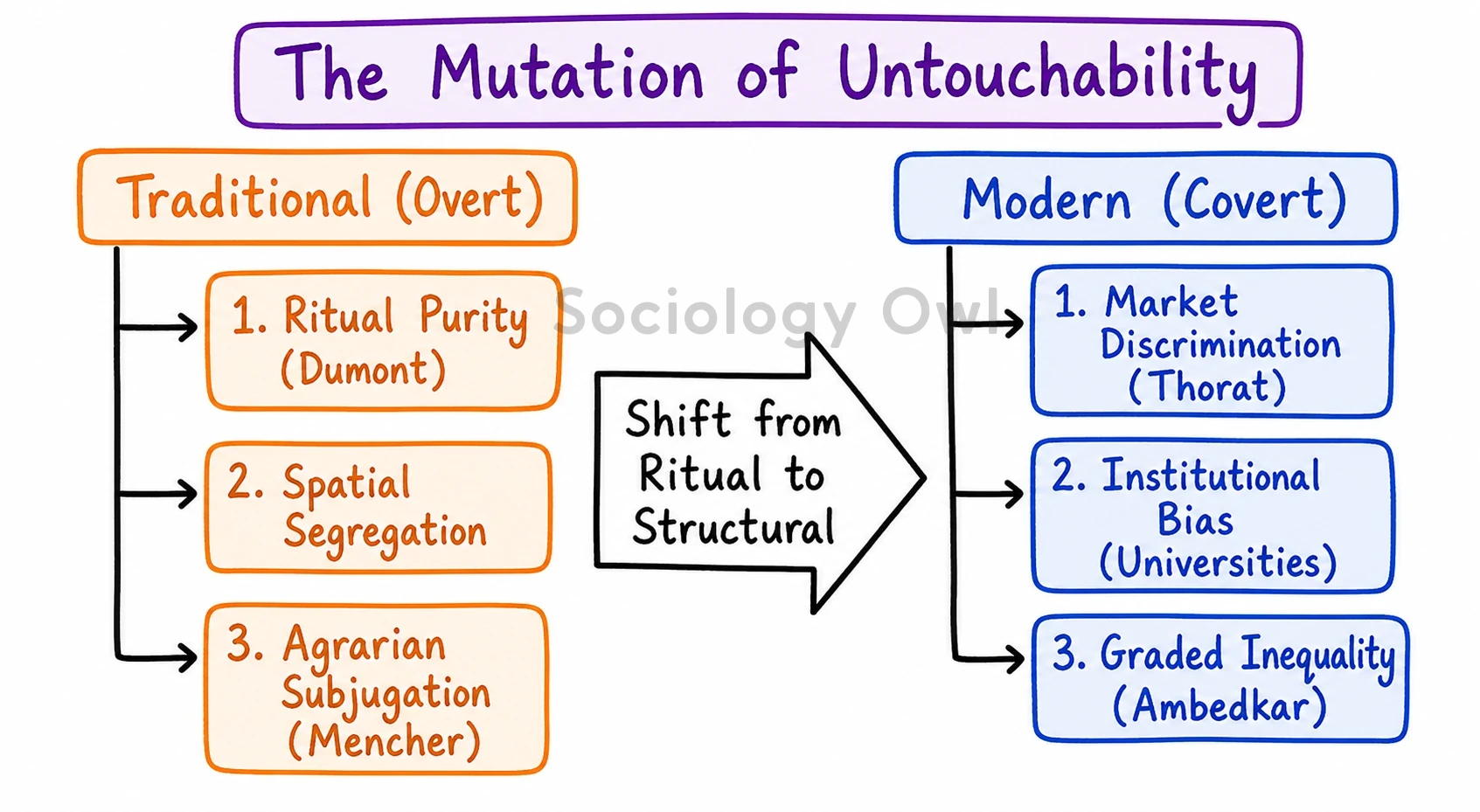
Untouchability refers to the practice of ritual and social exclusion of certain castes, historically justified through notions of purity–pollution. Though abolished by Article 17 of the Constitution, it persists in transformed and covert ways, making its study central to understanding inequality in India.
Forms of untouchability:
1. Ritual–religious forms
– Denial of temple entry, separate offerings, separate priests or prohibition from performing religious rituals.
– Louis Dumont links this to hierarchical ordering based on purity, while G.S. Ghurye saw it as an extreme form of caste-based distance.
– In many villages, Dalits are still relegated to the margins of religious festivals and cremation grounds.
2. Social and spatial segregation
– Separate hamlets (cheris, wadis), separate wells and tea cups, prohibition on inter-dining.
– M.N. Srinivas showed that even where Sanskritisation occurs, physical distance and commensality barriers often continue.
– Studies by Sukhadeo Thorat reveal separate seating and discrimination in mid-day meals and classrooms.
3. Economic and occupational forms
– Concentration of Dalits in stigmatized, “polluting” labour: manual scavenging, skinning carcasses, sewer work, despite the 2013 Prohibition of Employment as Manual Scavengers Act.
– André Béteille highlights how caste structures access to land and labour, producing chronic landlessness and wage discrimination.
– Audit studies (Thorat & Newman) show CVs with Dalit names get fewer interview calls, indicating new market-mediated untouchability.
4. Political–institutional forms
– Atrocities against assertive Dalits, boycott of Dalit hamlets, social and economic embargoes (documented by Ghanshyam Shah).
– In panchayats, “proxy” Dalit sarpanches and coercion show symbolic inclusion but real exclusion from power.
– In universities, the Thorat Committee (AIIMS/IIT) showed systematic academic and social discrimination; the Rohith Vemula case symbolises institutional untouchability.
5. Intra-Dalit and gendered forms
– Hierarchies among Dalits themselves (e.g., Valmikis vs other Dalits) reproduce untouchability.
– Dalit feminists like Sharmila Rege highlight “triple discrimination” based on caste, class and gender, including sexual violence as a tool of caste domination.
B.R. Ambedkar’s idea of “graded inequality” explains why overt bans may decline, yet newer, subtler exclusions persist across rural–urban and traditional–modern sites.
Untouchability has shifted from overt ritual bans to subtle exclusions; only combined legal enforcement, material redistribution and anti-caste conscientisation can secure genuine equality.
More Questions:
Download our app for UPSC Sociology Optional - Syllabus, NCERT Books, IGNOU Books, Past Paper with Model Answers, Topper Notes & Answer Sheet.