Model Answer:
Reverse Migration Meaning
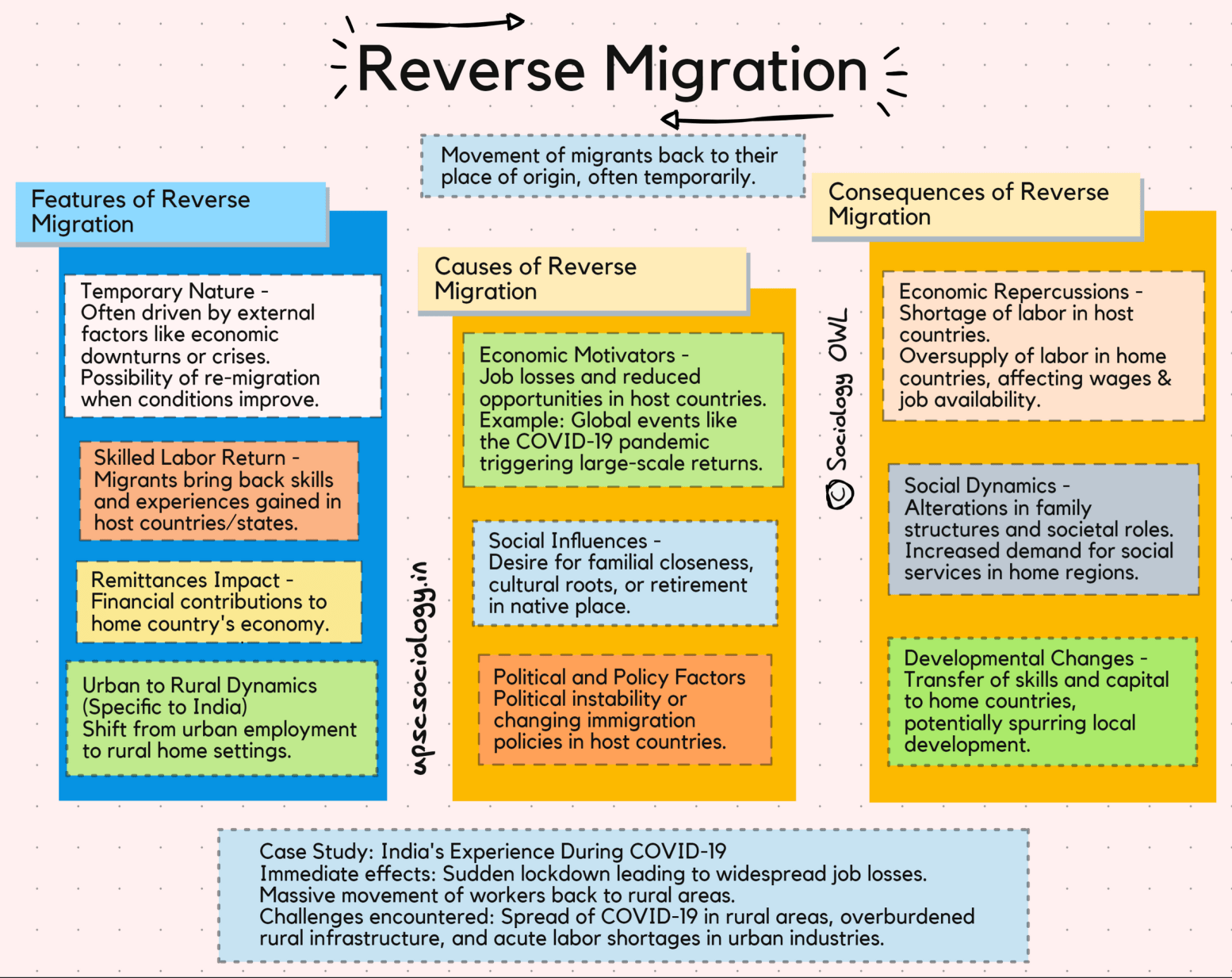
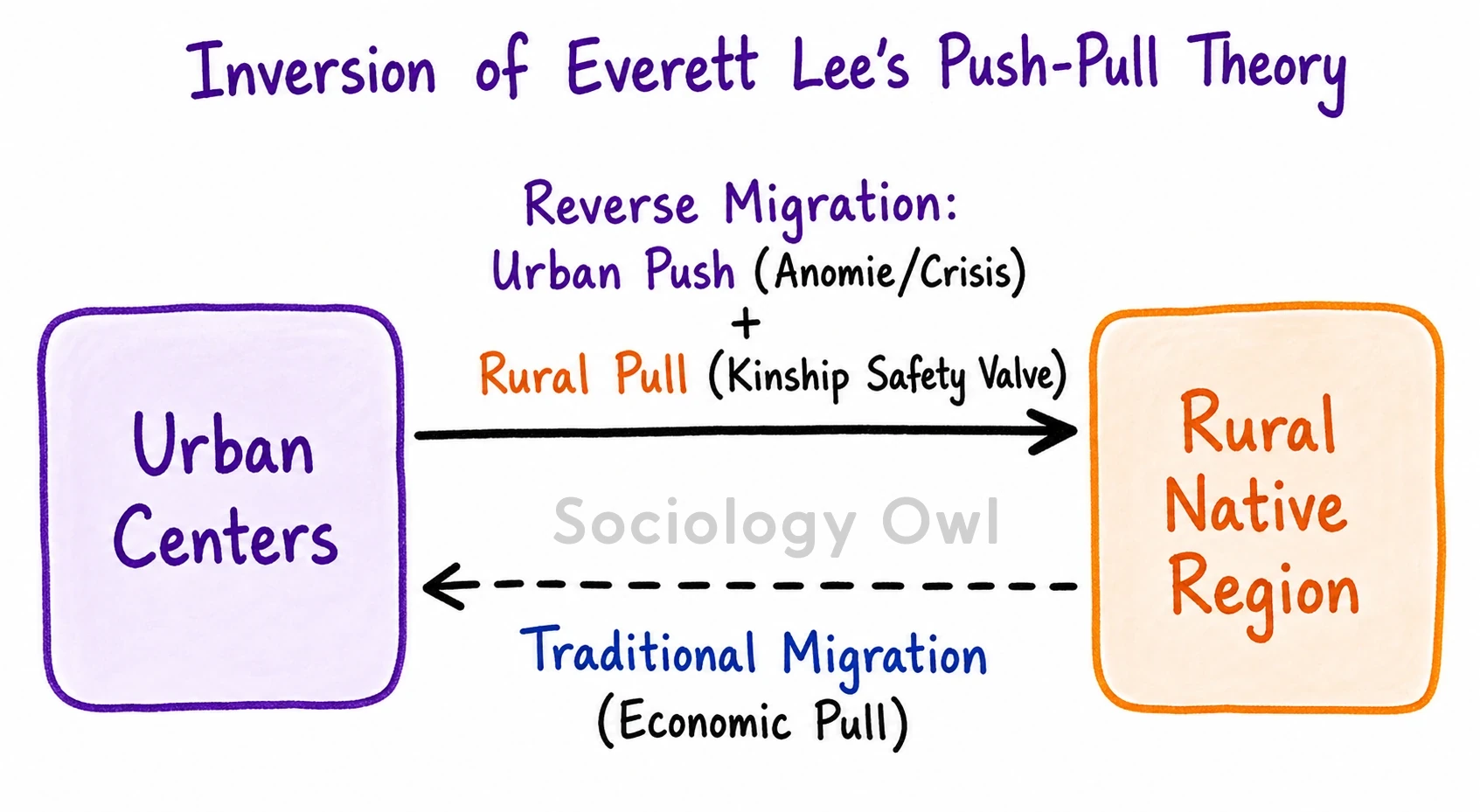
Reverse migration is the large-scale return of migrants to their native regions, disrupting Everett Lee’s Push-Pull theory. In India, it signifies a structural shift from “pull-driven” urbanization to distress-induced, “push-driven” rural return.
Features and Causes of Reverse Migration
- Circularity and Distress: Jan Breman describes such informal migrants as “Footloose Labour,” oscillating involuntarily between rural and urban spaces.
- Marxist Perspective: Migrants serve as a “reserve army of labour,” extracted for surplus value by capitalist urban centers but discarded during crises.
- International Dimension: While largely internal, it includes international returns, such as Gulf-to-Kerala migration studied by Leela Gulati.
- Urban Alienation: Migrants lack “social citizenship” and basic entitlements in cities, leading to systemic exclusion that creates urban Anomie.
- Rural Safety Valve: Structural-functionalists view traditional caste and kinship networks as the ultimate sanctuary during crises, reinforcing Dipankar Gupta’s concept of the rural-urban continuum.
Sociological Consequences
- Caste Hierarchies: Returning marginalized castes lose the relative anonymity of cities, facing a re-traditionalization of rigid village hierarchies.
- Gender Dynamics: Reverses the “feminization of agriculture”; returning men reclaim economic decision-making, while women’s domestic care-burden drastically increases.
- Demographic Strain: Disproportionately impacts Ashish Bose’s BIMARU states, exacerbating agrarian distress and disguised unemployment.
The COVID-19 pandemic triggered mass reverse migration. Chinmay Tumbe, in India Moving, highlights this as India’s second-largest exodus after Partition. It necessitated policy interventions like MGNREGA (rural safety net) and One Nation One Ration Card (ONORC) for portable food security.
Conclusion
Reverse migration exposes the fault lines of India’s unequal, urban-biased development model. Echoing Amartya Sen’s welfare perspectives, ensuring inclusive urbanization and portable social security is imperative to rescue informal workers from the dual trap of urban exploitation and rural stagnation.