Model Answer:
Commodity Fetishism and Its Evolution
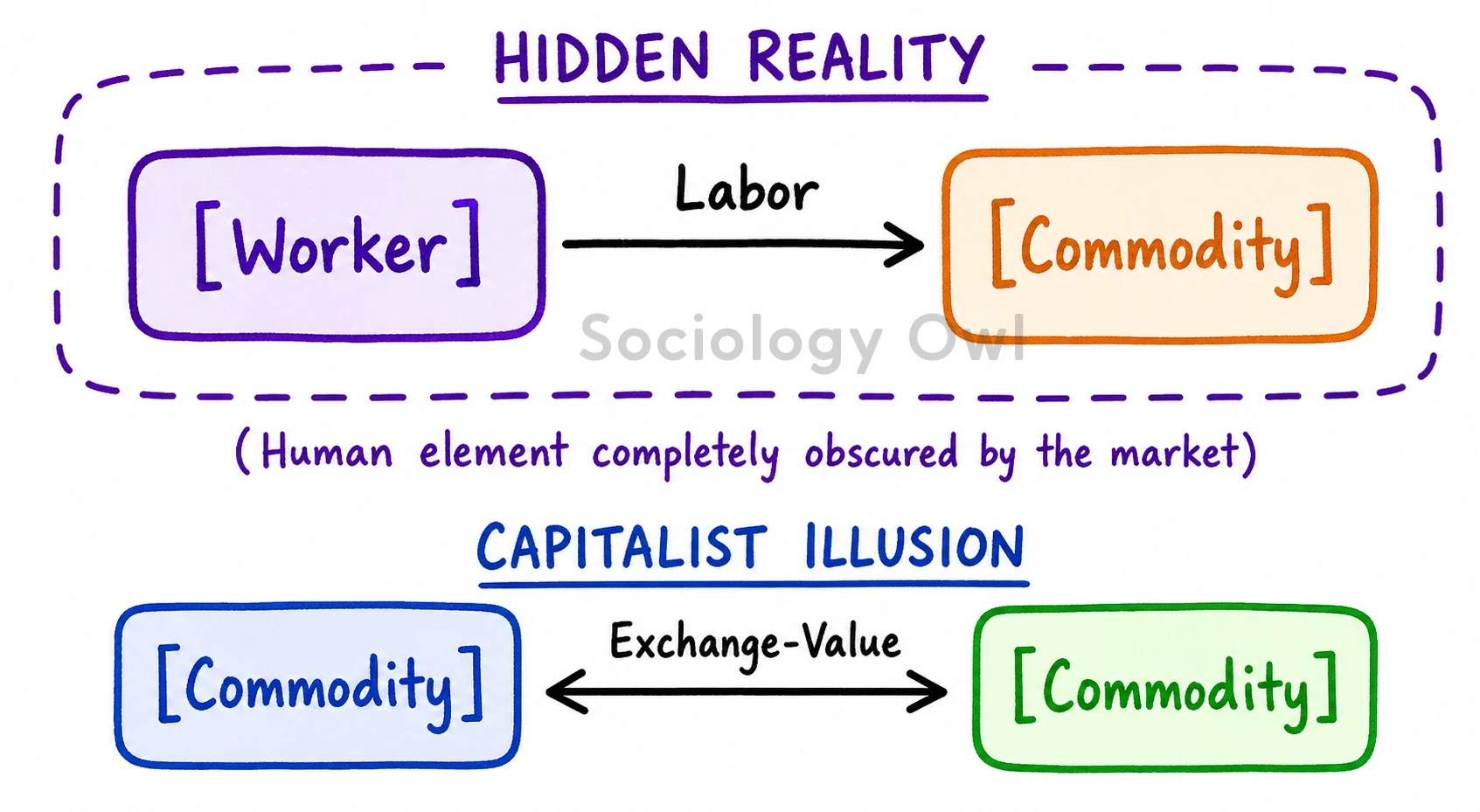
In Das Kapital, Karl Marx defines Commodity Fetishism as the phenomenon where Exchange-Value (market price) entirely overshadows Use-Value (utility). In capitalism, “a definite social relation between men assumes the fantastic form of a relation between things.”
Mechanism and Extensions
Obscured Relations: Commodities appear to possess intrinsic, “magical” power, masking the exploitative human labor that produced them.
Georg Lukács: Expanded this into Reification, where abstract social relations appear as natural, unchangeable objects.
Jean Baudrillard: Argued that modern fetishism is driven by Sign-Value (prestige and status), evolving beyond mere economic exchange.
Critique
Max Weber: Argued that modern alienation is driven by bureaucratic Rationalization, which would persist even in non-capitalist societies.
Interactionist View: Consumers are not merely passive victims of false consciousness; they actively use commodities to construct identity and meaning.
Society fetishizes smartphones for their sleek design and brand status (Sign-Value), remaining entirely blind to the exploitative labor (e.g., sweatshops, cobalt mining) driving their production.
Conclusion
Despite critiques, commodity fetishism remains a vital sociological tool to decode Alienation, hyper-consumerism, and the hidden exploitation embedded within modern global supply chains.