Emile Durkheim, one of the founding fathers of sociology, established the discipline as a rigorous, independent science. In his seminal work, “The Rules of Sociological Method” (1895), Durkheim provided the methodological blueprint for sociology by proposing that its unique subject matter should be the study of Social Facts. This framework definitively separated sociology from philosophy (which lacked empirical grounding) and psychology (which focused on individual minds).
Historical Context: The Emergence of Scientific Sociology
In the late 19th century, sociology was struggling for academic legitimacy. Influenced by Auguste Comte’s Positivism, Durkheim sought to apply the rigorous methodologies of natural sciences to the study of society. Amidst the chaos of the Industrial Revolution and the French Revolution, Durkheim wanted to understand how social order is maintained. To avoid psychological reductionism, he argued that society is an emergent reality (Sui Generis)—greater than the sum of its parts—and must be studied through observable, external phenomena.
I. Understanding “Social Facts”
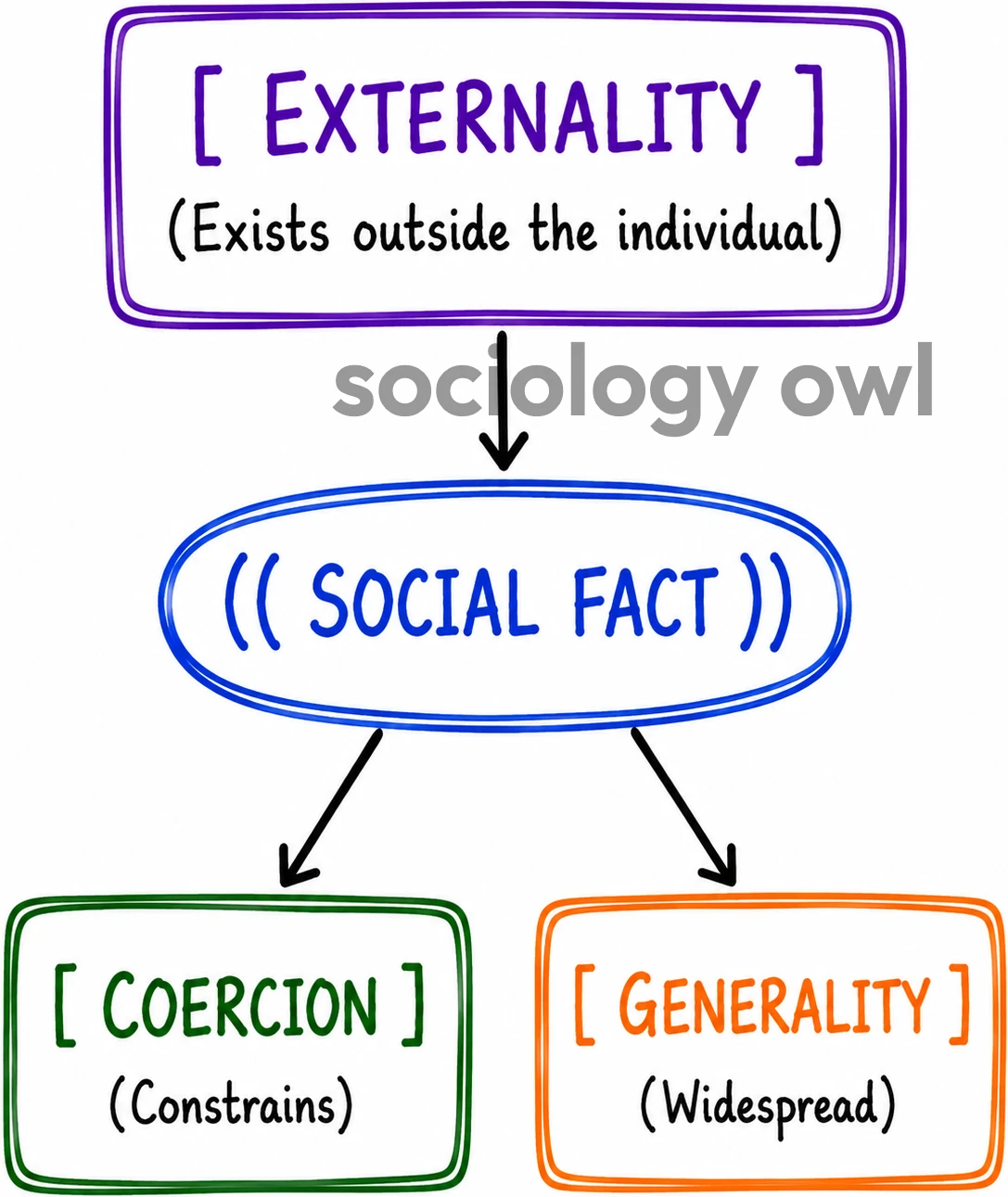
Durkheim defined Social Facts as “ways of acting, thinking, and feeling, external to the individual, and endowed with a power of coercion, by reason of which they control him.”
Core Characteristics of Social Facts
- Externality: They exist outside the individual conscience. They are present before a person is born and continue after they die (e.g., language, legal systems).
- Constraint (Coercion): They exert pressure on individuals to conform. Disobedience leads to social sanctions, ranging from mild ridicule to imprisonment.
- Generality and Independence: They are diffused throughout the group and exist independently of individual manifestations.
Material vs. Non-Material Social Facts
- Material Social Facts: Observable, physical realities such as architecture, technology, legal codes, and population distribution.
- Non-Material Social Facts: Invisible but deeply felt forces like norms, values, culture, and the Collective Conscience.
II. Rules for Observing Social Facts
To ensure absolute scientific objectivity, Durkheim prescribed specific methodological rules for sociologists:
- Treat Social Facts as “Things” (Choses): This is the cornerstone of Durkheim’s positivism. Sociologists must study social phenomena with the same detachment as physicists study matter. They must be observed objectively, free from subjective bias.
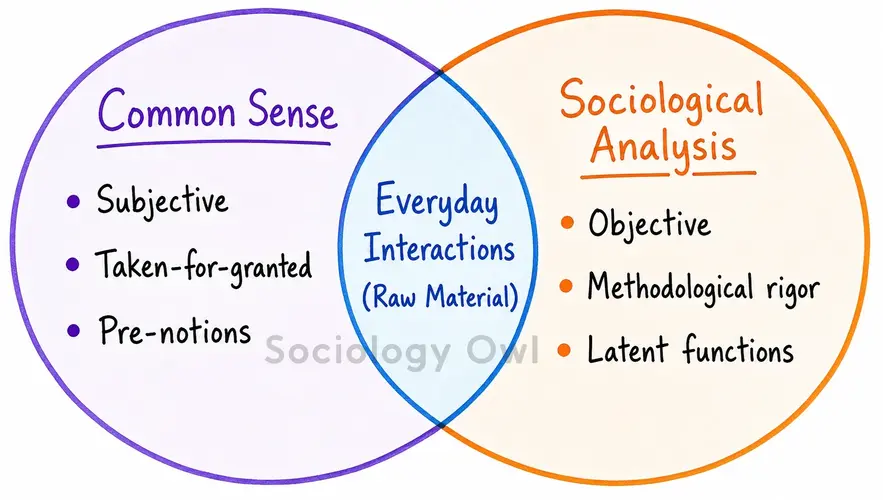
- Eradicate Preconceptions: The sociologist must discard common sense, ideological biases, and personal beliefs—a concept akin to Phenomenological Bracketing.
- Precise Conceptualization: Focus only on observable properties. For instance, instead of studying “social cohesion” abstractly, Durkheim studied Law (Repressive vs. Restitutive) as an empirical indicator in “The Division of Labour in Society” (1893).
III. The Role of Statistics: The Study of Suicide
In his masterwork, “Suicide” (1897), Durkheim brilliantly demonstrated his methodology. While suicide appears to be a profoundly individual and psychological act, Durkheim analyzed statistical records across Europe to prove it is a social fact.
- He used suicide rates as an indicator of invisible social currents.
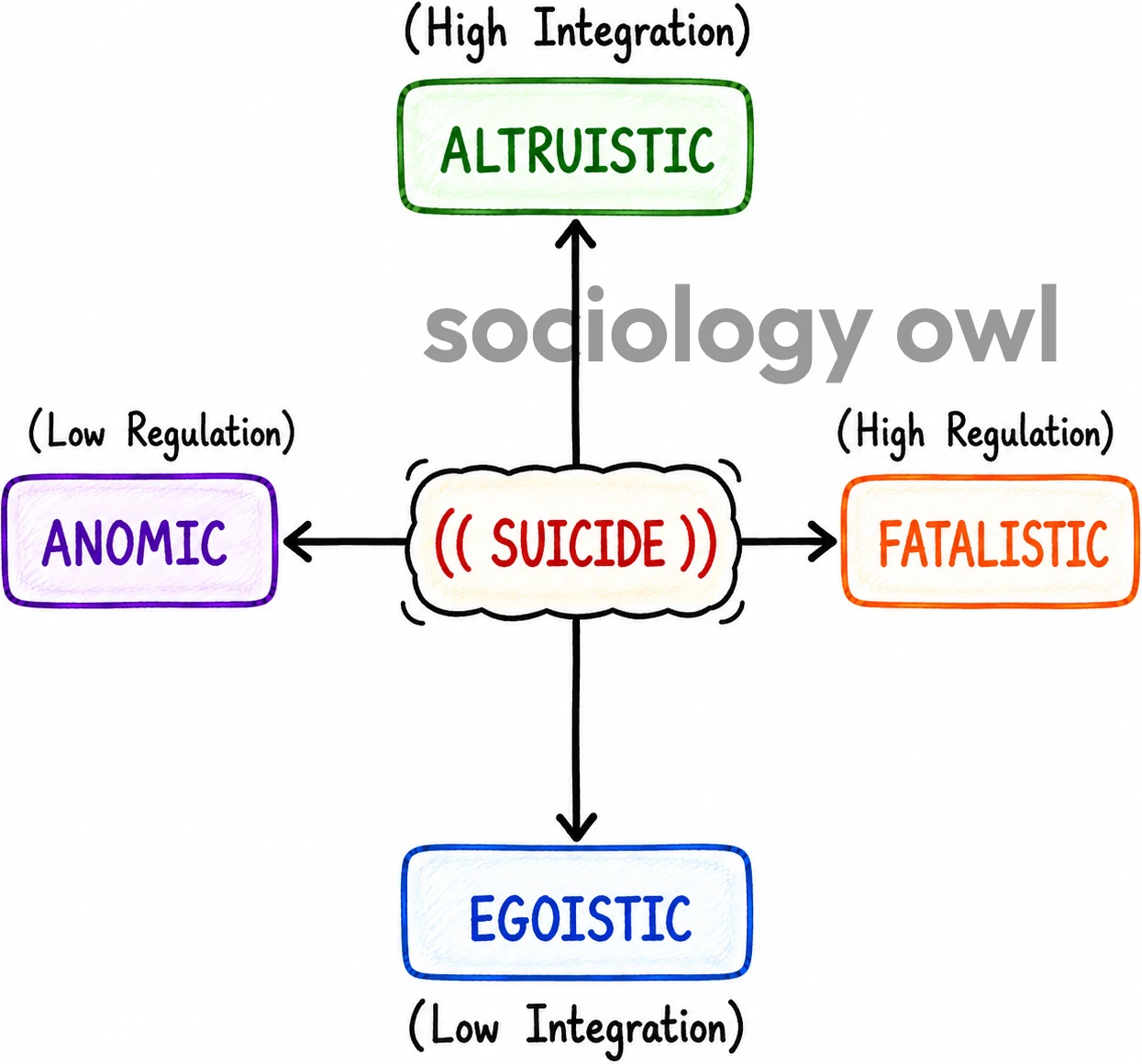
- By correlating suicide rates with social integration and regulation, he proposed four types of suicide: Egoistic, Altruistic, Anomic, and Fatalistic.
- This proved that even the most personal acts are governed by external social forces.
IV. Distinguishing Normal and Pathological Social Facts
Durkheim challenged conventional morality by insisting that sociologists must scientifically differentiate between healthy and sick social phenomena.
| Feature | Normal Social Facts | Pathological Social Facts |
|---|---|---|
| Definition | Widely distributed; exists in the average society of a certain type. | Deviates significantly from the statistical average; disruptive to society. |
| Function | Serves a vital utility for societal functioning and cohesion. | Fails to serve a utility; threatens social integration. |
| Example | A moderate level of Crime. It clarifies moral boundaries and prompts social evolution (e.g., Socrates). | An exceptionally high crime rate or sudden spike in suicide rates (Anomie). |
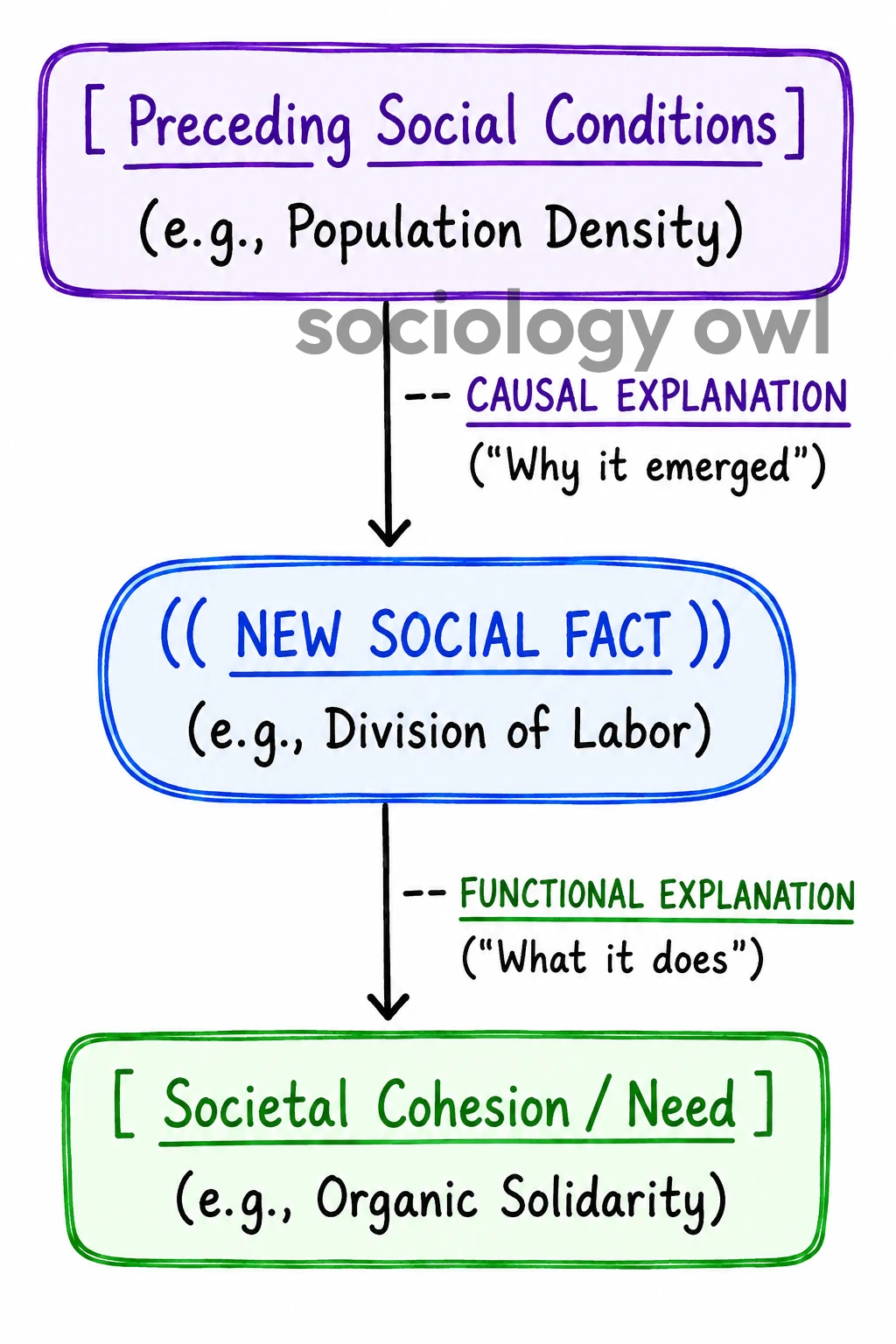
V. Explaining Social Facts: Causal and Functional Approaches
Durkheim argued that a complete sociological explanation requires two distinct but complementary approaches:
- Causal Explanation: Identifying the historical and social conditions that produced the social fact (e.g., Population density and moral density causing the Division of Labor). Cause must always be sought in preceding social facts, not in individual psychology.
- Functional Explanation: Identifying the need it fulfills in society (e.g., Religion functions to reinforce group solidarity and the Collective Effervescence).
VI. The Indian Context: Applying Durkheim (Paper 2 Integration)
Durkheim’s methodology provides a profound lens for analyzing Indian society, and many Indian sociologists have implicitly or explicitly utilized this structural-objective approach:
- The Caste System as a Social Fact: Through the lens of Louis Dumont (in Homo Hierarchicus) and G.S. Ghurye, the Indian caste system is the ultimate non-material social fact. It is external to the individual (ascribed by birth), highly coercive (enforced through strict rules of endogamy and commensality), and general across the subcontinent.
- Purity and Pollution: M.N. Srinivas‘s study of the caste hierarchy is deeply rooted in the collective conscience of purity and pollution. When lower castes attempt Sanskritization, they are reacting to the coercive structural realities of the Hindu social order.
- Dowry as a “Normal” vs. “Pathological” Fact: Historically, Stridhan might have been a normal social fact (serving the function of female inheritance). However, in contemporary India, the coercive, commercialized demand for Dowry has become a pathological social fact, leading to extreme anomie and female victimization.
- Village as an Entity: S.C. Dube and Andre Beteille studied the Indian village not just as a collection of individuals, but as a holistic social entity with its own structural realities (Panchayats, Jajmani system) that constrain individual behavior.
VII. Contemporary Relevance of Social Facts
In the 21st-century globalized and digital world, Durkheim’s concept of social facts remains highly explanatory:
- Social Media Algorithms and “Cancel Culture”: The internet acts as a massive repository of the collective conscience. Cancel Culture is a modern manifestation of punitive social coercion, forcing individuals to adhere to newly established digital norms.
- Globalization and Climate Change: These are macro-level social facts. No single individual created them, yet they externally constrain economic policies, lifestyle choices, and political discourses worldwide.
- Global Pandemics: The COVID-19 pandemic demonstrated how social facts (lockdown mandates, social distancing norms) can instantly become external, coercive, and generalized, fundamentally altering human interaction.
Critique of Durkheim’s Approach
- Max Weber: Criticized Durkheim for ignoring individual agency and meaning. Weber argued for Interpretative Sociology (Verstehen), asserting that society is driven by social actions infused with subjective meanings, not just external forces.
- Symbolic Interactionism (G.H. Mead) & Social Constructivism (Peter Berger): They argue that social facts are not objective “things” but are continuously negotiated and constructed through daily human interactions.
VIII. Conclusion
Emile Durkheim’s conception of social facts laid the bedrock for Structural Functionalism, deeply influencing later giants like A.R. Radcliffe-Brown and Talcott Parsons. Despite critiques of structural determinism, his insistence on studying societal structures objectively remains vital. As the eminent sociologist Raymond Aron noted, Durkheim’s genius lay in proving that “society is not a mere sum of individuals, but the system formed by their association represents a specific reality which has its own characteristics.” Ultimately, Durkheim taught us that to change individuals, we must first understand and change the social facts that govern them.