Émile Durkheim, one of the founding fathers of sociology, sought to establish sociology as an independent scientific discipline. His doctoral thesis, published as the book “The Division of Labour in Society” (1893), remains a cornerstone of sociological functionalism. Durkheim’s primary objective was to explain how modern societies maintain social cohesion and moral order despite the rapid fragmentation, increasing individualism, and specialization brought about by the Industrial Revolution.
Historical and Intellectual Context
To appreciate Durkheim’s perspective, it is crucial to understand the intellectual climate of his time, primarily the debate between classical economic theorists and early sociologists regarding what holds society together:
- Auguste Comte: Argued that moral consensus and shared values (collective conscience) were the primary forces binding society. He feared that excessive specialization would destroy social solidarity.
- Herbert Spencer: Contended from a utilitarian perspective that society is held together by individual self-interest and voluntary contractual agreements in a free market.
- Adam Smith: In the economic realm, Smith saw the division of labor purely as a mechanism for increasing economic productivity and wealth creation.
Durkheim’s Departure: Durkheim rejected Spencer’s utilitarianism, arguing that a contract is not sufficient to bind society because “a contract presupposes a society.” He also disagreed with Smith’s purely economic view, asserting that the true function of the division of labor is moral—it creates a feeling of solidarity between two or more people.
Durkheim’s Theory: Mechanical and Organic Solidarity
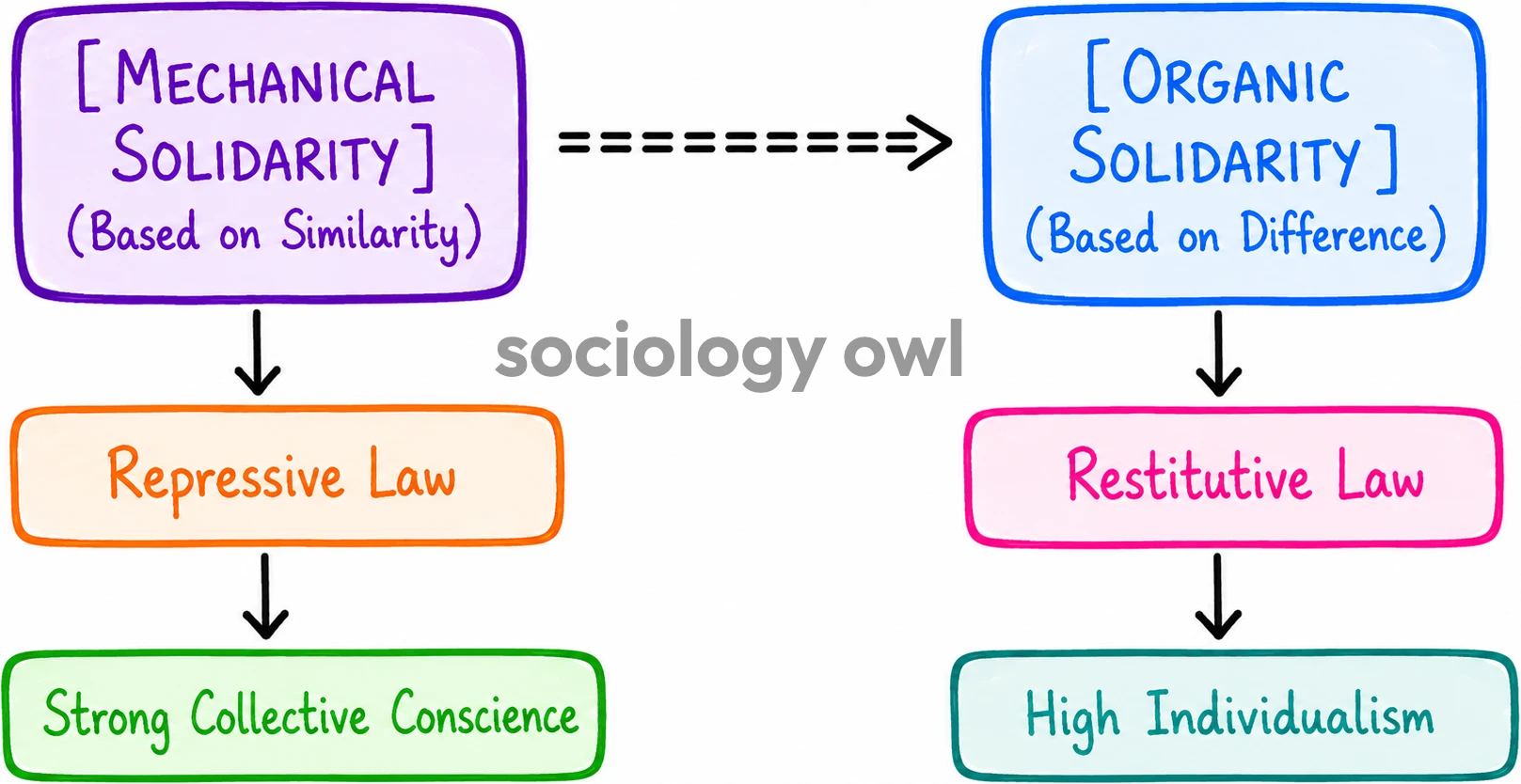
Central to Durkheim’s analysis is his evolutionary perspective on society, shifting from simple to complex structures. He classified social solidarity into two distinct types:
| Feature | Mechanical Solidarity | Organic Solidarity |
|---|---|---|
| Type of Society | Pre-industrial, traditional, agrarian societies. | Modern, complex, industrial societies. |
| Basis of Bonds | Similarity, likeness, and shared experiences. | Differences, specialization, and mutual interdependence. |
| Collective Conscience | Very strong; covers almost all aspects of life; highly religious. | Weakened and generalized; greater scope for secularism and individualism. |
| Type of Law | Repressive Law: Aimed at punishing the offender to heal the wounded collective conscience. | Restitutive Law: Aimed at restoring the status quo (e.g., civil, commercial law). |
| Autonomy | Virtually absent; the individual is absorbed into the collective. | High; personal freedom and individual consciousness are celebrated. |
Causes of the Division of Labor
Durkheim rejected teleological explanations (that division of labor exists *because* it increases happiness or productivity). Instead, he offered a causal explanation rooted in social morphology:
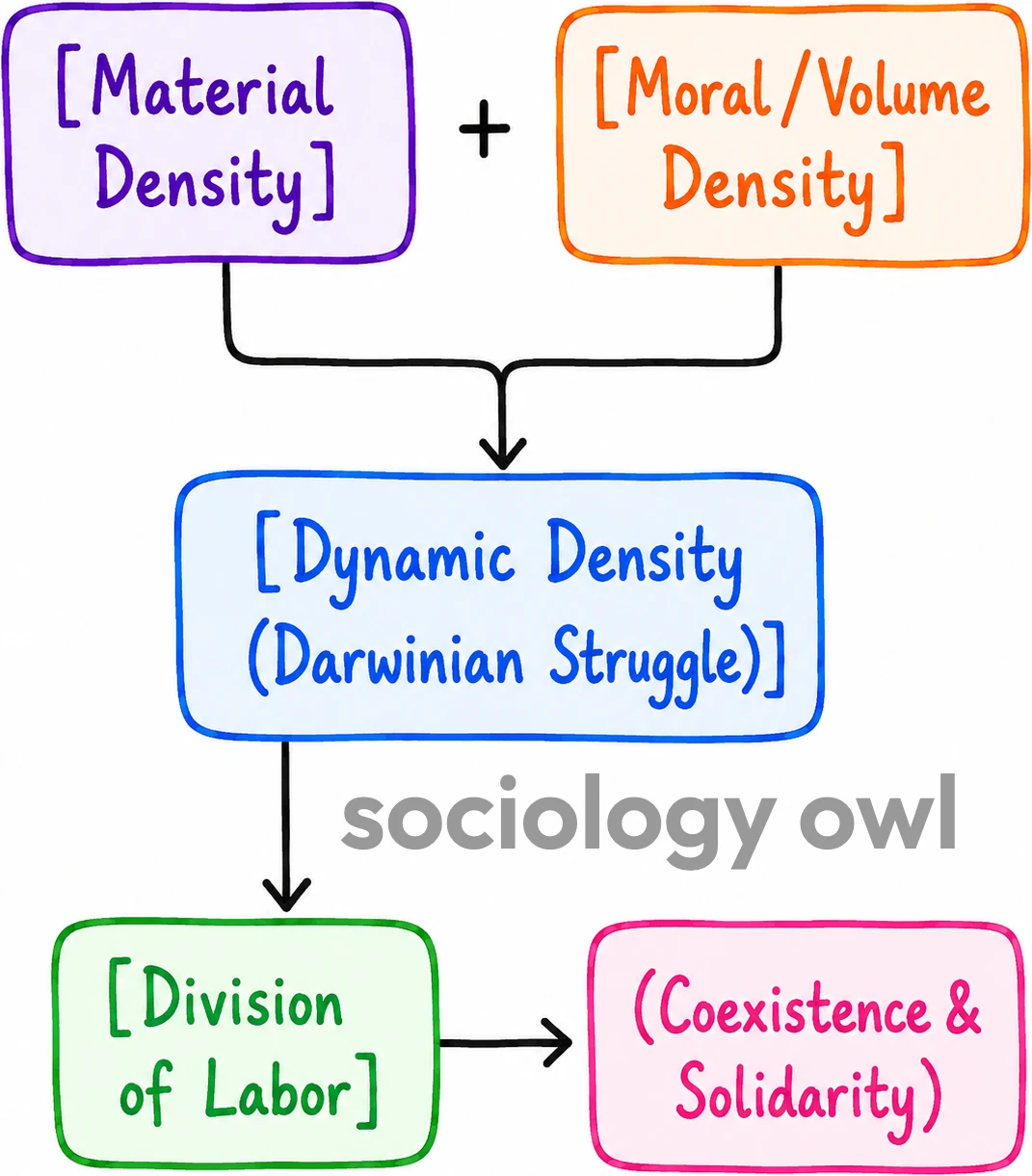
- Dynamic Density: The primary cause of the division of labor is an increase in “dynamic density,” which comprises two elements:
- Material Density: The physical increase in population size and their concentration in a specific geographical area.
- Moral (or Volume) Density: The increased frequency and intensity of social interactions and communications among people.
Influenced by Charles Darwin, Durkheim argued that increased density leads to a struggle for survival over scarce resources. Instead of eliminating one another, individuals specialize into different niches, reducing direct competition and allowing them to coexist cooperatively.
Abnormal Forms of the Division of Labor
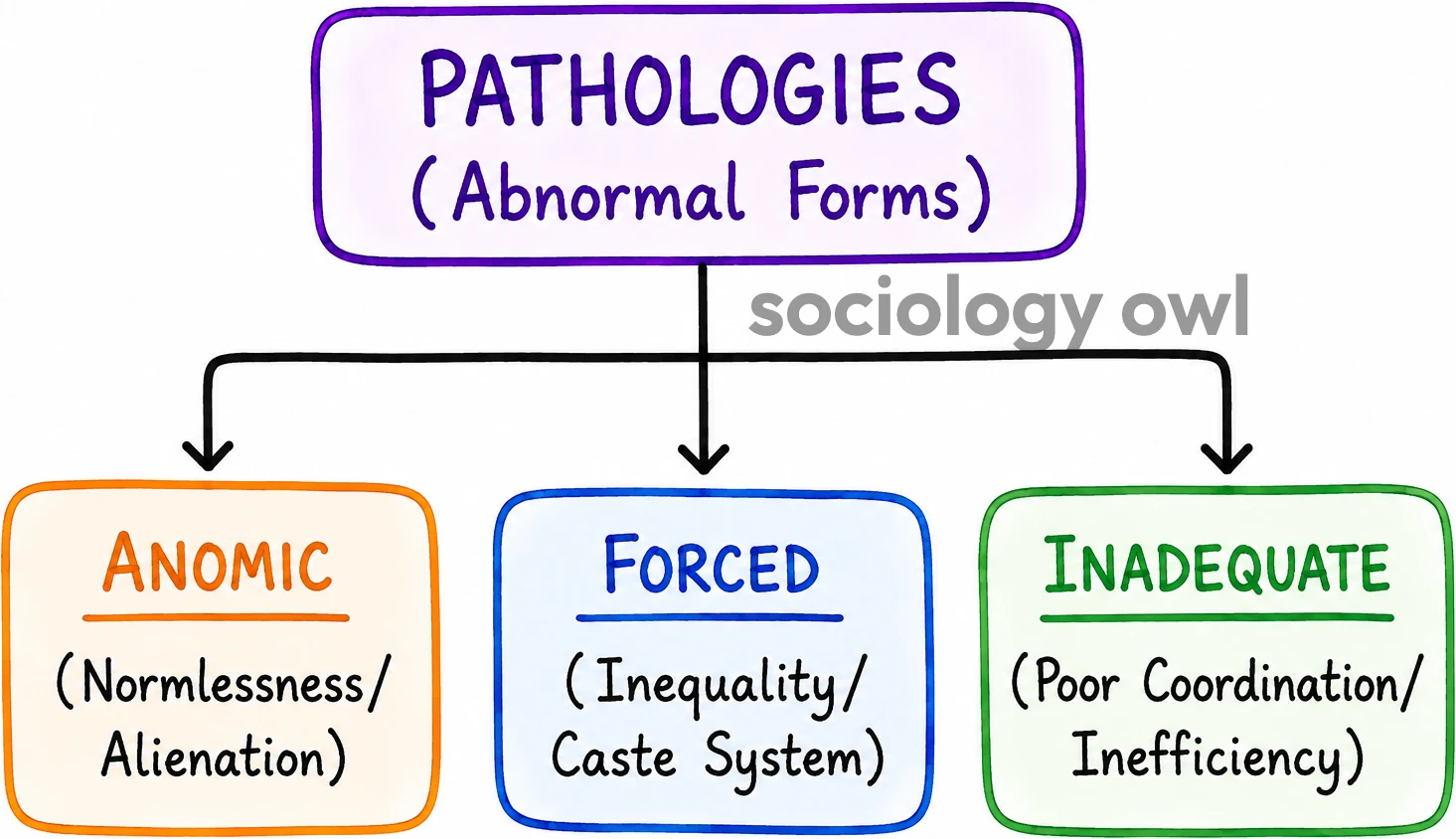
While Durkheim viewed the division of labor as a normal and morally positive phenomenon, he acknowledged that the rapid transition during the Industrial Revolution led to pathological or “abnormal” forms:
- Anomic Division of Labor: A state of normlessness. Rapid economic change outpaces the development of moral regulations. Industrial crises, bankruptcies, and capital-labor conflicts are symptoms of anomie, where workers feel alienated and disconnected from the broader purpose of their work.
- Forced Division of Labor: Occurs when the distribution of tasks is not aligned with natural talents but is dictated by external constraints like inherited wealth, nepotism, or coercive social systems. This leads to class conflict and resentment.
- Inadequately Coordinated Division of Labor: When specialization occurs without proper organization, leading to inefficiencies, wasted effort, and workers feeling like mere cogs in a disconnected machine.
The Indian Context: Application and Critique (Paper 2 Integration)
Durkheim’s theory is highly relevant when analyzing the traditional and transitional phases of Indian society. However, Indian sociologists provide a nuanced critique based on India’s unique social fabric:
- The Jajmani System: Anthropologist William H. Wiser studied the Jajmani system, which exhibits elements of Organic Solidarity (economic interdependence between different castes for goods and services). However, unlike modern organic solidarity, it was strictly rooted in ritual hierarchy and mechanical beliefs (purity and pollution).
- Caste System as Forced Division of Labor: B.R. Ambedkar famously critiqued the Hindu caste system, stating that it is not merely a division of labor but a “division of labourers.” It is a classic example of Durkheim’s Forced Division of Labor, as occupations are ascribed by birth, stifling natural aptitude and leading to social friction.
- Transition in Modern India: Sociologist Yogendra Singh notes that structural modernization in India (urbanization, industrialization) is pushing society towards organic solidarity. However, Dipankar Gupta argues that India still heavily relies on mechanical ties (caste, kinship, religion) in politics and marriage, creating a hybrid society where modern occupations coexist with traditional identities.
Contemporary Relevance
Durkheim’s insights continue to offer a profound framework for understanding the modern globalized world:
- The Gig Economy and New Anomie: The rise of platform workers (Uber, Swiggy) highlights a modern Anomic Division of Labor. Workers are highly specialized but lack protective social norms, job security, and collective bargaining rights, leading to isolation.
- Global Division of Labor: Scholars like Immanuel Wallerstein (World Systems Theory) show how the division of labor has expanded globally, with core nations specializing in high-tech and peripheral nations constrained to raw material extraction—often resembling a Forced Division of Labor on a macro scale.
- Artificial Intelligence (AI) and Hyper-Specialization: As AI takes over routine tasks, human labor is forced to adapt to hyper-specialized cognitive niches. Durkheim’s warning about the need for new moral regulations and professional ethics (e.g., AI ethics) is highly pertinent today to prevent societal disintegration.
Conclusion
Emile Durkheim successfully elevated the concept of the division of labor from a mere economic mechanism to a fundamental sociological phenomenon that dictates the moral and structural cohesion of modern societies. By identifying both the integrative power of organic solidarity and the dangers of its abnormal forms, he provided a timeless diagnostic tool for societal health.
As Durkheim aptly concluded, “The division of labor is not merely an economic phenomenon; it is the principal source of social solidarity… its true function is to create between two or more people a feeling of solidarity.” In an increasingly fragmented and rapidly innovating world, fostering this moral solidarity alongside economic specialization remains the greatest challenge of contemporary social policy.