Introduction and Historical Context
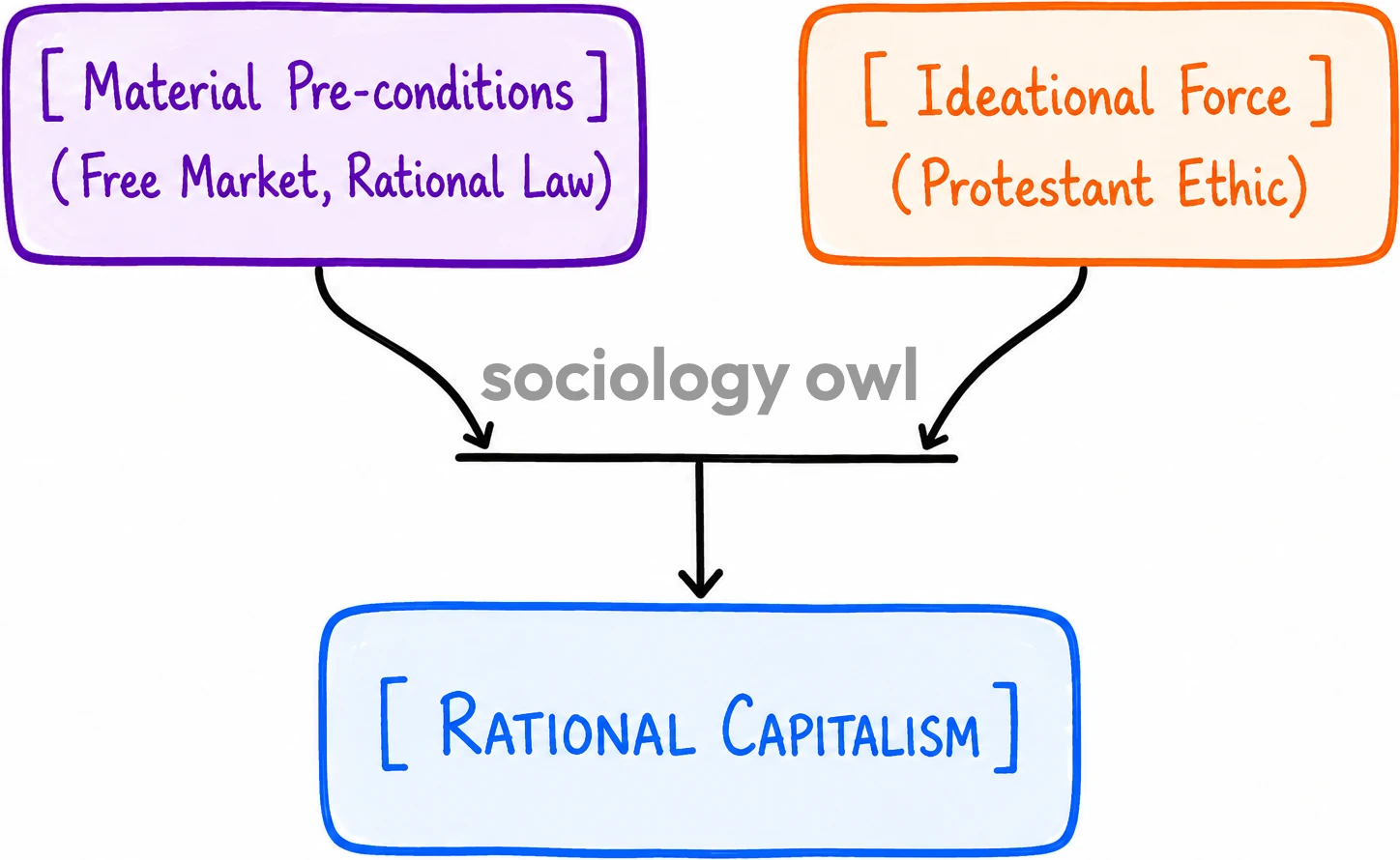
Max Weber, a foundational figure in sociology, offered a multi-dimensional analysis of capitalism that challenged the prevailing unilinear and economically deterministic views of his time. Historically, Weber’s analysis emerged during the rapid industrialization of Europe in the late 19th and early 20th centuries. While Karl Marx viewed capitalism primarily through the lens of historical materialism and class struggle, Weber adopted a multi-causal approach. In his seminal work, “The Protestant Ethic and the Spirit of Capitalism” (1905), Weber argued that material factors alone did not give rise to modern capitalism; rather, specific ideational forces—namely, religious ethics—acted as the crucial catalyst.
The Concept of Rationality and Western Civilization
At the core of Weber’s sociological framework is the concept of Rationalization. Weber argued that the defining characteristic of modern Western civilization is a historical shift towards Zweckrationalität (instrumental or goal-oriented rationality). This process involves the demystification or “Disenchantment of the World”, where magical and religious thought is replaced by scientific calculation and logical deduction.
Weber posited that rationalization permeated all spheres of Western life:
- Science: The development of verifiable, empirical knowledge.
- State: The emergence of the Rational-Legal Authority and modern bureaucracies characterized by written rules and specialized institutions.
- Art: Systematic notation in music and rationalized architecture.
- Economy: The unprecedented development of Rational Capitalism.
Distinction: Traditional vs. Rational Capitalism
Unlike orthodox Marxists who saw capitalism as a monolithic mode of production, Weber differentiated between “booty” or adventure capitalism of the past and the modern, systematic form. He outlined this distinction in his work “General Economic History”.
| Feature | Traditional Capitalism | Rational (Modern) Capitalism |
|---|---|---|
| Nature of Activity | Highly speculative, based on sporadic trade and high-risk overseas ventures. | Methodical, predictable, and based on continuous, calculated enterprise. |
| Production Focus | Self-sufficient households; trade limited to luxury goods for a select clientele. | Mass production and distribution of everyday goods for a broad market. |
| Attitude towards Profit | Business viewed as a gamble with substantial windfalls or absolute losses. | Pursuit of forever-renewed profit through continuous, rational capitalist enterprise. |
| Labor Force | Reliance on slave, serf, or bound labor. | Utilization of formally free labor governed by legal contracts. |
Pre-conditions and Factors for Rational Capitalism
In “Economy and Society”, Weber identified specific structural and institutional prerequisites essential for the emergence of rational capitalism:
- Private appropriation: Private ownership of the physical means of production.
- Market freedom: A free market with unrestricted trade and commercialization of the economy.
- Calculability: Rational techniques of production, systematic book-keeping, and a stable common currency.
- Rational Legal System: Predictable, codified laws that protect property rights and enforce contracts.
- Institutional Separation: The strict separation of the household economy from the business enterprise.
The Protestant Ethic Thesis
Weber’s most famous contribution is his thesis that structural pre-conditions were insufficient without a psychological driving force. He traced this to Calvinism and its doctrine of Predestination. Believing their salvation was pre-determined, Calvinists sought “signs” of God’s favor through relentless, successful work (their Calling). This generated a “This-worldly asceticism”—a strict, disciplined lifestyle where profits were not squandered on hedonistic consumption but relentlessly reinvested into the business. This unique ethos became the “Spirit of Capitalism”.
The Indian Context: Weber and Beyond (Paper 2 Integration)
Weber applied his comparative methodology to India in his book “The Religion of India”. He argued that despite having favorable structural conditions (trade networks, mathematics, artisan guilds), rational capitalism did not spontaneously emerge in India. He attributed this to the Hindu doctrines of Karma and Samsara (reincarnation), which he viewed as fatalistic and deeply embedded in the rigid Caste System. To Weber, Hinduism fostered an “other-worldly asceticism” that discouraged the rational accumulation of wealth for its own sake.
However, Indian sociologists have heavily critiqued and nuanced Weber’s views:
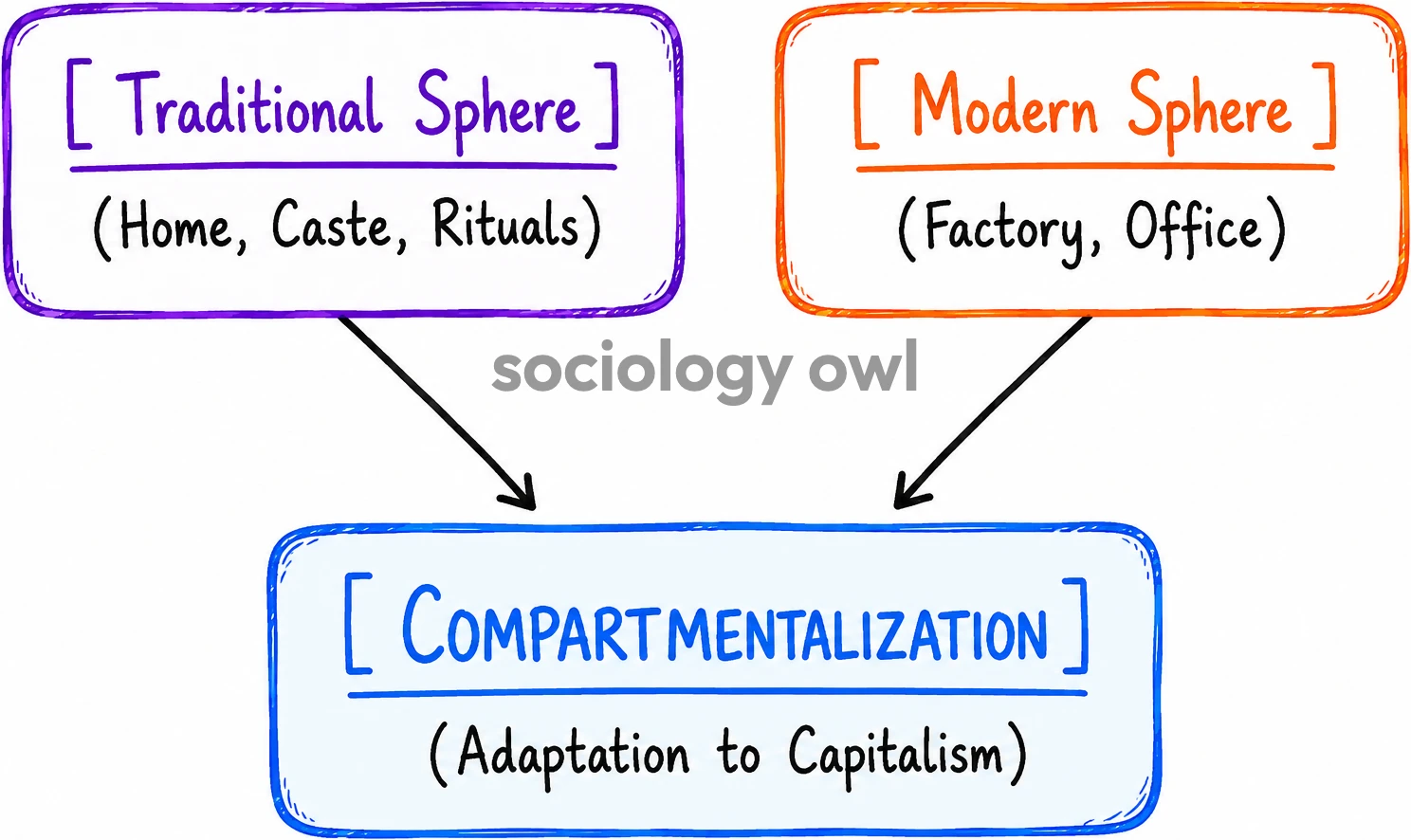
- Milton Singer: In his study of industrial leaders in Madras, Singer refuted Weber. He found that Hindu industrialists successfully adapted to modern capitalism through Compartmentalization (separating modern business practices at the office from traditional religious practices at home), proving that Hindu beliefs are not antithetical to industrialization.
- Thomas Timberg & Dipankar Gupta: They highlighted the rise of Marwari and Bania capitalism. Gupta points out that in India, capitalism grew utilizing traditional networks of family, kinship, and caste for credit and trust, rather than replacing them with pure rational-legal systems.
- Amartya Sen: Argues that India has a long tradition of argumentative and rational thought (as seen in early trading diasporas), contradicting Weber’s assertion of an exclusively mystical Indian mindset.
Contemporary Relevance
Weber’s analysis of rational capitalism remains highly relevant in the 21st century’s globalized economy:
- McDonaldization of Society: Sociologist George Ritzer expanded on Weber’s rationalization, showing how modern capitalism prioritizes efficiency, calculability, predictability, and control (e.g., the fast-food industry, Amazon fulfillment centers).
- The Gig Economy and Algorithmic Management: Platforms like Uber and Swiggy represent the peak of instrumental rationality, where human labor is strictly quantified, surveilled, and managed by algorithms.
- Financialization: The modern stock market relies on hyper-rational predictive models and high-frequency trading, perfectly mirroring Weber’s concept of an economy driven by calculated, systemic profit-seeking.
Conclusion
Max Weber’s sociology of capitalism provides a profound understanding of how material conditions and deeply held cultural ideas interact to shape economic systems. However, Weber was deeply pessimistic about the ultimate trajectory of rational capitalism. He warned that the relentless drive for efficiency would eventually trap humanity in an “Iron Cage” (Stahlhartes Gehäuse) of bureaucratic and economic rationality, stripped of its original spiritual meaning. As Weber hauntingly concluded about modern capitalist man: “Specialists without spirit, sensualists without heart; this nullity imagines that it has attained a level of civilization never before achieved.”