1. Introduction and Historical Context
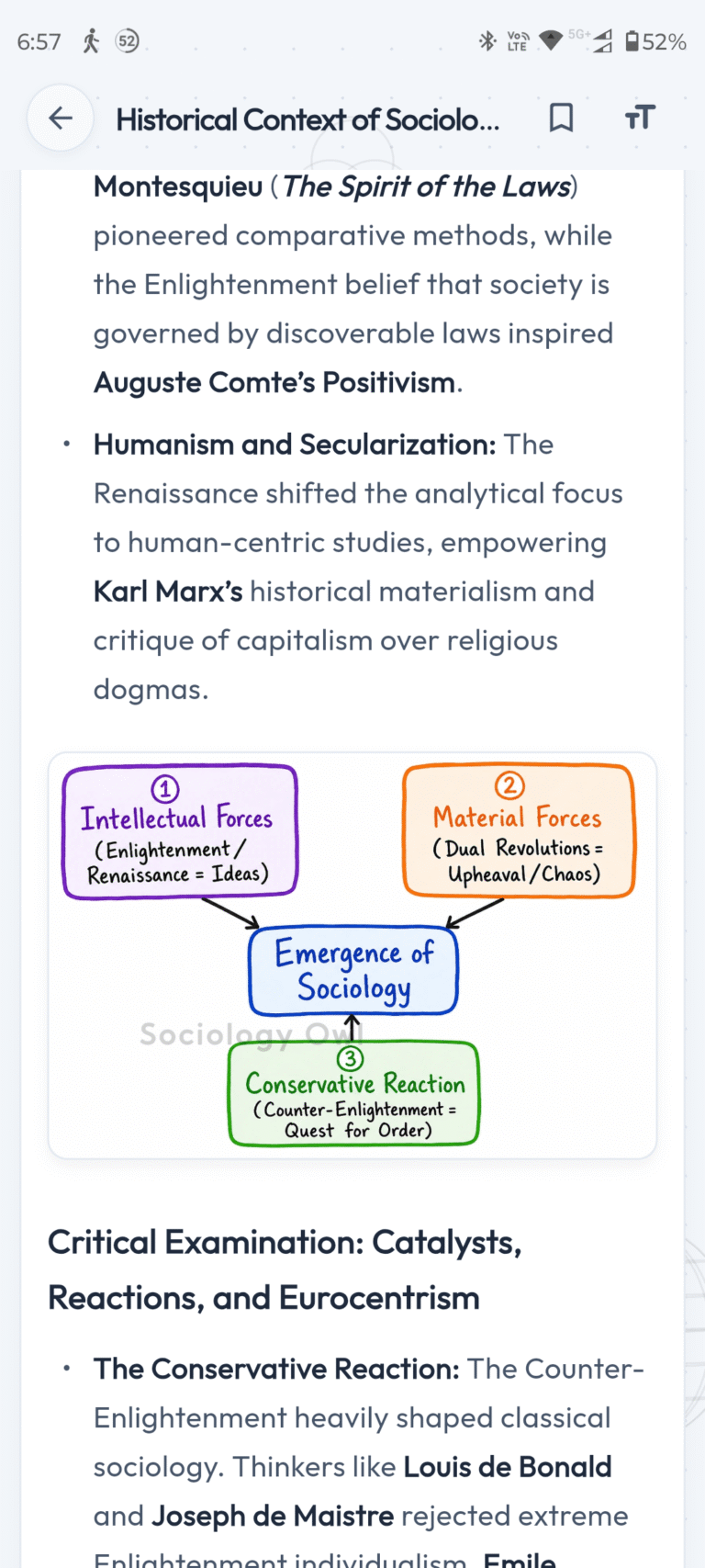
Social change is the cornerstone of sociological inquiry. Historically, sociology emerged in 19th-century Europe as an intellectual response to the massive social transformations unleashed by the French Revolution and the Industrial Revolution. Early founding fathers sought to understand the breakdown of traditional feudal structures and the transition to modernity.
In sociological terms, social change refers to the significant alterations in social structures, cultural symbols, rules of behavior, and value systems over time. Kingsley Davis, in his book Human Society (1949), defines it strictly as “only such alterations as occur in social organization, that is, structure and functions of society.” Meanwhile, Wilbert E. Moore (Social Change, 1963) broadens it to include significant alterations in social structures, including consequences and manifestations of such structures embodied in norms, values, and cultural products.
Sociologists like R.M. MacIver and Charles H. Page (Society: An Introductory Analysis) differentiate between social change (changes in human relationships) and cultural change (changes in art, science, and technology), though they acknowledge both are deeply intertwined (Socio-cultural change).
2. Sociological Theories of Social Change
A. Evolutionary Perspective
Heavily influenced by Charles Darwin’s biological evolution, this 19th-century perspective posits that societies evolve from simple, undifferentiated forms to complex, differentiated ones. It is characterized by unilinear progress.
- Auguste Comte: Proposed the Law of Three Stages, arguing that human intellect and society evolve from Theological to Metaphysical, and finally to the Positivist (scientific) stage.
- Herbert Spencer: Applied Social Darwinism, arguing societies evolve from militant (based on coercion) to industrial (based on voluntary cooperation) forms.
- Émile Durkheim: In The Division of Labour in Society, he traced change from Mechanical Solidarity (based on likeness) to Organic Solidarity (based on interdependence).
Critique: Later anthropologists like Franz Boas criticized it for extreme ethnocentrism, as it placed Western capitalist society at the pinnacle of human progress.
B. Cyclical Theories
Challenging the linear progression model, cyclical theories argue that societies undergo inherent life cycles of birth, growth, decay, and death.
- Oswald Spengler: In The Decline of the West (1918), he argued that cultures act like biological organisms. He predicted the inevitable decay of Western civilization.
- Vilfredo Pareto: In The Mind and Society, he proposed the Circulation of Elites. Change is merely the shifting of power between “Lions” (forceful elites) and “Foxes” (cunning elites).
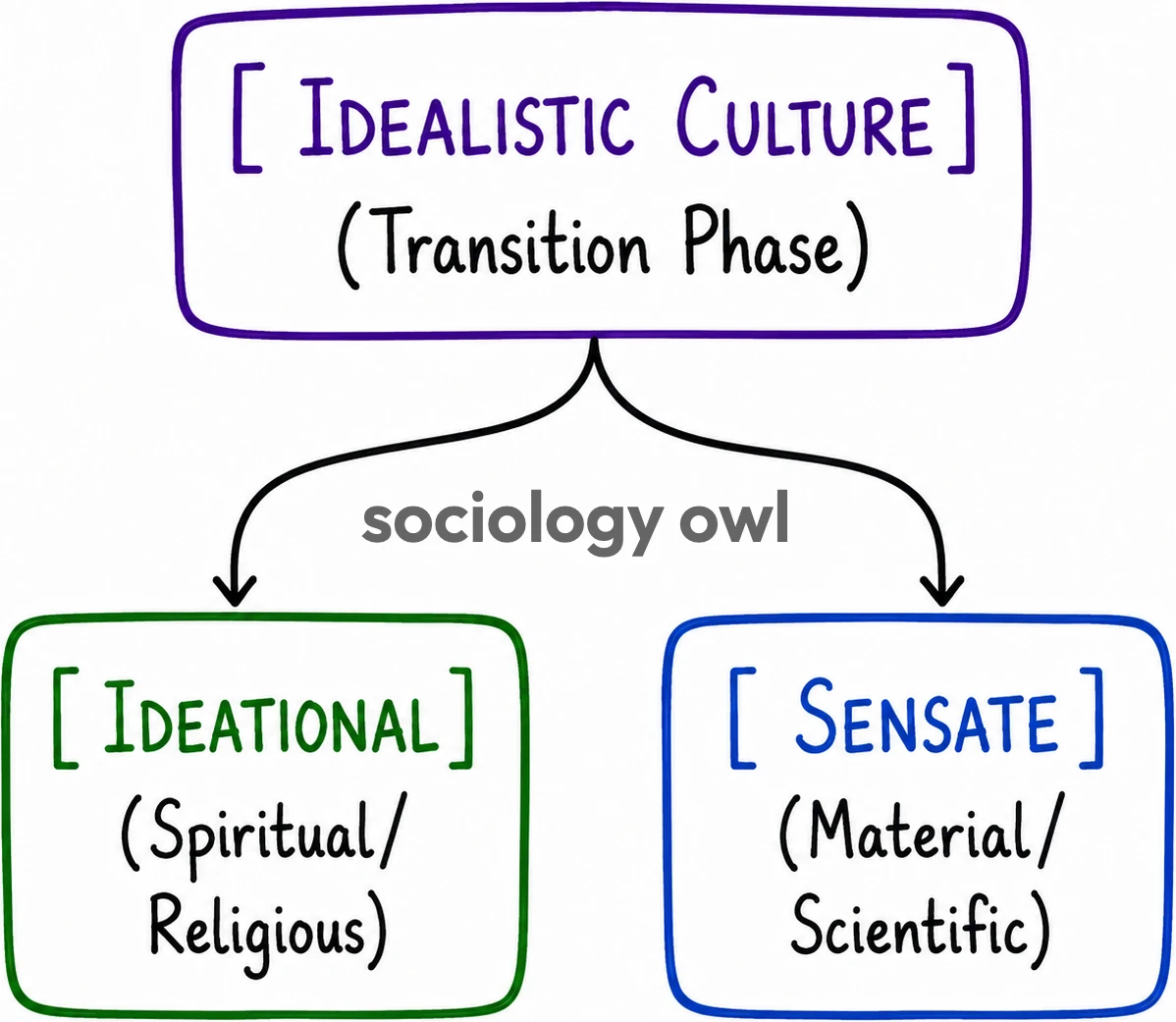
- Pitirim Sorokin: In Social and Cultural Dynamics, he conceptualized change as a pendulum swing between Ideational (spiritual/religious) and Sensate (materialistic/scientific) cultures, passing through an Idealistic transition phase.
C. Structural-Functionalist Perspective
Functionalists view society as a system in Moving Equilibrium. Change is seen as an adaptive response to internal tensions or external environments, emphasizing gradual, orderly transformation rather than revolution.
- Talcott Parsons: Proposed the concept of Evolutionary Universals. Society changes through differentiation, adaptive upgrading, inclusion, and value generalization to maintain stability.
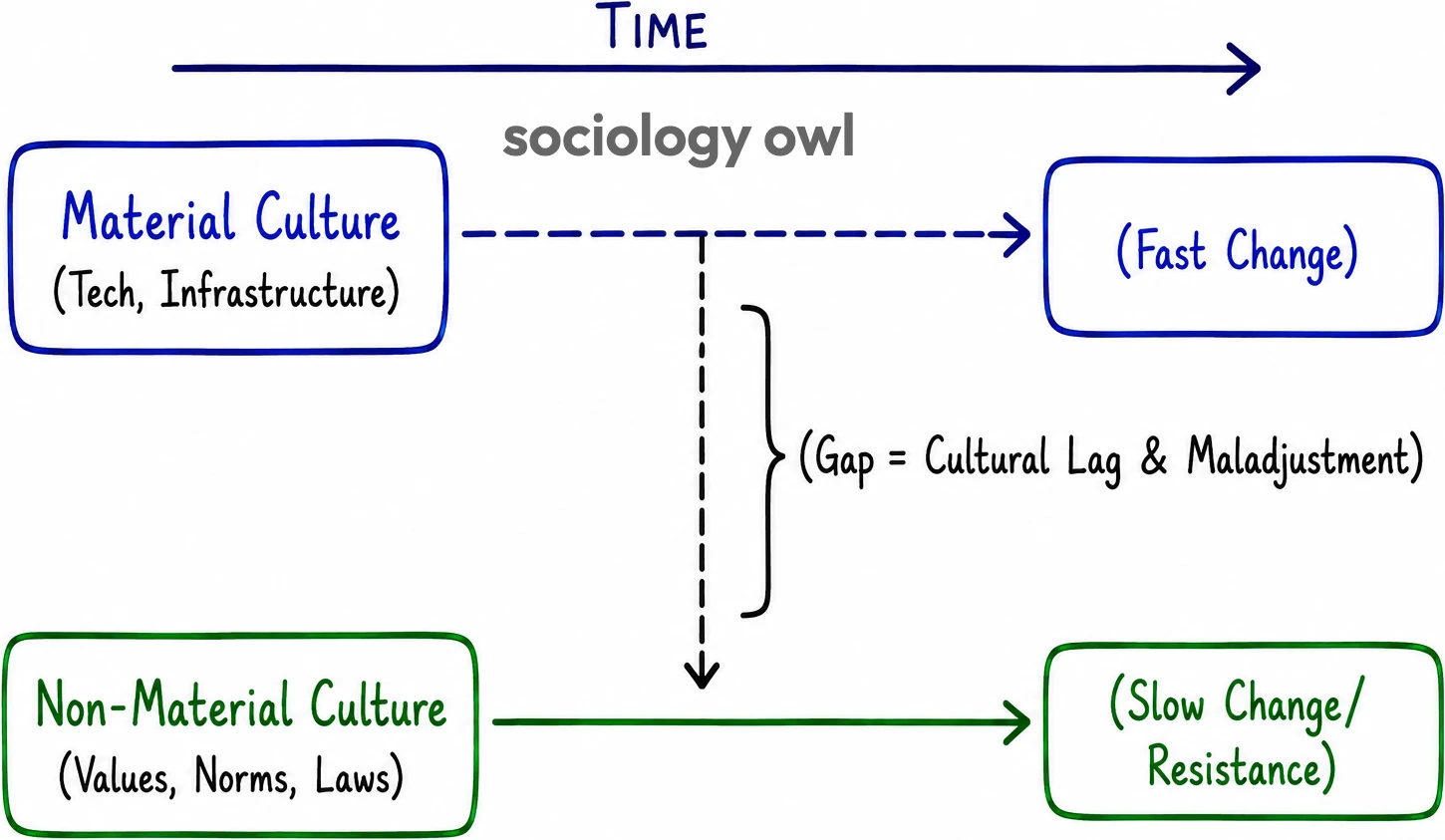
- William F. Ogburn: In his book Social Change (1922), he introduced the concept of Cultural Lag. He argued that material culture (technology, infrastructure) changes rapidly, while non-material culture (customs, values, laws) lags behind, creating social friction and maladjustment.
D. Conflict Perspective
Rooted in Marxist thought, this perspective argues that conflict, not consensus, is the primary engine of social change. It emphasizes dialectics (the clash of opposites).
- Karl Marx: Proposed Historical Materialism. He argued that changes in the economic base (Forces and Relations of Production) inevitably lead to changes in the superstructure (laws, religion, culture). The conflict between the ‘Haves’ and ‘Have-nots’ drives epochal shifts (e.g., Feudalism to Capitalism).
- Ralf Dahrendorf: Shifted focus from economic classes to authority relations. He argued that institutionalized power struggles in Imperatively Coordinated Associations (ICAs) drive structural change.
E. Modernization and Dependency (Development Perspectives)
- Modernization Theory (W.W. Rostow): Posits that developing nations must emulate Western economic and cultural models to achieve progress (The Stages of Economic Growth).
- Dependency Theory (A.G. Frank, Immanuel Wallerstein): Rebuts modernization, arguing that the “development of underdevelopment” occurs because Core (Western) countries systematically exploit the Periphery (developing world) in a global capitalist World-System.
3. Factors Influencing Social Change
- Technological Factors: Often termed Technological Determinism (Thorstein Veblen). The invention of the steam engine, internet, and now AI radically alters labor relations, family structures, and communication.
- Demographic Factors: Changes in population size, migration, and age structure. For example, India’s “demographic dividend” is currently reshaping its economic and social institutions.
- Cultural Factors: Max Weber in The Protestant Ethic and the Spirit of Capitalism demonstrated how specific religious values (Calvinism) catalyzed the monumental structural change of modern capitalism.
- Environmental/Geographical Factors: Climate change, natural disasters, and ecological depletion force societal adaptation, as studied under environmental sociology.
4. The Indian Context (Paper 2 Integration)
In the Indian context, social change is highly complex due to the coexistence of tradition and modernity. Indian sociologists have developed specific frameworks to analyze this transition.
| Thinker | Key Concepts / Books | Perspective on Social Change in India |
|---|---|---|
| M.N. Srinivas | Social Change in Modern India (1966) Sanskritization, Westernization | Viewed change as both positional (Sanskritization by lower castes seeking mobility) and structural (Westernization bringing secular, rational institutions). |
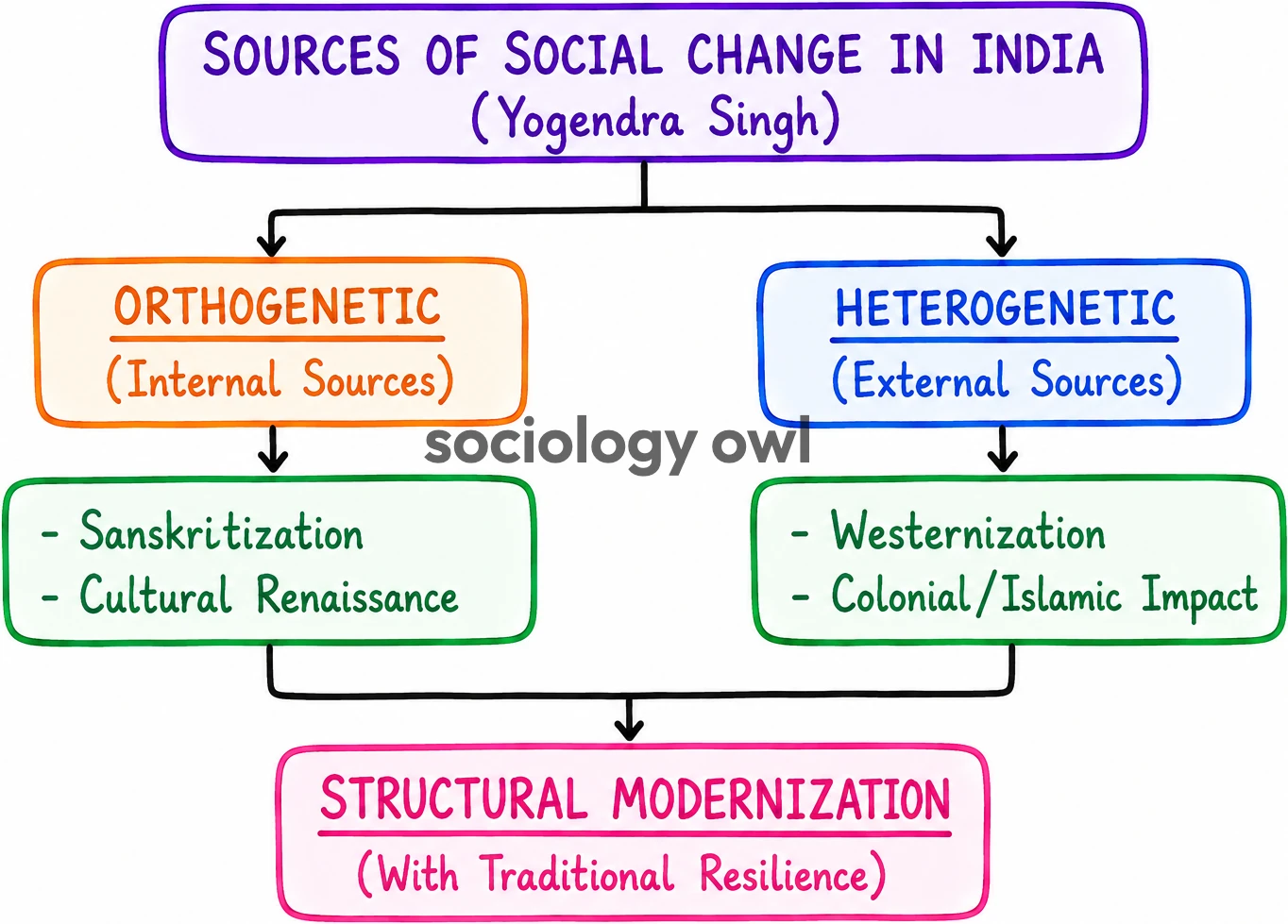
| Yogendra Singh | Modernization of Indian Tradition (1973) | Classified change into Orthogenetic (internal sources like Sanskritization) and Heterogenetic (external sources like Islamic and Western impact). Argued that India is undergoing a “structural modernization” while maintaining “traditional resilience.” |
| A.R. Desai | Social Background of Indian Nationalism (1948) | Applied the Marxist perspective. Argued that British colonial policies altered the land relations, creating new classes (zamindars, agricultural laborers) which led to structural contradictions and the nationalist movement. |
| Dipankar Gupta | Mistaken Modernity (2000) | Argues that India has achieved technological modernity but lacks structural/ideological modernity (e.g., persistence of casteism and nepotism). |
Furthermore, thinkers like S.C. Dube highlighted the role of state-planned initiatives (Community Development Programmes) as planned exogenous factors of change, while Andre Beteille noted how the transition from “Caste to Class to Power” reflects structural changes in rural Indian stratification.
5. Contemporary Relevance: The Globalized World
In the 21st century, the pace of social change has reached unprecedented levels. Modern sociologists analyze this through new lenses:
- Globalization and Glocalization: Roland Robertson notes that global forces adapt to local conditions, creating hybrid cultures (e.g., McDonald’s offering McAloo Tikki in India).
- The Network Society: Manuel Castells argues that the Information Age has shifted social structures from physical hierarchies to global digital networks, fundamentally altering identity and power.
- Risk Society: Ulrich Beck suggests that modern social change is driven by the management of manufactured risks (e.g., nuclear energy, climate change, AI), shifting society from wealth distribution to risk distribution.
6. Conclusion
Social change is an omnipresent, multifaceted reality that defies a single theoretical explanation. It is a product of continuous dialectics between tradition and modernity, structure and agency, and local and global forces. As Anthony Giddens aptly describes in his concept of the “Juggernaut of Modernity,” contemporary social change is like a massive, unstoppable engine that we can only partially steer. For a civil servant, understanding these intricate dynamics—especially the structural versus cultural lags in Indian society—is crucial for effective policy formulation and planned social transformation.