Model Answer:
Rules provide the administrative framework, but an officer’s attitude dictates their application, differentiating between the pro-active “spirit” and the rigid “letter” of the law.
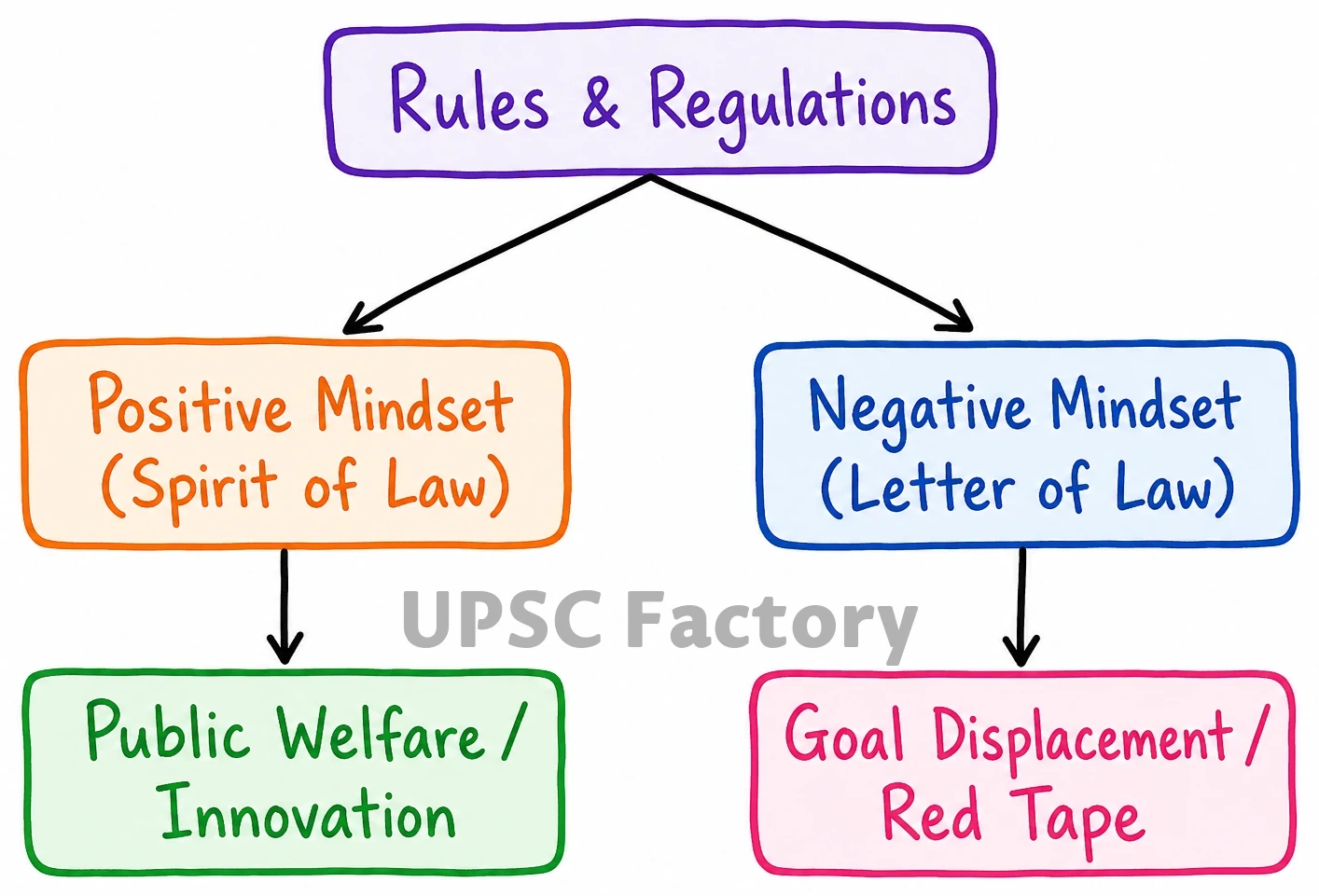
1. Positive Mindset: Upholding the “Spirit of the Law”
- Pro-Public Alignment: Interprets legal ambiguities to maximize citizen welfare and resolve grievances proactively.
- Ethical Innovation: Applies Emotional Intelligence to overcome procedural bottlenecks without violating statutory boundaries.
- Outcome-Oriented: Focuses on effective service delivery rather than finding procedural excuses to reject files.
- Illustration: IAS officer Armstrong Pame utilizing crowdfunding to build the 100km ‘People’s Road’ in Manipur, successfully bypassing bureaucratic funding delays.
2. Negative Mindset: Fixation on the “Letter of the Law”
- Goal Displacement: Procedures become the ultimate end, trapping administration in Weber’s rigid ‘Iron Cage’.
- Risk Aversion: Uses complex regulations as a defensive shield to avoid decision-making and accountability (red-tapism).
- Apathetic Compliance: Refuses to exercise lawful administrative discretion, even for highly vulnerable populations.
- Illustration: Denying life-saving PDS rations to starving citizens purely due to technical biometric/Aadhaar mismatches (e.g., Jharkhand starvation deaths).
Civil servants must be trained beyond mere procedural compliance toward true constitutional morality, ensuring that rules act as facilitators rather than barriers to public welfare.