Model Answer:
Gandhian movements marked a paradigm shift in the freedom struggle, transitioning Indian nationalism from elite constitutionalism into an all-inclusive, pan-Indian mass movement.
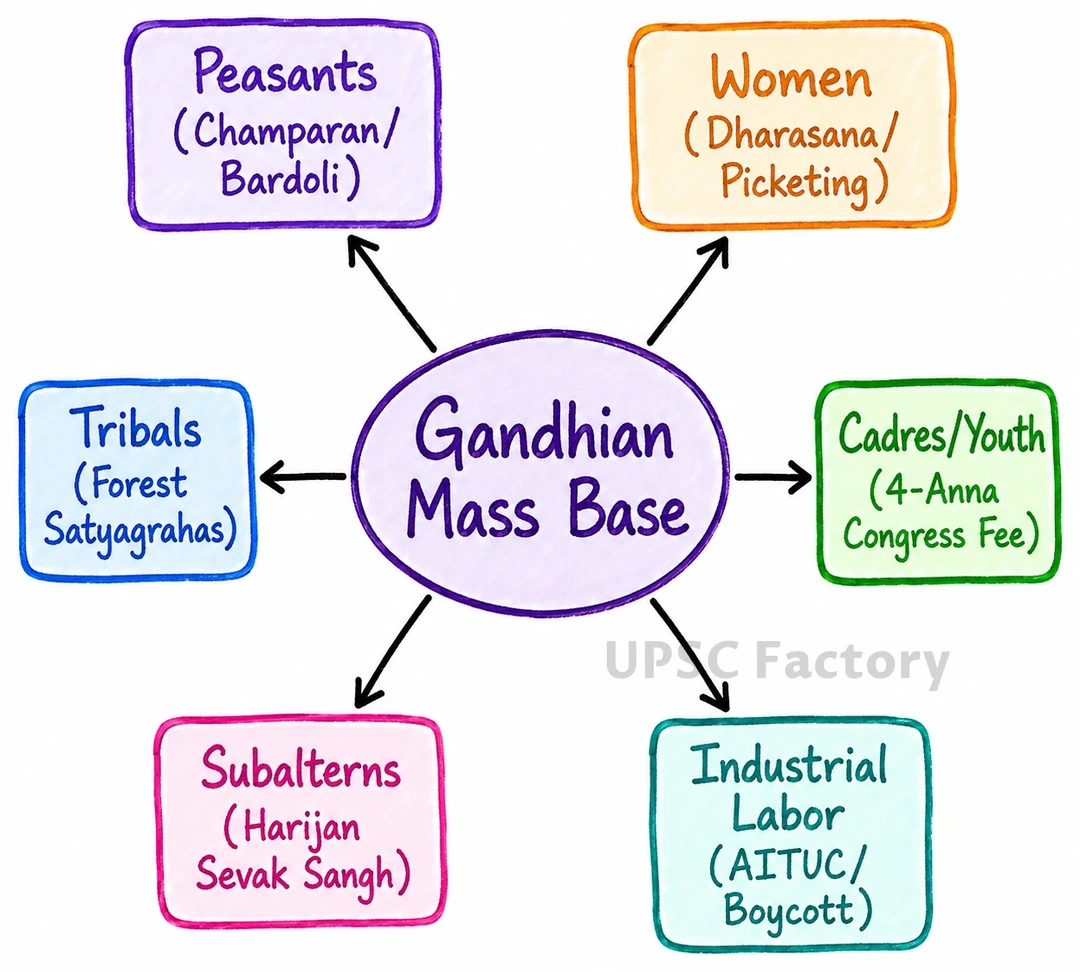
Social Democratization Across Strata
- Agrarian Mobilization: Integrated peasant grievances directly into national politics, creating a formidable rural base (e.g., Champaran, Bardoli Satyagraha).
- Women’s Agency: Mobilized women from domestic confines into active public defiance through picketing and salt manufacturing (e.g., Dharasana Satyagraha).
- Subaltern & Tribal Integration: Activated marginalized sections through constructive social programs and forest satyagrahas (e.g., Tana Bhagat movement, Harijan Sevak Sangh).
Strategic & Anti-Imperial Significance
- Institutional Democratization: The 1920 Nagpur Congress reduced membership fees to 4 annas, transforming the party into a mass-cadre organization.
- Erosion of Colonial Hegemony: Broad-based non-violent defiance dismantled the moral legitimacy of British rule (Bipan Chandra’s Gramscian counter-hegemony).
- Sustained Political Capacity: The Struggle-Truce-Struggle (S-T-S) model utilized non-active phases for mass constructive work, sustaining long-term anti-imperial resistance.
Ultimately, mass mobilization transformed passive subjects into active political agents, rendering British rule structurally, morally, and administratively unsustainable.