Model Answer:
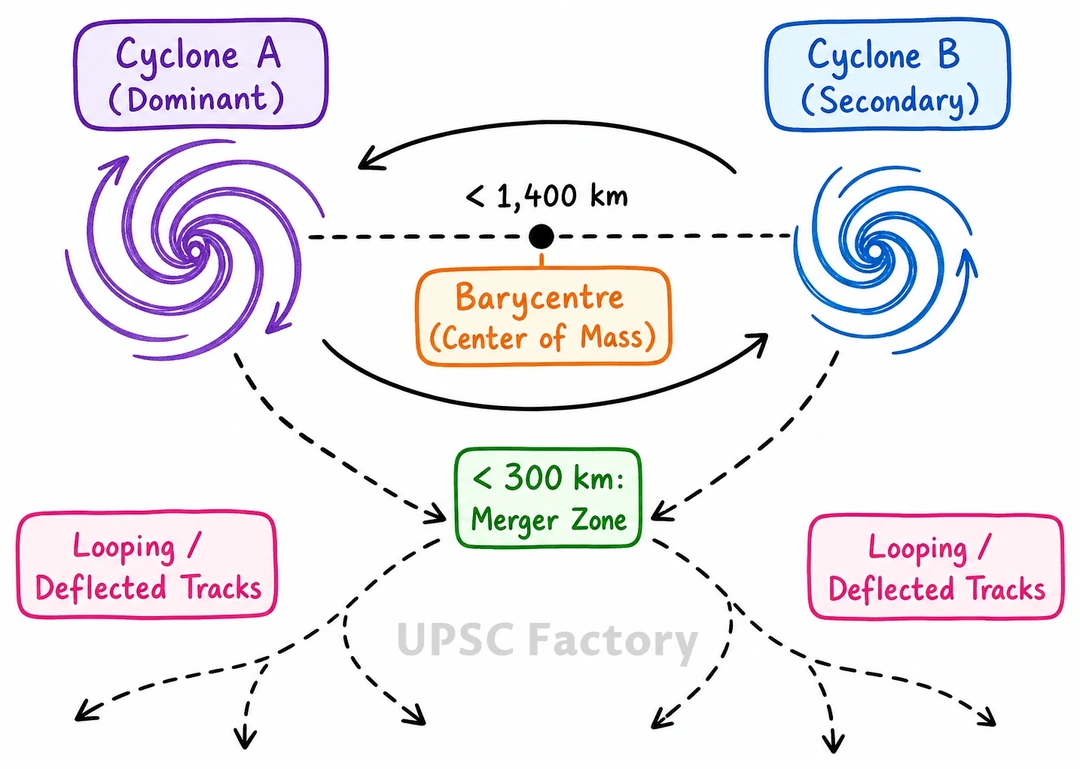
The Fujiwhara effect is a binary atmospheric phenomenon occurring when two tropical cyclones approach within ~1,400 km of each other, interacting dynamically and orbiting around a shared central barycentre.
Impact on Cyclonic Movement (Track Trajectory)
- Mutual Barycentric Orbit: Both systems rotate cyclonically around a common mass centre (counter-clockwise in the Northern Hemisphere).
- Erratic Track Deflection: Interaction causes sharp track deviations, stalls, and looping paths, complicating landfall predictions (Cyclones Seroja and Odette, 2021).
- Cannibalization (Merger): The larger vortex completely absorbs the smaller cyclone if separation reduces to under ~300 km (Typhoons Parma and Melor, 2009).
Impact on Cyclonic Intensity (Strength & Dynamics)
- Vertical Wind Shear: Outflow from the dominant storm induces strong shear over the weaker system, decapitating its convective core.
- Vorticity & Moisture Transfer: The stronger vortex strips latent heat and angular momentum, leading to rapid weakening of the secondary storm.
- Post-Merger Intensification: Merged cores can consolidate into an expanded, high-intensity cyclonic system with a broader gale-force wind radius.
As ocean warming increases the frequency of simultaneous cyclogenesis, modeling Fujiwhara dynamics is critical for precise early warning and coastal disaster mitigation.