Model Answer:
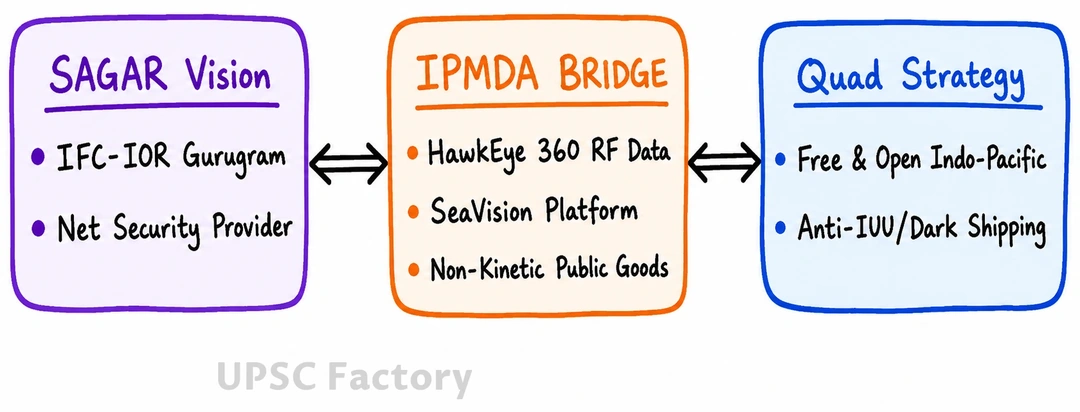
Announced at the 2022 Tokyo Quad Summit, the Indo-Pacific Partnership for Maritime Domain Awareness (IPMDA) harnesses commercial satellite data to enhance shared surveillance, directly operationalizing India’s SAGAR vision within the Quad’s regional architecture.
1. Synergies: Aligning SAGAR with Quad Strategy
- Institutional Interoperability: Integrates India’s IFC-IOR (Gurugram) with regional nodes, solidifying India’s position as a preferred security partner.
- Non-Traditional Security: Tracks “dark vessels” and IUU fishing via RF satellite tracking (e.g., HawkEye 360), advancing SAGAR’s economic and ecological goals.
- Maritime Public Goods: Democratizes low-cost, unclassified situational data (SeaVision platform) to littoral states without forcing strategic alignment.
- HADR Integration: Facilitates coordinated, real-time responses to maritime natural disasters and marine ecological hazards.
2. Strategic and Operational Limitations
- Enforcement Asymmetry: Detects illicit activities but lacks an integrated kinetic enforcement mechanism for interdiction under international law (UNCLOS Art. 73).
- Intelligence Ceilings: Reliance on unclassified, commercial feeds limits its utility against sophisticated, gray-zone military incursions.
- Regional Hesitancy: ASEAN centrality concerns and Pacific islanders’ wariness of Quad-led militarization impede comprehensive data-sharing.
IPMDA successfully translates SAGAR’s collaborative ethos into multilateral action; supplementing shared data with littoral capacity-building is vital to securing a free and open Indo-Pacific.