Model Answer:
BRICS+ represents ~45% of the world population and over 35% of global GDP (PPP), emerging as a primary institutional platform amplifying Global South agency against Western-dominated multilateralism.
1. Mechanisms Projecting BRICS as an Alternative to Western Blocs
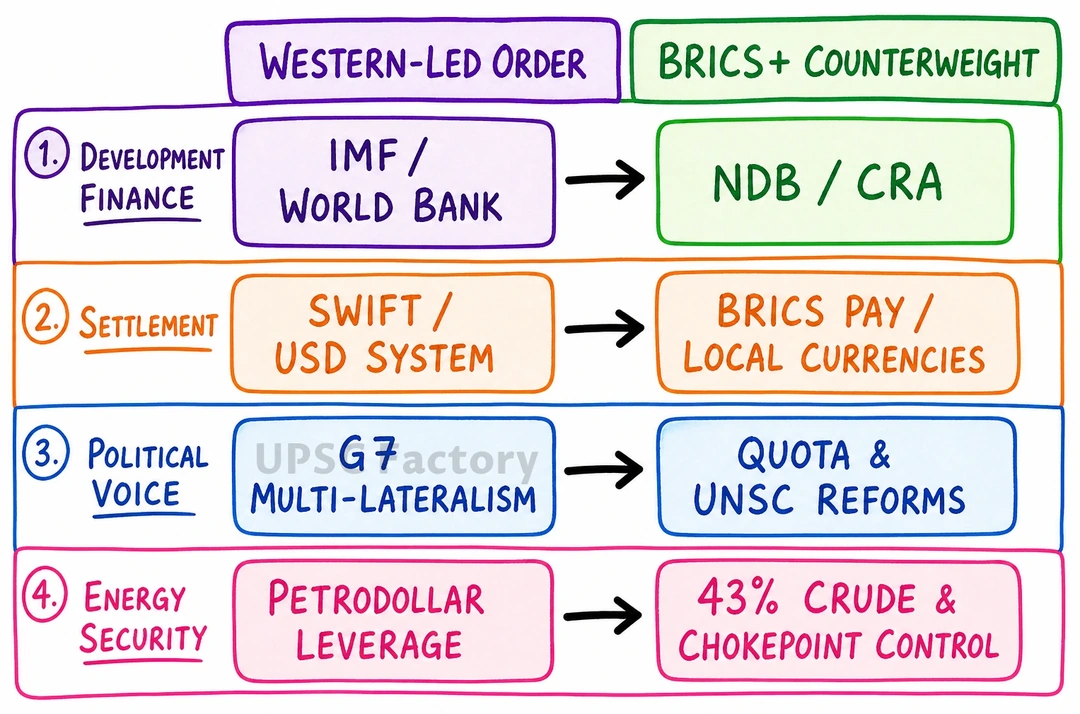
- Alternative Financial Architecture: Challenges Bretton Woods conditionalities through the New Development Bank (NDB) and the Contingent Reserve Arrangement (CRA).
- De-dollarization & Trade Mechanisms: Facilitates cross-border settlements in local currencies and interoperable payment systems (BRICS Pay), reducing vulnerability to unilateral sanctions (Kazan Declaration 2024).
- Reforming Global Governance: Champions democratized multilateralism, demanding quota reforms in the IMF/World Bank and expansion of the UN Security Council.
- Geoeconomic Resource Leverage: BRICS+ consolidation aggregates critical energy reserves (~43% of global crude oil) and vital trade choke points (Strait of Hormuz, Suez Canal).
2. Structural Challenges Limiting its Efficacy
- Ideological Divergence: Split between an “anti-Western” revisionist stance (China, Russia, Iran) and a “non-Western” multi-alignment approach (India, Brazil, South Africa).
- Bilateral Frictions & Asymmetry: Sino-Indian border disputes and intra-bloc trade imbalances undermine institutional cohesion.
BRICS must bridge internal strategic divides to transition from a symbolic counterweight into a stable, rules-based alternative for global governance.