Model Answer:
Agricultural marketing in India suffers from structural fragmentation, causing high post-harvest losses and restricting the farmer’s share in the consumer rupee to 15–40% (Ashok Dalwai Committee).
1. Factors Responsible for Marketing Inefficiencies
- APMC Monopolies & Intermediation: Multi-layered intermediaries (Arhtiyas) and high market fees create cartelization and high price spreads.
- Information Asymmetry: Lack of real-time price dissemination forces distress sales to local village aggregators.
- Infrastructure Deficits: Inadequate cold-chain, scientific storage, and automated assaying facilities lead to 15–20% perishable losses.
- Credit-Tied Sales: Informal credit dependency (Dadni system) binds smallholders to sell produce below market value.
2. How E-Commerce Reduces Inefficiencies
- Supply Chain Disintermediation: Direct farm-to-fork procurement bypasses intermediaries, increasing farmer margins by 15–20% (e.g., Ninjacart, DeHaat).
- Transparent Price Discovery: Digital bidding aggregates nationwide demand, eliminating local price manipulation (e.g., e-NAM, ONDC).
- Predictive Logistics & Storage: Tech-enabled logistics integrate farm-gate collection and cold warehousing, minimizing transit time and post-harvest wastage.
- Financial & Market Inclusivity: Transaction trails facilitate formal credit underwriting and forward-contracting for Farmer Producer Organisations (FPOs).
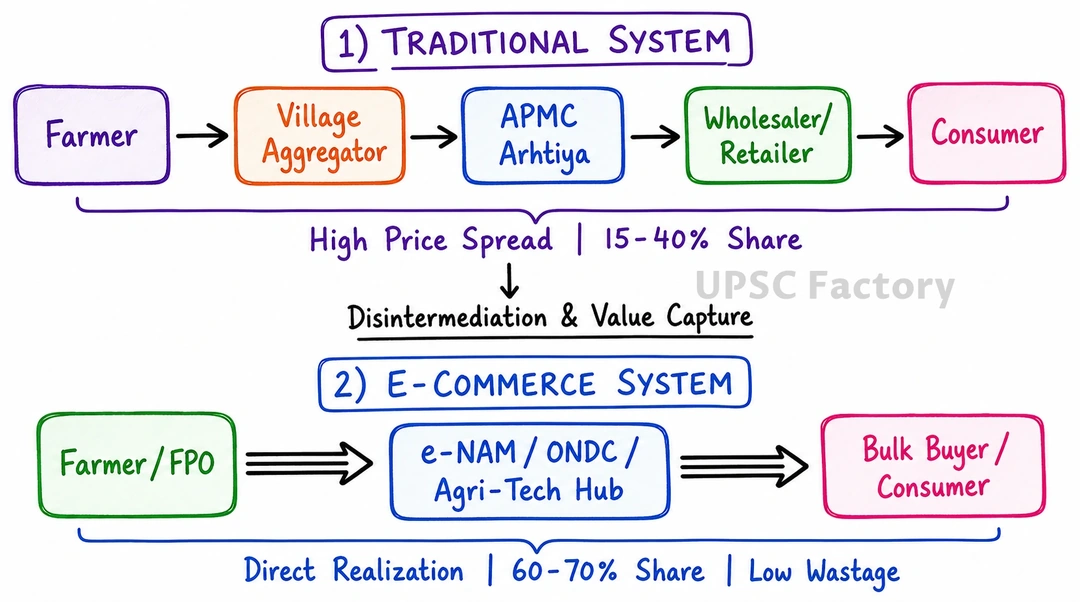
Scaling digital agri-commerce integrated with FPOs and rural physical infrastructure is vital to achieve a unified national agriculture market and double farmers’ income.