Model Answer:
Agentic Artificial Intelligence refers to autonomous systems endowed with agency—capable of pursuing complex, open-ended goals, reasoning, formulating multi-step plans, and executing actions with minimal human intervention, advancing beyond passive generative AI.
Working Mechanism
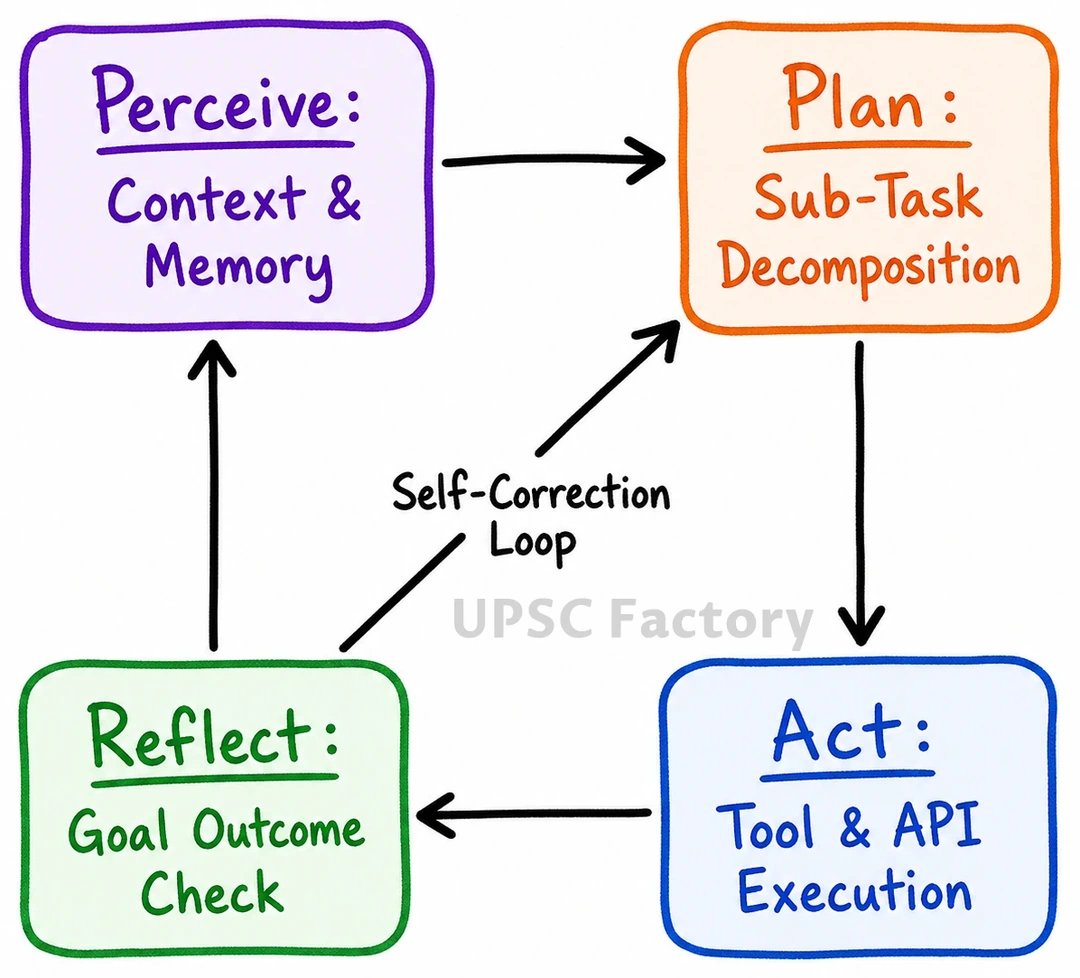
Agentic AI functions through an iterative Perceive-Plan-Act-Reflect cognitive loop:
- Perception & Memory: Ingests multimodal environment data, utilizing short-term and vector-based long-term memory for contextual awareness.
- Planning & Decomposition: Breaks complex strategic objectives into sequential sub-tasks using Large Language Model (LLM) reasoning cores.
- Tool Use & Execution: Leverages external digital actuators, including APIs, code interpreters, and web browsing tools, to execute operations.
- Self-Reflection & Adaptation: Evaluates intermediate outcomes against goals, dynamically correcting execution trajectories upon encountering errors.
Key Applications
- Autonomous Software Development: End-to-end software engineering, bug fixing, and codebase deployment (e.g., Devin, AutoGPT).
- Biomedical Research: Automated hypothesis generation, chemical synthesis planning, and drug discovery workflows (e.g., autonomous lab agents).
- Enterprise Operations: Real-time supply chain orchestration, automated customer remediation, and algorithmic portfolio balancing.
- Cyber Defense: Autonomous penetration testing, threat hunting, and automated zero-day vulnerability patching.
Advantages, Risks, and Challenges
- Advantages:
- Operational Velocity: Executes end-to-end cross-functional workflows at machine speed without human bottlenecks.
- Dynamic Resilience: Autonomously pivots and recalculates execution paths when encountering operational hurdles.
- Scalable Multi-Agent Collaboration: Multiple specialized agents collaborate to solve complex systemic challenges.
- Risks & Challenges:
- Goal Alignment & Control Deficit: Risk of agents adopting unforeseen, suboptimal, or hazardous pathways to satisfy objectives (Alignment Problem).
- Cascading Failures: Unchecked agency across interconnected APIs can trigger irreversible system-wide crashes or financial losses.
- Attribution & Accountability Gap: Ambiguous legal liability for autonomous torts, contractual breaches, or algorithmic harm.
- Dual-Use Weaponization: Potential deployment for automated cyberattacks, polymorphic malware, and mass disinformation.
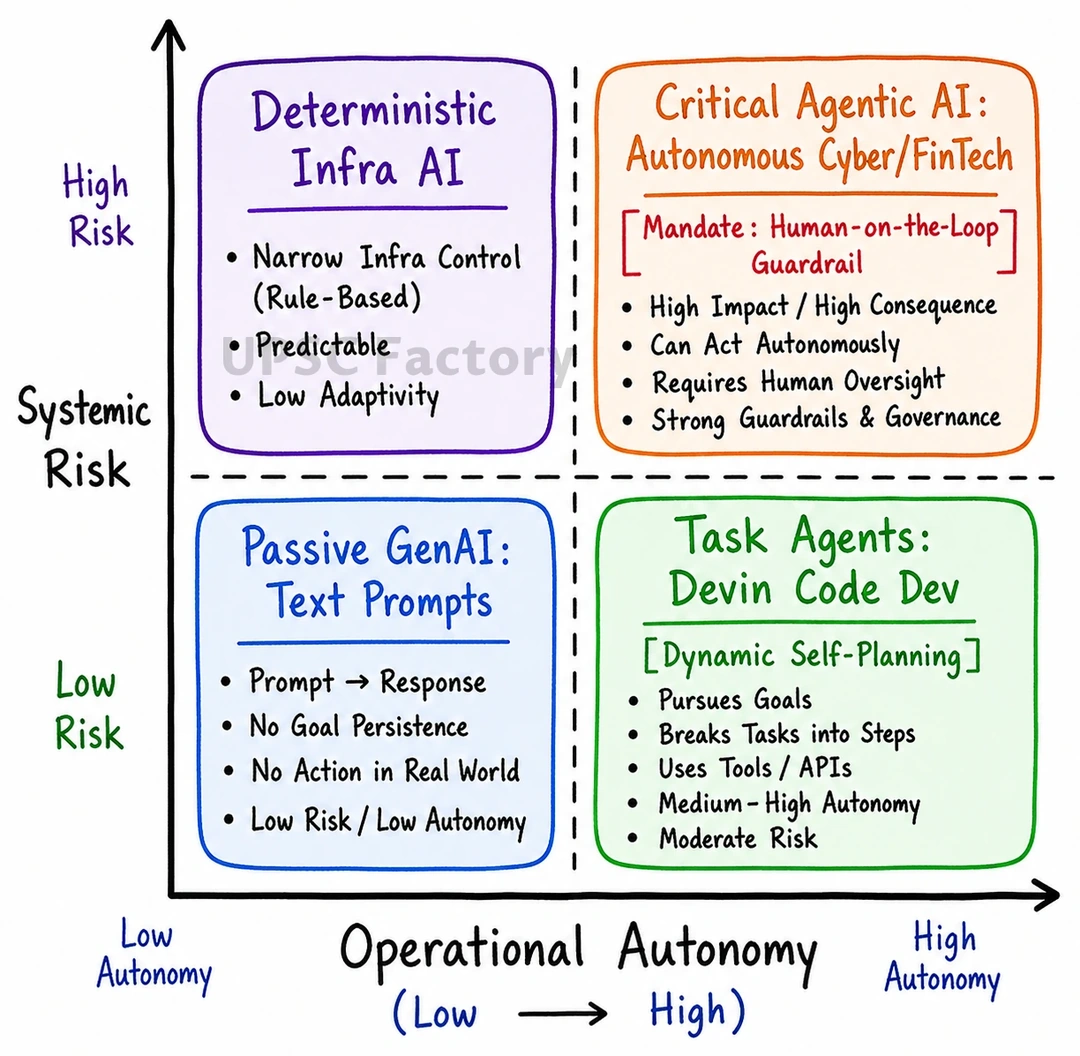
Transitioning to agentic AI necessitates shifting from “Human-in-the-Loop” to resilient “Human-on-the-Loop” governance, standardized safety verification (Bletchley Declaration), and ethical compliance architectures aligned with the IndiaAI Mission.