Model Answer:
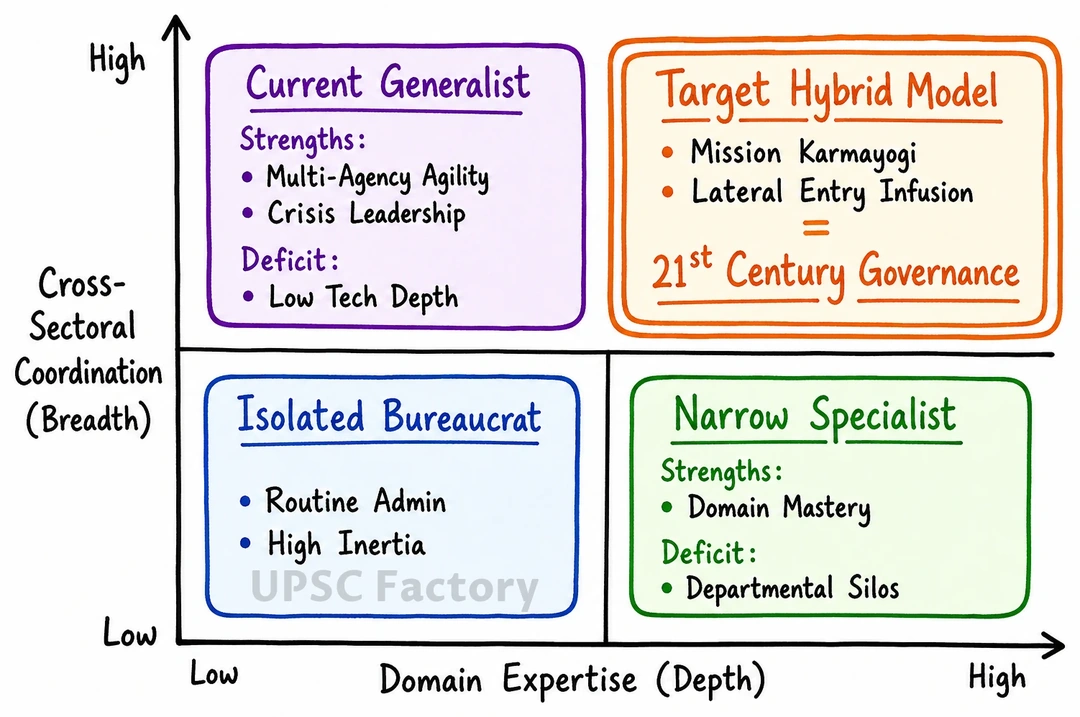
Rooted in Article 312 and colonial administrative design, India’s generalist civil services provide unified, cross-sectoral leadership across diverse socio-economic domains.
Advantages of Generalist Administration
- Cross-Sectoral Coordination: Synthesizes multi-departmental mandates, breaking administrative silos and aligning policy implementation across tiers of government.
- Crisis Leadership & Adaptability: Displays agility in mobilising multi-agency resources during complex field emergencies (e.g., District Disaster Management).
- Democratic Interface: Functions as a neutral, broad-based mediator balancing technical inputs with citizen welfare and socio-political realities.
- National Integration: Fosters an all-India administrative ethos, preventing narrow parochialism in state and central policy execution.
Contemporary Limitations
- Techno-Managerial Deficits: Lacks deep domain expertise needed for modern regulatory landscapes (e.g., AI governance, green finance, cyber-security).
- Tenure Instability: Rapid rotations and short tenures impede subject mastery, weakening long-term institutional memory and accountability.
- Regulatory & Contractual Inefficiency: Inadequate specialized knowledge hampers complex techno-commercial negotiations (e.g., Infrastructure PPP renegotiations).
- Policy Inertia: Over-reliance on generic precedents slows innovation, hindering agile, evidence-based policy formulation.
To navigate modern governance complexities, implementing 2nd ARC recommendations by institutionalizing lateral entry and operationalizing Mission Karmayogi will effectively bridge the generalist-specialist divide.