Model Answer:
Malnutrition (NFHS-5: 35.5% stunting, 57% women anaemic) violates the constitutional mandate of raising nutrition levels (Article 47), transcending clinical health into a multi-dimensional structural deficit.
Challenge of Social Equity & Human Development
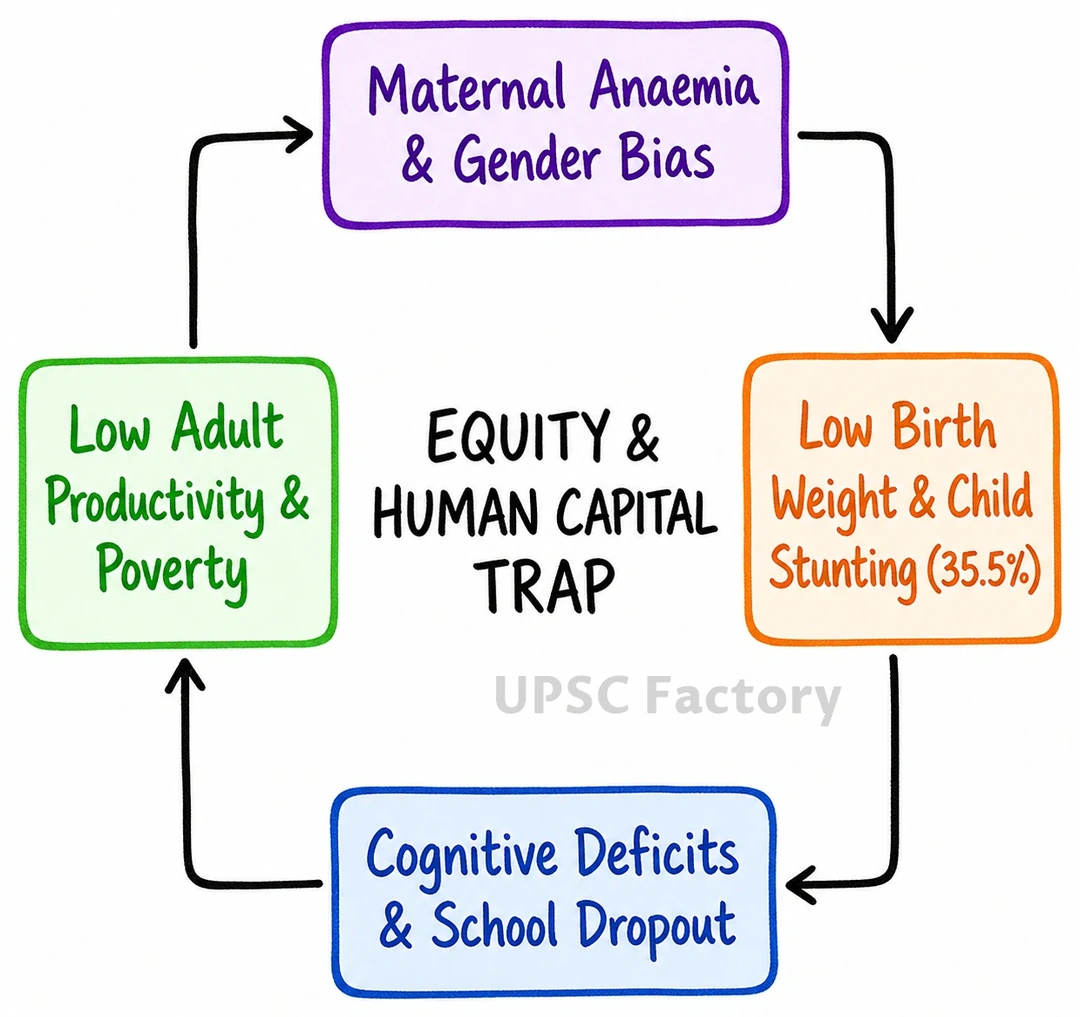
- Gender Inequity: Intra-household food discrimination and early childbearing perpetuate an intergenerational cycle of undernutrition.
- Marginalized Vulnerability: Higher stunting rates among SC/ST populations reflect structural poverty and socio-economic exclusion.
- Human Capital Depletion: Chronic undernutrition causes irreversible cognitive deficits, lowering adult earning capacity and threatening India’s demographic dividend.
- Spatial Disparity: Aspirational districts and tribal belts bear an unequal burden due to regional development imbalances.
Welfare Governance Bottlenecks & Reform Needs
- Cereal-Centric PDS: Heavy focus on wheat-rice ignores dietary diversity, driving hidden hunger (e.g., Odisha Millets Mission).
- Administrative Silos: Lack of convergence between sanitation (Swachh Bharat), drinking water (JJM), and childcare (ICDS).
- Delivery Deficits: Inadequate Anganwadi infrastructure and unaddressed supply-chain leakages weaken last-mile nutrition security.
- Data & Monitoring Gaps: Under-utilization of real-time monitoring tools (e.g., Poshan Tracker) hampers localized targeting.
Achieving SDG-2 (Zero Hunger) requires transforming POSHAN 2.0 into a decentralized Jan Andolan, converging welfare delivery with targeted social justice interventions.