Model Answer:
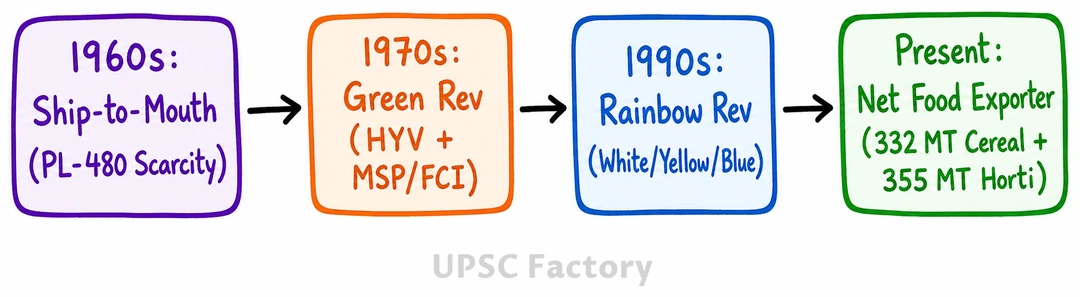
India transformed from a “ship-to-mouth” vulnerability under US PL-480 to a net food exporter, achieving record foodgrain (~332 MT, 2023-24) and horticulture production (~355 MT).
Catalysts of Transformation: From Deficit to Food Surplus
- Technological Package (Green Revolution): Introduction of High Yielding Variety (HYV) dwarf seeds (wheat/paddy), chemical fertilizers, and intensive irrigation.
- Institutional Pricing & Procurement: Guaranteed floor prices through Minimum Support Price (MSP) via CACP and open-ended procurement by Food Corporation of India (FCI).
- Public Infrastructure Investment: Large-scale irrigation networks (e.g., Bhakra Nangal), rural electrification, and agricultural research institutions (ICAR, KVKs).
- Targeted Input Subsidies: Concessional power, urea pricing subsidies, and expansion of Priority Sector Lending (PSL) via NABARD.
- Multi-Sectoral Revolutions: White Revolution (Operation Flood), Blue Revolution (Fisheries), and Yellow Revolution (Oilseeds) structurally expanded output beyond staples.
Government Policies Driving Agricultural Diversification
- Horticulture Promotion:
- Mission for Integrated Development of Horticulture (MIDH) promotes high-value fruits, vegetables, and protected cultivation.
- Oilseeds & Palm Oil Mission:
- NMEO-OP (National Mission on Edible Oils – Oil Palm) incentivizes shift away from water-guzzling paddy in the Northeast and Telangana.
- Nutri-Cereals (Millets):
- Shree Anna Initiative promotes climate-resilient millets through MSP enhancements, processing hubs, and inclusion in POSHAN 2.0.
- Allied & High-Value Sector Support:
- Pradhan Mantri Matsya Sampada Yojana (PMMSY) and Animal Husbandry Infrastructure Development Fund (AHIDF) drive vertical income diversification.
- Sustainable & Natural Agriculture:
- Paramparagat Krishi Vikas Yojana (PKVY) and National Mission on Natural Farming (NMNF) support organic certification and chemical-free farming.
- Value Chain & Market Infrastructure:
- RKVY-RAFTAAR and Agriculture Infrastructure Fund (AIF) provide post-harvest credit for specialized crop clusters and FPOs.
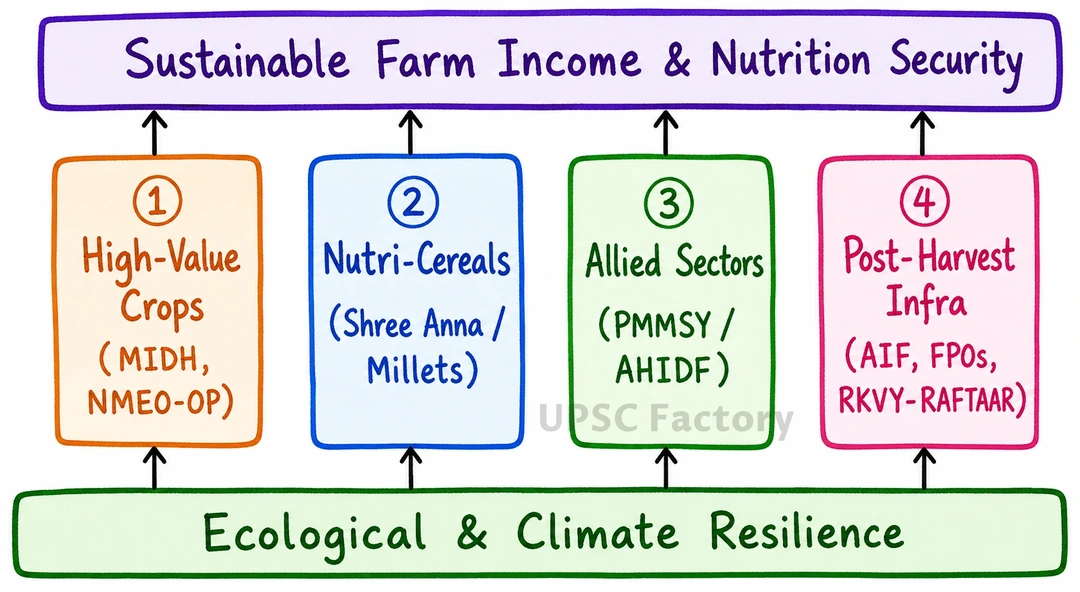
Transitioning from calorie-focused food security to nutrition-dense, climate-resilient, and market-led crop diversification is critical for sustainable farm incomes and ecological balance.