Model Answer:
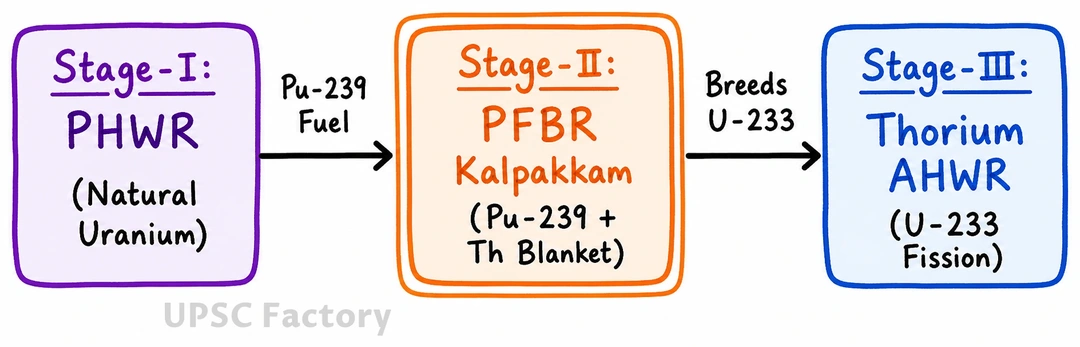
Core loading at the 500 MWe Prototype Fast Breeder Reactor (PFBR) at Kalpakkam operationalizes Stage-II of India’s Three-Stage Nuclear Programme, accelerating the transition toward a closed fuel cycle.
Distinction: FBR vs. Thermal Reactor
| Parameter | Fast Breeder Reactor (FBR) | Thermal Nuclear Reactor (e.g., PHWR) |
|---|---|---|
| Neutron Energy | Fast neutrons (>0.1 MeV) | Slow/thermal neutrons (≈ 0.025 eV) |
| Moderator | None used | Heavy/Light water or Graphite required |
| Coolant | Liquid Sodium | Heavy water / Light water |
| Fuel Cycle | Breeds more fissile material (Pu-239) than it burns | Net consumer of fissile fuel (U-235) |
‘Criticality’ Explained
Criticality refers to the state where a nuclear fission chain reaction becomes self-sustaining—the neutron multiplication factor (keff) equals 1, ensuring stable, continuous power generation without external neutron injection.
Implications for Clean Energy Future
- Thorium Roadmap: Acts as the vital bridge to Stage-III by breeding fissile U-233 from vast domestic Thorium reserves.
- Waste & Fuel Efficiency: Multiplies energy extraction from uranium by >70× while incinerating long-lived minor actinides, minimizing radioactive waste.
- Firm Green Baseload: Supplies stable, round-the-clock clean electricity to balance intermittent solar-wind grids, supporting the Net-Zero 2070 target.
PFBR criticality cements indigenous technological mastery (BHAVINI), unlocking long-term energy security through sustainable, closed-loop nuclear power.