Model Answer:
Caste (ascription-based, closed status group) and class (achievement-based, economic position) are not mutually exclusive systems; they continuously reconstitute each other, shaping the complex architecture of social stratification.
Dimensions of Caste-Class Intersection in Social Structure
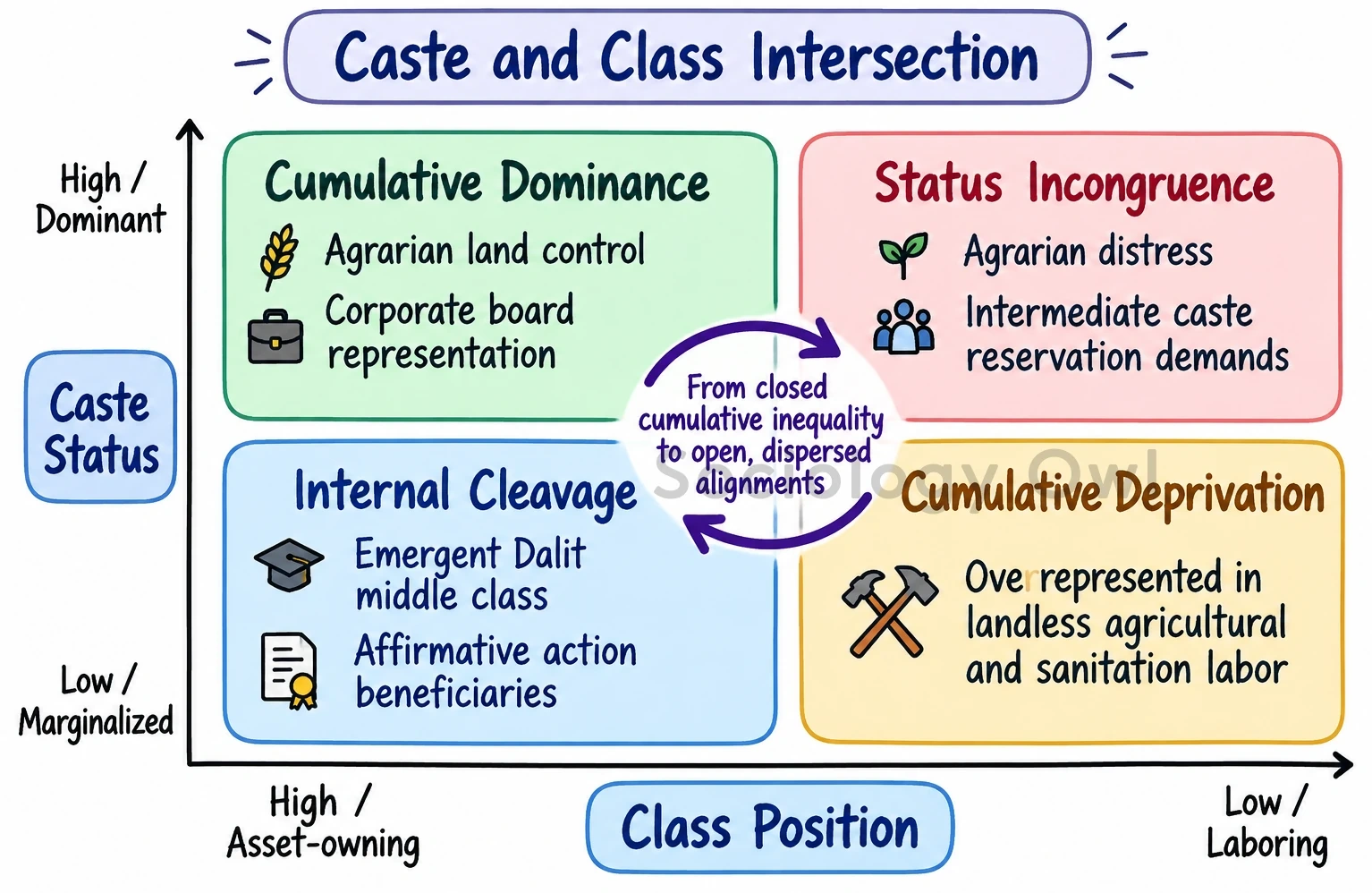
- Cumulative to Dispersed Inequalities: André Béteille demonstrated that while ritual status, wealth, and power traditionally converged into cumulative inequalities, modern democratization has dispersed them, even as substantial structural overlaps endure.
- Agrarian Class Relations: Agrarian hierarchies directly mirror caste stratification; land ownership and surplus extraction remain concentrated among dominant castes, while landless agricultural tenant-laborers remain overwhelmingly marginalized castes.
- Labor Market Segmentation: Modern capitalist markets mobilize traditional social capital; low-end, precarious, and sanitation labor remains structurally caste-coded, whereas upper-caste networks disproportionately monopolize corporate and managerial capital.
- Intra-Caste Class Differentiation: State welfare and affirmative action have birthed a distinct “Dalit middle class,” creating cross-cutting economic cleavages that fracture monolithic caste solidarity from within.
- Marital Alliances and Homogamy: The institution of endogamy increasingly functions as caste-based class homogamy, where class compatibility operates as a secondary filter within rigid caste boundaries.
- Political Mobilization for Economic Ends: Dominant intermediate agrarian castes frequently leverage primordial caste networks to demand state-mediated class concessions, such as affirmative action quotas, to offset agrarian distress.
Caste and class operate not as parallel structures, but as co-constitutive systems reproducing durable social inequalities.