Model Answer:
In post-independence India, planned development was conceived not merely as economic engineering, but as a deliberate state apparatus to dismantle primordial hierarchies and orchestrate democratic social change.
Synchronising Interventions: Structural Shifts and Lived Realities
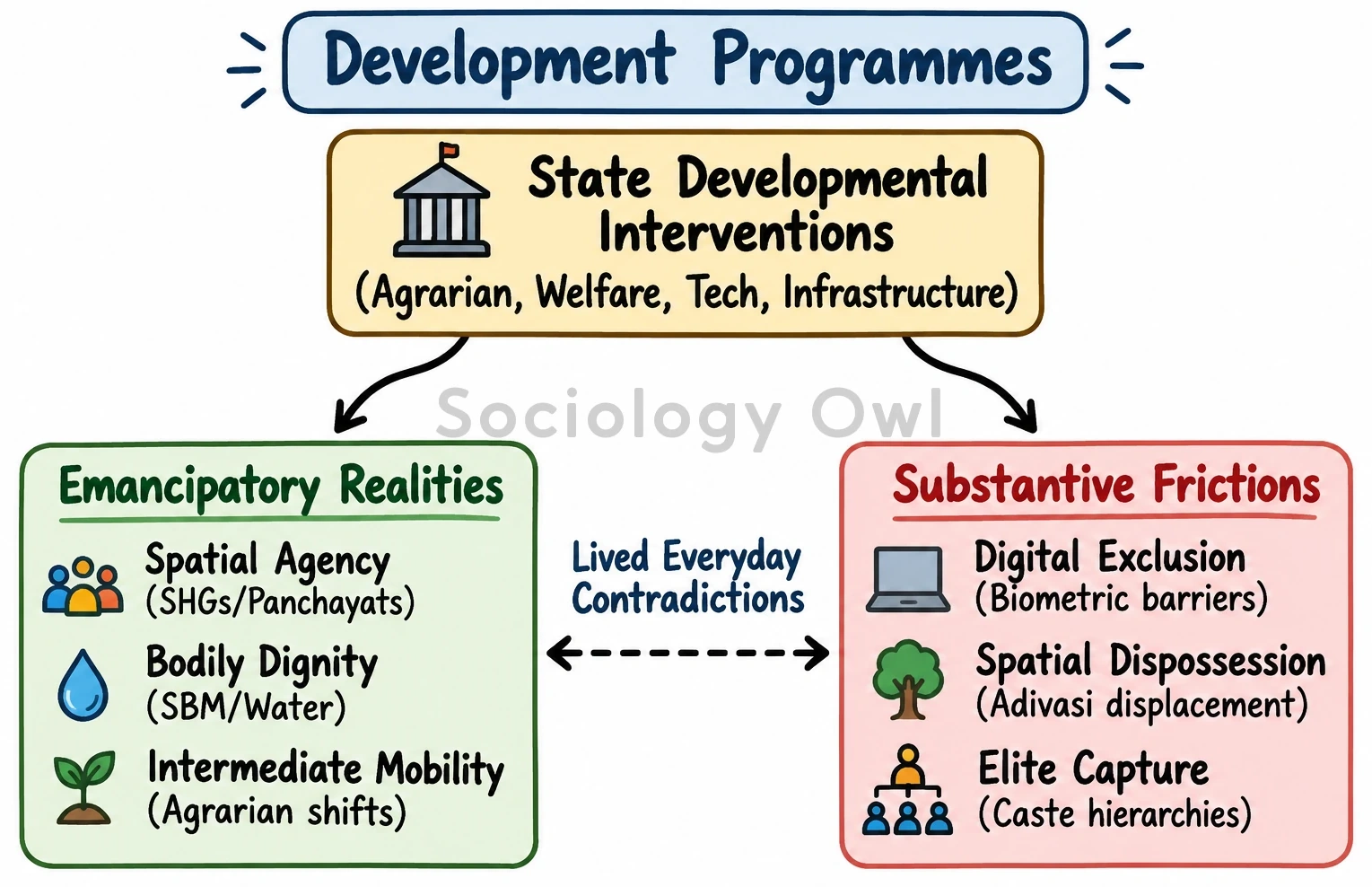
- Agrarian Restructuring and Intermediate Dominance: Early interventions like the Green Revolution and institutional land reforms altered agrarian stratification, producing what Lloyd and Susanne Rudolph termed bullock capitalists. In everyday life, this shifted village power from traditional upper-caste zamindars to agrarian Backward Classes, while pushing landless Dalits into precarious circular migration.
- Feminisation of Rural Agency: Interventions like MGNREGA and Self-Help Group (NRLM) federations have reshaped domestic and spatial negotiations. Independent wage credits and collective financial autonomy visible in weekly micro-meetings have weakened traditional purdah restrictions and enhanced women’s intra-household bargaining capacity.
- Decentralised Power and Subaltern Assertion: The 73rd and 74th Constitutional Amendments altered local political architecture. Despite initial patriarchal resistances like panchayat-pati syndicates, lived experiences across rural India show subaltern and female representatives increasingly asserting bureaucratic and political agency.
- Infrastructural Dignity and Bodily Integrity: Initiatives such as the Swachh Bharat Mission and Jal Jeevan Mission have transformed the micro-geographies of everyday life. Eliminating distant water fetching and open defecation significantly reduced bodily vulnerability and experiential humiliation, particularly for rural women and lower castes.
Frictions and Paradoxes in the Everyday Developmental Experience
- Techno-Welfarism and Digital Gatekeeping: While Direct Benefit Transfer (DBT) streamlined delivery, lived realities reveal forms of digital exclusion. Biometric authentication failures and administrative opacity generate anxiety and disenfranchisement for marginal beneficiaries, reflecting what Reetika Khera describes as systemic hurdles in technological welfare delivery.
- Development-Induced Displacement: Large infrastructural undertakings—dams, industrial corridors, and mining zones—routinely generate an alienated underclass. As Gail Omvedt observed, adivasi and agro-pastoral communities bear disproportionate costs of modernisation through spatial uprooting, loss of cultural commons, and forced urban-slum proletarianisation.
- Continuity of Relational Asymmetries: Despite targeted socio-economic programmes, development often re-inscribes deep-seated social cleavages, where programmatic benefits are mediated and captured by local elites, leaving foundational caste relations substantively unreconstructed.
Development programmes have democratised everyday lived spaces, yet genuine emancipation requires dismantling persistent structural inequalities beyond mere material delivery.