Model Answer:
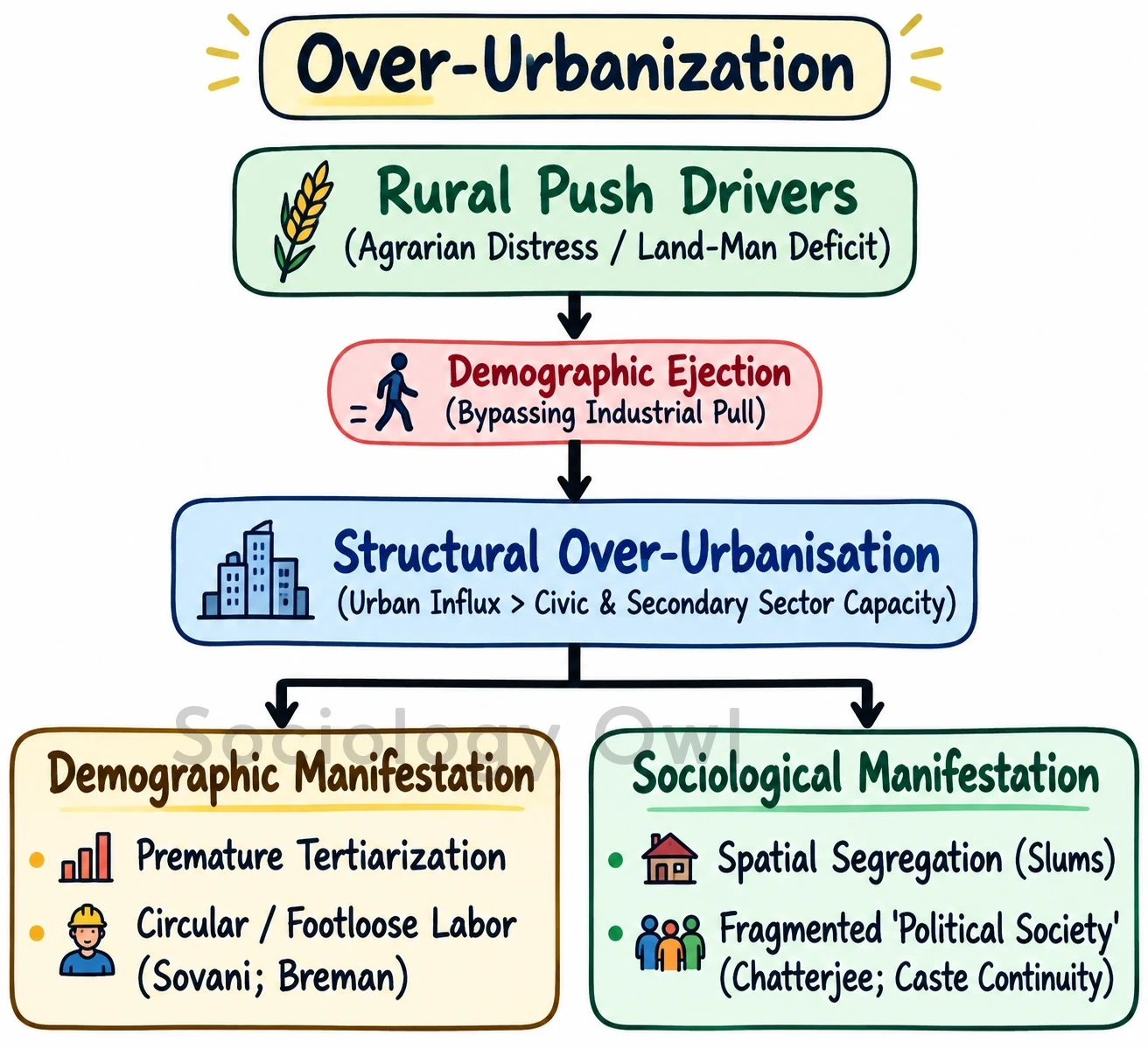
Urbanisation in post-colonial India diverged significantly from the Western trajectory: rather than being driven by industrial dynamic pull, it has been largely propelled by agrarian stagnation, creating over-urbanisation—a condition where urban demographic growth outstrips industrialisation, civic infrastructure, and formal employment capacity.
Demographic Dimensions of Over-Urbanization and Rural Push
- Top-Heavy Urban Primacy: Growth is skewed toward Class-I metropolitan centres rather than medium towns, concentrating population density without regional demographic diffusion.
- Premature Tertiarization: Demographic influx bypasses the secondary industrial sector, shifting directly from low-yield agriculture to precarious, informal urban services, validating N.V. Sovani’s critique of premature urban growth.
- Agrarian Surplus Ejection: Decreasing land-man ratios, unviable landholdings, and mechanization expel surplus labor, converting rural demographic pressure into urban distress.
- Footloose and Circular Demography: As noted by Jan Breman, rural push produces seasonal, floating migrant streams that oscillate between village and city without permanent urban absorption.
- Skewed Spatial Sex Ratios: Male-selective working-age migration creates sex-ratio imbalances in metropolitan receiving zones while leaving skewed dependency ratios in rural sending regions.
Sociological Dimensions: Stratification and Exclusion
- Slumification and Spatial Marginality: The structural inability to house push-migrants spawns expansive informal settlements, producing exclusionary, segmented cityscapes marked by deep environmental deficits.
- Urban Reproduction of Caste: Marginalized castes escaping rural feudal ties enter the lowest rungs of urban informal labor, exchanging traditional dependence for urban gig and sanitation precarity.
- Fragmented Civic Citizenship: Migrant laborers occupy what Partha Chatterjee terms political society, depending on tenuous political patronage rather than secure rights and social protections.
- Feminization of Agrarian Labor: Male out-migration leaves rural women managing agricultural labor and household survival, without holding formal land titles or credit access.
- Alienation and Breakdown of Solidarity: Migrants face the dissolution of traditional rural community safety nets without gaining entry into modern institutional support systems, heightening psychosocial insecurity.
Rectifying India’s distorted urbanization demands revitalizing the agrarian economy alongside building inclusive, decentralized, and socially absorptive urban infrastructure.