Model Answer:
In India, violence against women is not an aberrant, individual pathology but a structural instrument used to enforce patriarchal dominance, police female sexuality, and reproduce unequal caste and class hierarchies.
Sociological Explanations of Violence Against Women
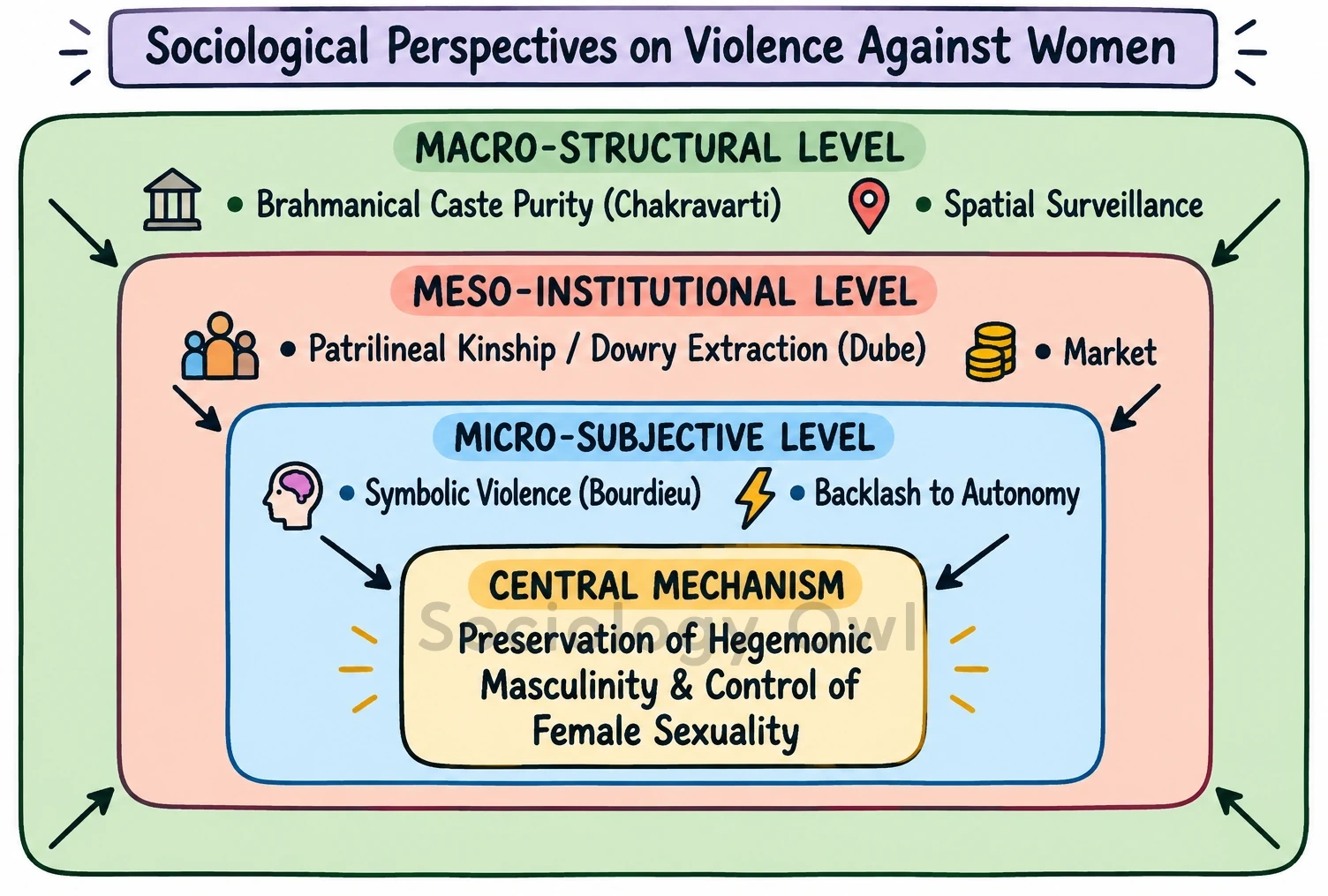
- Brahmanical Patriarchy and Caste Hegemony: Uma Chakravarti demonstrates that sexual violence against subaltern women is systemic, weaponized by dominant castes to maintain ritual purity, enforce caste hierarchy, and punish collective assertion.
- Patrilineal Kinship and Structural Vulnerability: Leela Dube highlights how patrilocal and patrilineal systems treat women as transferable property, rendering the private household the primary site of domestic abuse, female foeticide, and unpaid emotional subjugation.
- Commodification and the Political Economy of Dowry: Rapid capitalist transition has intensified consumerism, transforming marriage into an extortionate transaction where women face dowry harassment and custodial deaths due to asymmetric economic bargaining power.
- Spatial Hegemony and Surveillance: As shown by Shilpa Phadke et al. in Why Loiter?, the constant threat of public violence serves as an informal mechanism to restrict women’s spatial mobility under the pretext of familial “honour” and safety.
- Backlash Against Female Autonomy: Rising female labour force participation and political assertion destabilize traditional male breadwinner status, triggering compensatory violence from men seeking to reclaim hegemonic masculinity.
- Symbolic Violence and Socialization: Applying Pierre Bourdieu’s framework, violence is culturally normalized through internalised gender roles, causing victims to endure everyday abuse as an immutable domestic duty (chhoti-moti baatein).
Multi-Dimensional Strategies for Mitigation
- Transforming Masculinity through Socialization: Restructure primary socialization via school curricula to dismantle toxic entitlements, desegregate domestic labor, and cultivate relational empathy among young boys.
- Intersectional Legal Implementation: Reorient institutions enforcing the Protection of Women from Domestic Violence Act (PWDVA) and the SC/ST (PoA) Act from patriarchal conciliation toward prompt, survivor-centric justice.
- Dismantling Spatial Segregation: Move away from paternalistic protectionism by redesigning inclusive, well-lit urban public spaces that institutionalize women’s unconditional “right to the city.”
- Material Independence and Asset Ownership: Incentivize independent land, housing, and property titles for women, eliminating the structural poverty and economic dependence that traps them in abusive conjugal units.
- Community-Led Accountability: Empower grassroots networks, such as Mahila Panchayats and Self-Help Groups, to act as localized surveillance systems that de-privatize domestic violence and provide immediate institutional backing.
Ending gender violence requires dismantling deep-seated patriarchal structures, eradicating caste-gender hierarchies, and institutionalizing women’s unconditional autonomy across India.