Model Answer:
Objectivity—the pursuit of value-neutral empirical truth—remains sociology’s central methodological paradox because the researcher is an intrinsic participant within the very social fabric they seek to investigate.
Dilemmas in Capturing Objective Social Reality
- Ontological Entanglement: Unlike inanimate natural phenomena, human subjects possess consciousness and assign meaning to actions, rendering pure external detachment conceptually inadequate, as Max Weber highlighted through Verstehen.
- Value-Infiltration Across Research Phases: While value-freedom may be attempted during data collection, values inevitably dictate problem choice and hypothesis formulation (value-relevance), limiting absolute neutrality.
- The Myth of Detached Neutrality: Gunnar Myrdal argued that total objectivity is a chimera; unstated biases are far more distortive than explicit, acknowledged presuppositions.
- Positivist Reductionism: Emulating the natural sciences risks treating fluid social processes as static things, committing what Peter Berger and Thomas Luckmann call reification of socially constructed reality.
- Ideological Hegemony: Critical theorists argue that institutionalized sociological research often uncritically adopts ruling-class categories, masking systemic power dynamics under the guise of “objective” science.
- The Reflexive Solution: Rather than pursuing unattainable neutrality, Pierre Bourdieu proposed epistemic reflexivity, where researchers systematically interrogate their own social position, field biases, and academic habitus.
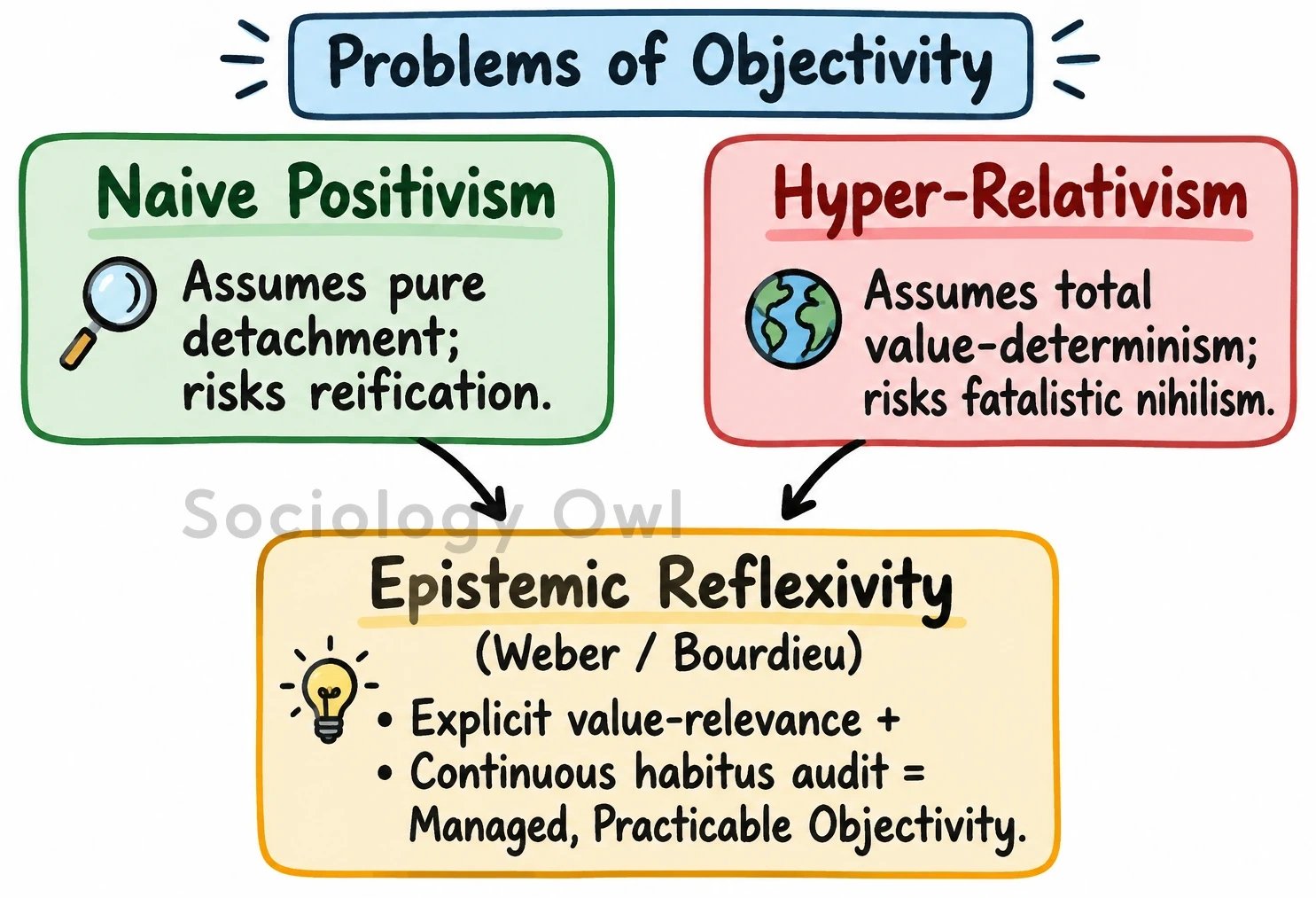
Objectivity in sociology is not absolute detachment, but conscious methodological reflexivity that rigorously recognizes and manages researcher subjectivity.