Model Answer:
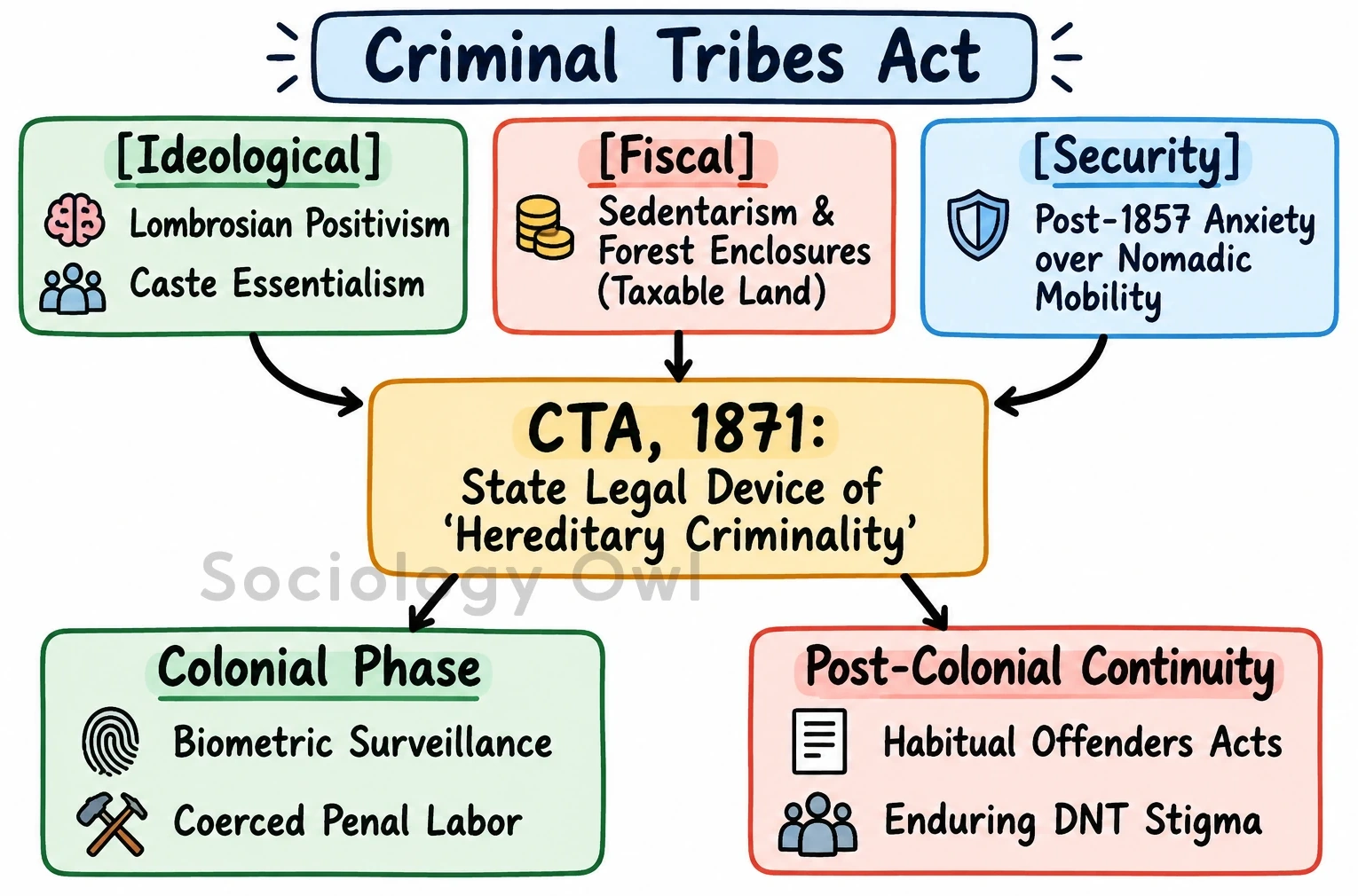
The Criminal Tribes Act (CTA), 1871 codified the colonial construct of hereditary crime, institutionalizing an epistemological fusion of European positivist criminology with caste-based occupational determinism to control non-sedentary communities.
Raison d’Être of the Colonial Classification
- Colonial Sedentarism: British rule equated civilization and revenue extraction with settled agriculture; itinerant communities resisted fiscal extraction and spatial mapping (Nicholas Dirks).
- Positivist Caste Essentialism: Administrators transposed biological theories of born criminals onto the Indian caste system, viewing criminality as an inborn, hereditary caste trade (Sanjay Nigam).
- Ecological Dispossession: Forest Acts and the expansion of private property criminalized traditional hunting, pastoralism, and foraging, pushing displaced communities into survivalist offences (Meena Radhakrishna).
- Security Paranoia: Following the 1857 uprising, mobile and wandering populations were viewed as unpredictable conduits for rebellion requiring stringent surveillance.
Sociological and Structural Implications
- Institutionalized Surveillance: Mandated biometric tracking, spatial internment, and daily roll-calls that systematically dismantled community autonomy and civil liberties.
- Coerced Penal Labor: Stigmatized tribes were funneled into forced, underpaid labor regimes in factories and canal colonies, often supervised by the Salvation Army.
- The Living Legacy of DNTs: Though repealed in 1952, its replacement by Habitual Offenders Acts preserved structural police brutality, enduring social stigma, and institutional marginality for De-notified Tribes.
Decolonizing justice requires dismantling this historical trauma, transforming De-notified Tribes from perpetual administrative suspects into constitutionally empowered citizens.