Model Answer:
Post-Independence village studies established an empirical field-view countering colonial myths of the “isolated republic.” However, projecting these atomized, localized ethnographies onto the macro-structural canvas of Indian society poses serious methodological and analytical dilemmas.
Epistemological and Methodological Impediments
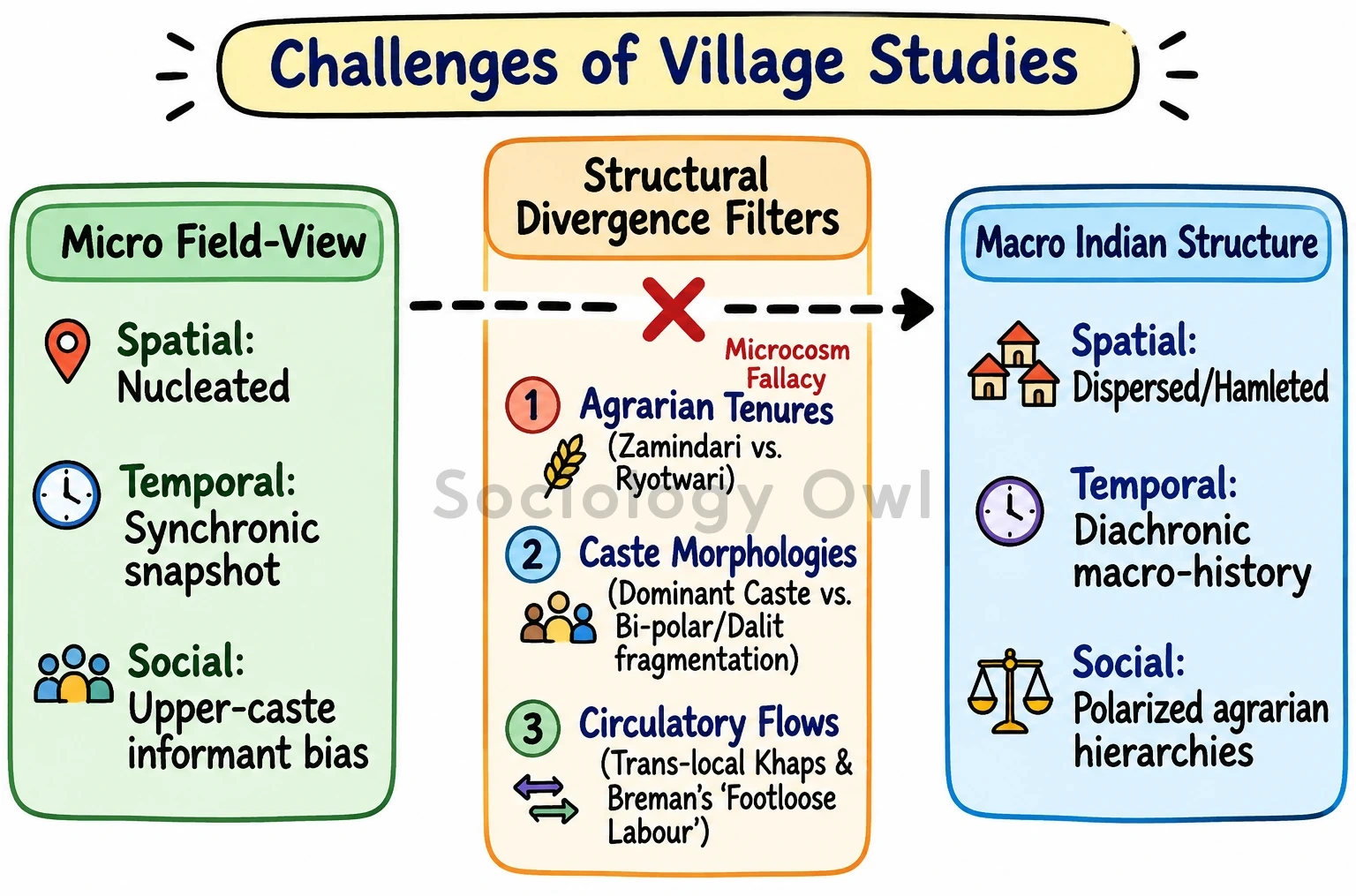
- The Microcosm Fallacy: Early monographs uncritically borrowed Robert Redfield’s concept of the Little Community, falsely assuming a single village mirrors the civilizational macrocosm. A nucleated settlement in Uttar Pradesh cannot reflect the dispersed homesteads (desam) of Kerala or tribal hamlets of the Northeast.
- Agrarian and Tenurial Divergence: Historical trajectories generated distinct structural matrices. As Andre Beteille noted, agrarian hierarchies under Eastern Zamindari systems created deep polarities between non-cultivating rentiers and unfree tenants, unreplicable in Western India’s Ryotwari peasant tracts.
- Synchronic Blind Spots: Intensive participant observation captures an ethnographic snapshot in time, often missing diachronic, macro-historical forces such as colonial de-industrialization, planned development, and uneven market integration.
- Subjective Investigator Bias: Intensive village studies were frequently skewed by the social location of informants—predominantly upper-caste, landowning males—thereby obscuring the macro-realities of systemic Dalit exploitation and subaltern resistance.
Structural and Contemporary Divergences
- Asymmetry of Caste Formations: M.N. Srinivas’s concept of the Dominant Caste, grounded in Rampura, fails in regions lacking numerically preponderant intermediate landholders, such as bi-polar caste settings or fragmented Dalit-majority villages.
- Neglect of Trans-Local Networks: Traditional ethnographies often underestimated multi-village kinship loops (khap networks), trade corridors, and pilgrimage circuits that B.R. Chauhan highlighted as structural bridges between local and regional systems.
- De-peasantisation and Fluidity: Contemporary village life cannot be mapped via self-contained spatial boundaries. Rural-urban continuums, state welfare penetration, and Jan Breman’s “footloose labour” involving circular migration have eroded territorial insularity into fluid regional networks.
Micro-studies illuminate lived social depth, but macro-validity necessitates synthesizing ethnographic specificity with structural, historical, and regional political economy.