Model Answer:
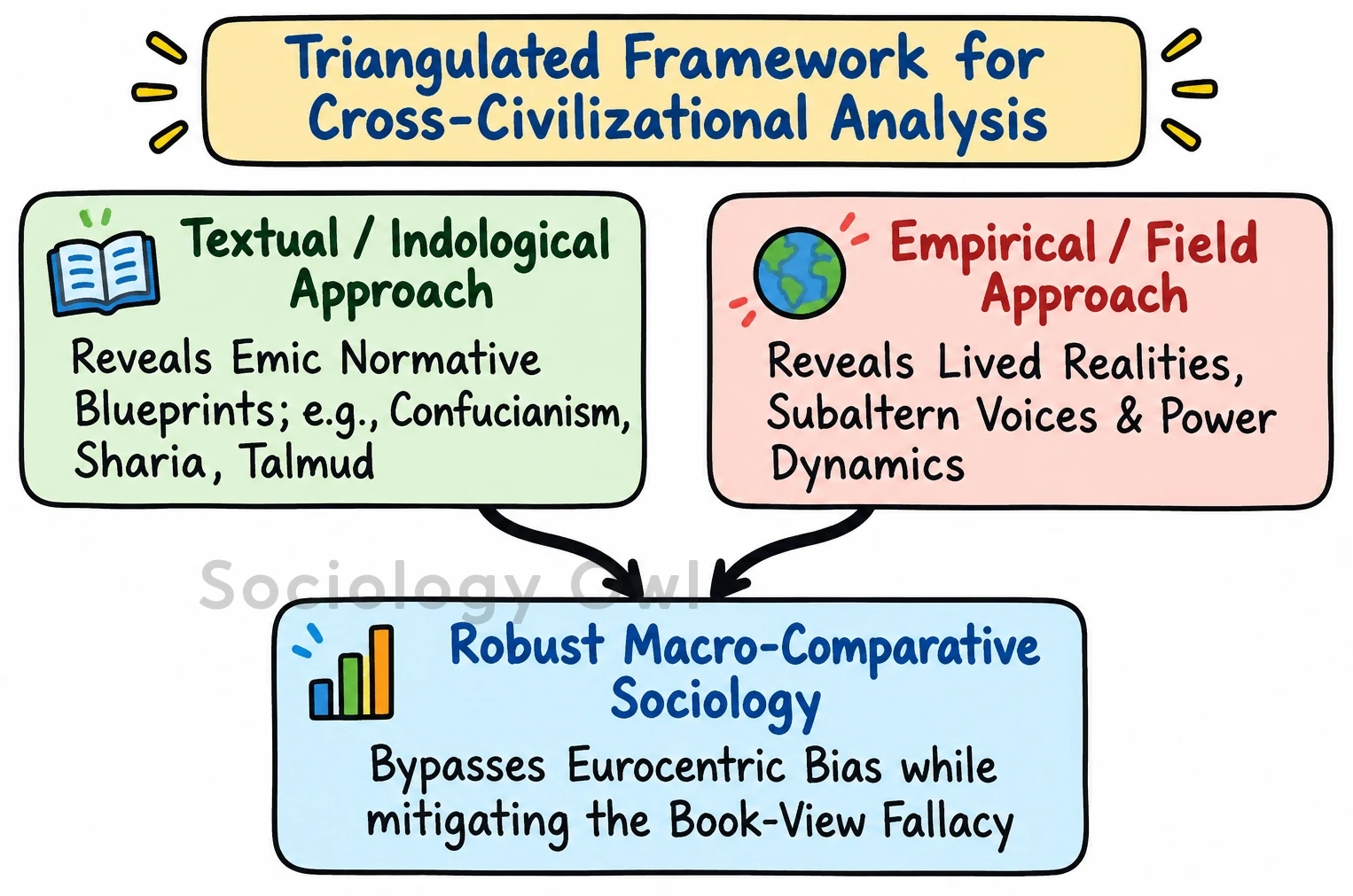
The Indological approach, pioneered by G. S. Ghurye, utilizes endogenous classical texts, linguistics, and scripture to examine social institutions and civilizational continuity. Beyond the Indian subcontinent, this textual-hermeneutic method provides a vital framework for deciphering the normative architectures of diverse global societies.
Epistemological Utility in Studying Other Societies
- De-centering Eurocentric Universalism: Applying indigenous textual analysis to non-Western societies—such as Sinology in China or Quranic hermeneutics in West Asia—counters Western ethnocentrism by evaluating societies through their own intellectual and conceptual traditions.
- Accessing the “Emic” Worldview: Sacred and classical texts reveal the internal ethical codes and collective consciousness (Weltanschauung) of a people, mirroring Max Weber’s interpretative project of understanding social action through the actor’s cultural meanings.
- Tracing Civilizational Continuity: Textual inquiry explains how ancient value systems influence modern structures, such as Confucian classics (Analects) continuously shaping contemporary East Asian family structures, statecraft, and corporate collectivism.
- Deciphering Legal and Normative Systems: In societies where positive law is historically intertwined with religious doctrines, such as Islamic jurisprudence (Fiqh) or Jewish rabbinic law (Talmud), texts remain indispensable for analyzing contemporary personal laws and morality.
- Enabling Macro-Comparative Sociology: As demonstrated by Louis Dumont, rigorous comparative sociology requires analyzing the civilizational texts of societies to juxtapose their foundational ideologies, such as Western egalitarian individualism versus non-Western hierarchical collectivism.
Methodological Caveats and Reflexivity
- The “Book-View” Fallacy: As M. N. Srinivas observed, textual analysis risks conflating ideal normative prescriptions with lived empirical reality, obscuring local variations and informal power dynamics.
- Hegemonic and Elite Bias: Canonical literature across civilizations—whether European clerical writings or Chinese literati records—systematically reflects elite male dominance, often rendering subaltern classes, folk traditions, and women invisible.
Textual approaches illuminate foundational cultural codes globally, provided they are dynamically triangulated with empirical, field-level social realities.