Model Answer:
A.R. Desai’s Dialectical Perspective on Indian Society
A.R. Desai pioneered the Dialectical-Historical perspective in India. In Social Background of Indian Nationalism, he applied Historical Materialism to analyze societal transformation, rejecting the dominant Indological and Structural-Functional approaches.
Key Features of the Perspective
- Primacy of Economic Infrastructure: Societal changes stem from shifts in property relations and the mode of production (e.g., British introduction of private land ownership), not mere cultural evolution.
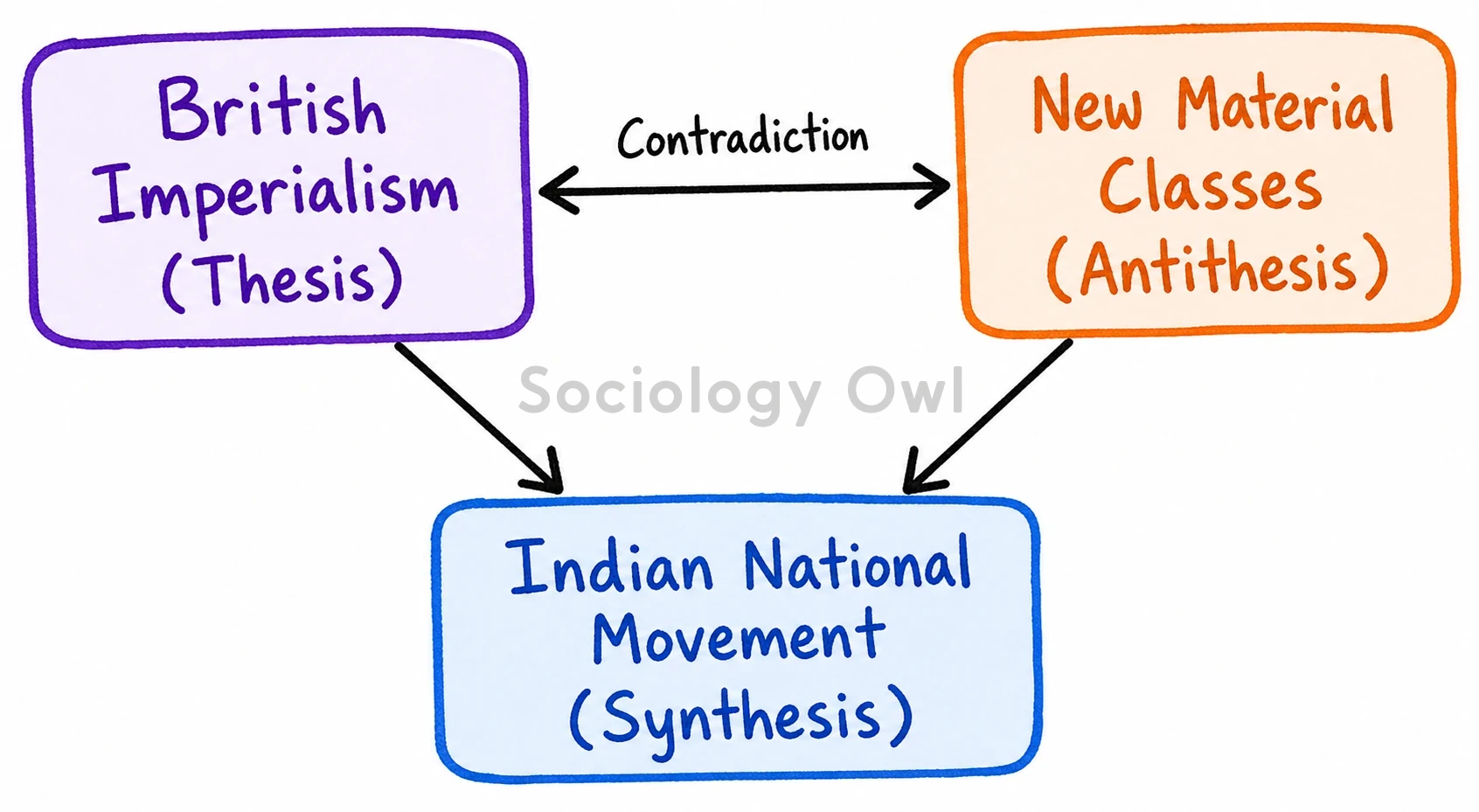
- Dialectics of Nationalism: The contradiction between British imperialism and newly emerged material classes (bourgeoisie, modern intelligentsia) birthed the Indian National Movement.
- Caste-Class Nexus: He rejected the purity-pollution binary, arguing that traditional caste is fundamentally an agrarian class structure disguised by religious hierarchy.
- The Myth of the Welfare State: Desai critiqued the post-independence Indian state for pursuing a “capitalist path of development” that marginalizes the peasantry and proletariat.
Desai’s dialectical method perfectly decodes the Green Revolution not merely as technological progress, but as a catalyst for agrarian class polarization, contextualizing contemporary farmer protests and rural distress.
Conclusion
Though critiqued for economic determinism by Subaltern scholars (Ranajit Guha) and Structuralists (Louis Dumont), Desai’s Marxist methodology remains indispensable for unmasking the structural contradictions and persistent inequalities driving modern Indian society.