Model Answer:
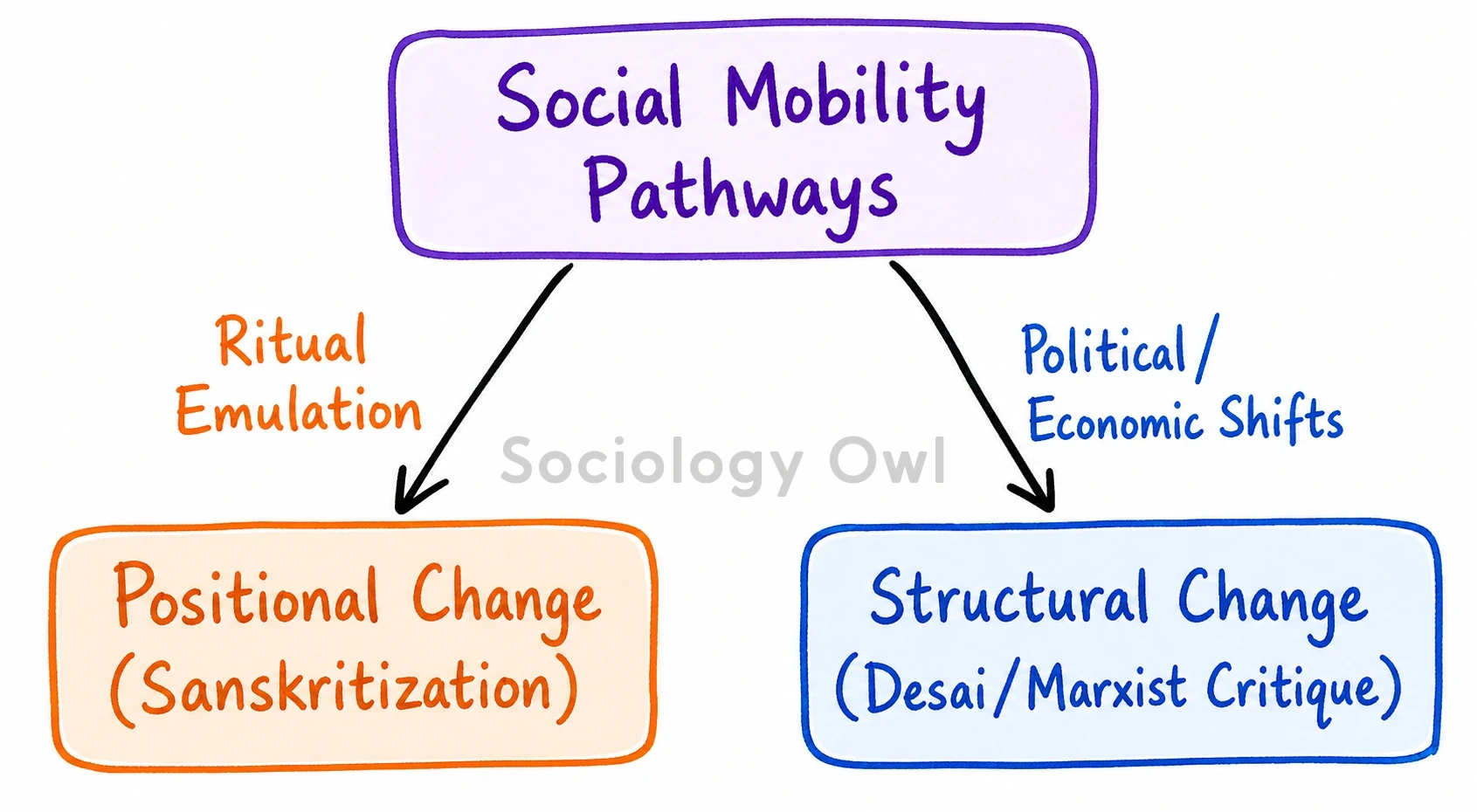
M.N. Srinivas introduced Sanskritization in Religion and Society among the Coorgs of South India (1952) to describe lower castes emulating upper-caste rituals for upward mobility. Yogendra Singh rightly characterizes this as merely a “positional change, not structural change” within the caste hierarchy.
Illustrations of Sanskritization
Robert Hardgrave: Studied upward mobility among Nadars of Tamil Nadu via adopting vegetarianism and Brahminical practices.
David Hardiman: Documented Adivasi purification attempts through the Devi movement in Gujarat.
Critical Examination
Subaltern Critique: Kancha Ilaiah views it as cultural hegemony (“Brahmanization”) that forces lower castes to abandon egalitarian practices for patriarchal, hierarchical upper-caste norms.
Marxist Critique: A.R. Desai argues that genuine upward mobility stems from shifts in the political economy and land ownership, not cultural emulation.
Counter-Processes: D.N. Majumdar highlighted De-Sanskritization, where upper castes abandon orthodox rituals for Western secular lifestyles.
Today, social mobility relies more on politicization, Constitutional reservations, and Dalit assertion. However, Neo-Sanskritization persists, visible in subaltern classes adopting dowry-heavy weddings or leading upper-caste religious processions (Kanwar Yatra).
Conclusion
While Sanskritization remains a foundational heuristic for understanding historical social mobility, contemporary Indian society is increasingly transformed by democratic secular-political empowerment rather than ritualistic cultural emulation.