Model Answer:
Kinship rests on two structural pillars. Descent, rooted in Structural-Functionalism (A.R. Radcliffe-Brown, Meyer Fortes), traces ancestry to form corporate kin groups, seen in India as patrilineal Vamsha or matrilineal Tarawad. Alliance, grounded in Structuralism (Claude Le9vi-Strauss), emphasizes affinal ties through the exchange of women. Louis Dumont emphasizes that in South India, alliance is not a secondary event but the foundational structure of kinship.
North versus South Indian Kinship
In Kinship Organization in India, Iravati Karve outlines stark contrasts between Northern (Indo-Aryan) and Southern (Dravidian) zones:
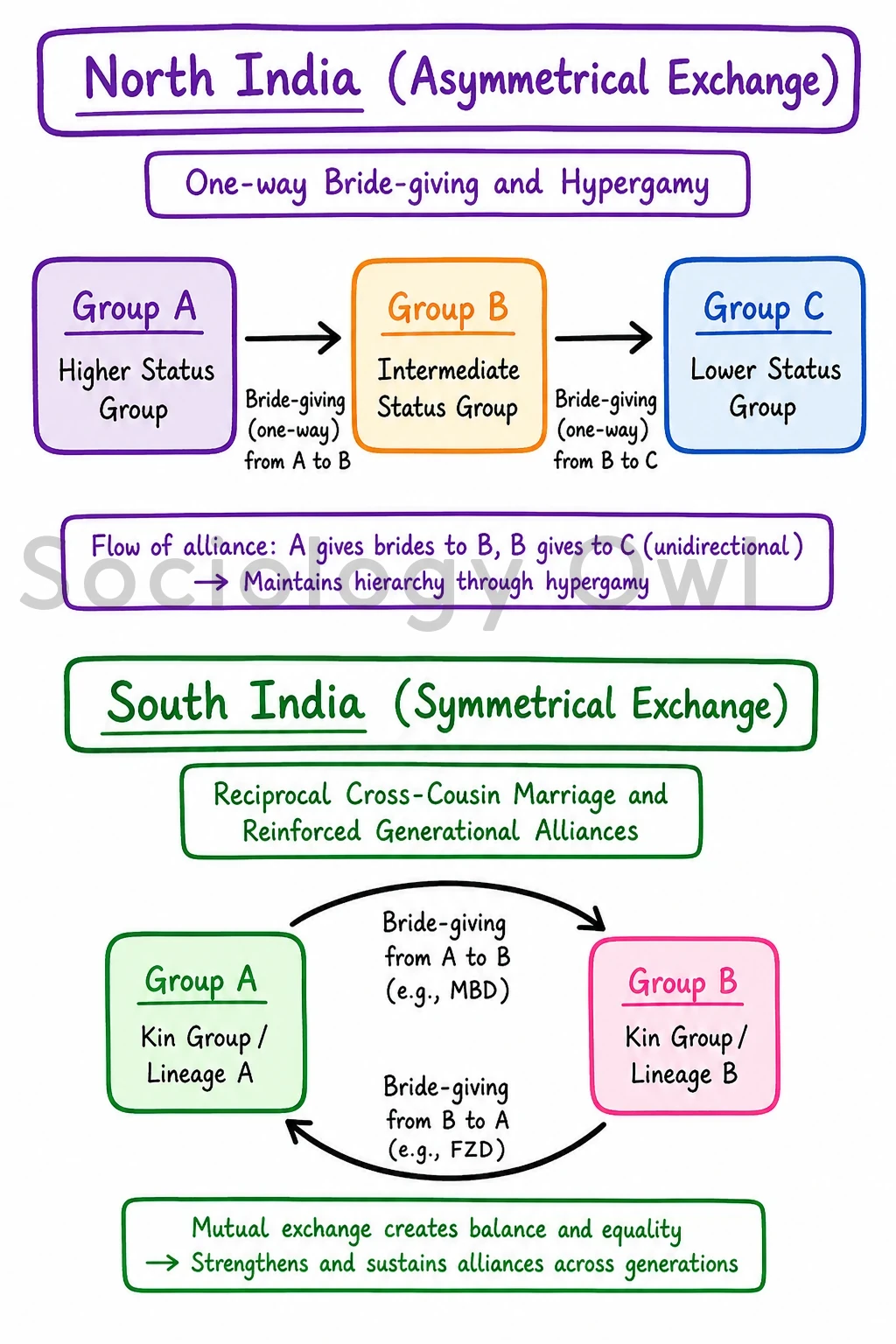
- Marriage Rules & Exogamy: North India enforces negative rules, specifically Gotra, Sapinda, and village exogamy. South India encourages positive rules, like cross-cousin and uncle-niece marriages.
- Terminology: Thomas Trautmann notes the Dravidian system uses classificatory terms distinguishing parallel kin from cross-cousins (potential spouses), unlike the descriptive Northern terminology.
- Hierarchy vs. Isogamy: Northern alliances practice Hypergamy, rendering bride-givers inferior. South India favors isogamy among equals, despite historical hypergamous exceptions like the matrilineal Nambudiri-Nayar Sambandham.
- Women’s Status: Northern women migrate to “stranger” families, facing drastic social isolation. Southern women marry into familiar kin circles, ensuring greater autonomy.
(Note: Karve identifies a “Central Zone” blending both regional practices).
Urbanization and migration are blurring rigid regional boundaries. Legally, the Hindu Marriage Act (1955) prohibits Northern Sapinda unions but accommodates Southern cross-cousin marriages as “customary law.” Furthermore, A.M. Shah observes that while household dimensions shrink, kinship alliances remain resilient, merely adapting to modern institutions like caste-based matrimonial portals.
Conclusion
While descent and alliance historically provided a rigid structural grammar for Indian society, modernization and legal reforms are transforming kinship from a system of strict obligations into dynamic, negotiated social networks.