Model Answer:
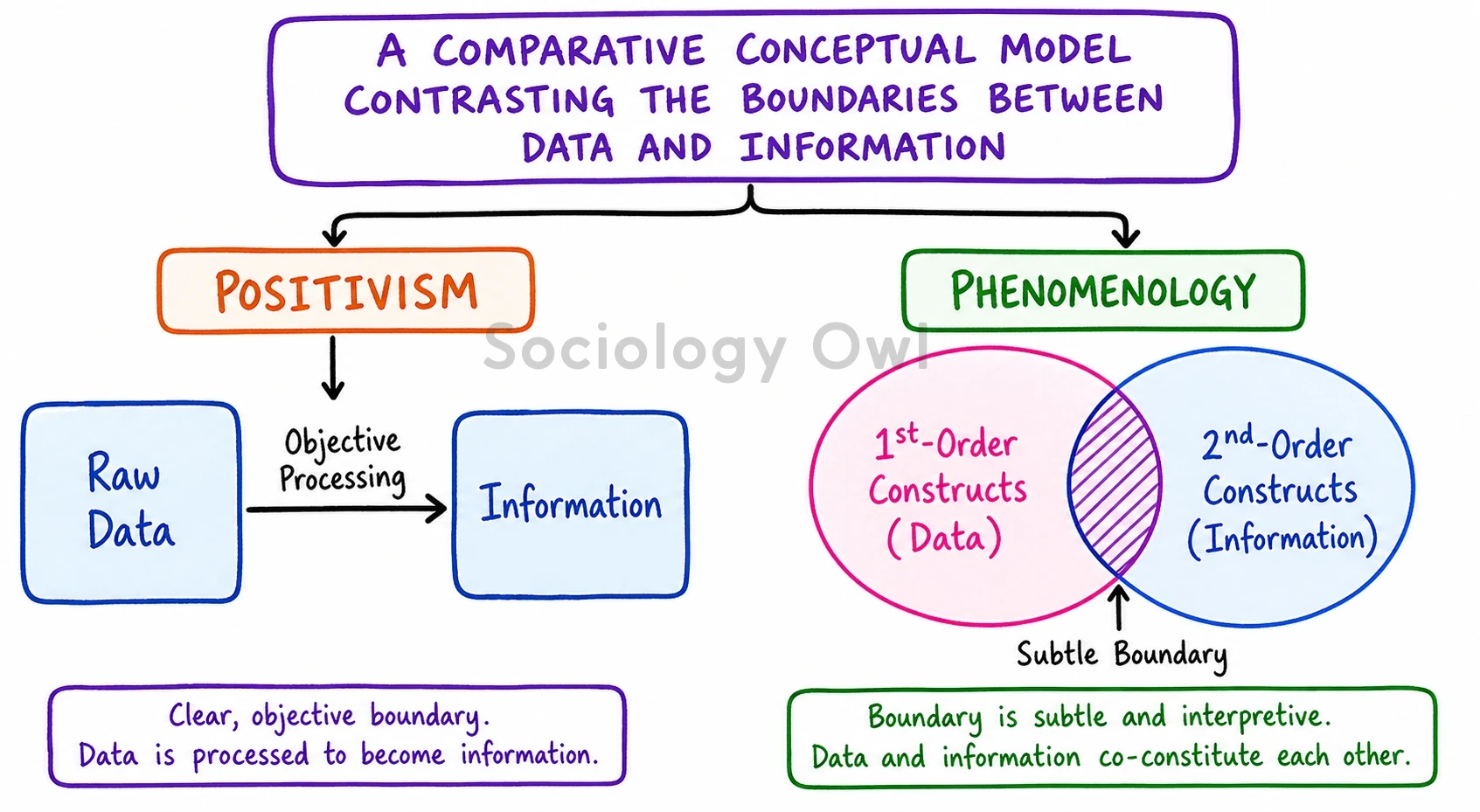
Data comprises raw, unprocessed facts, whereas information is interpreted data yielding meaning. In sociology, this distinction is subtle because social actions inherently carry subjective human context, unlike matter in natural sciences.
Positivism
The distinction is clear in positivism. For Émile Durkheim in Suicide, raw police statistics were data; correlating them to social integration generated sociological information.
Phenomenology
Alfred Schutz explains the subtlety, arguing that human “raw data” already possesses meaning assigned by actors (first-order constructs). Sociological “information” is merely a second-order construct, blurring the boundary.
Methodological Nuance
Quantitative surveys mechanically separate data collection from information processing. Conversely, qualitative methods merge them simultaneously, transforming observations directly into insights via Max Weber’s Verstehen.
Today, raw digital footprints constitute Big Data. Through algorithmic processing, this is transformed into predictive behavioral information, driving what Shoshana Zuboff terms Surveillance Capitalism.
Conclusion
Converting data to information is fundamentally epistemological. As Alvin Gouldner notes, it requires stringent reflexivity to prevent a researcher’s theoretical biases from distorting objective reality during interpretation.