Model Answer:
Little Tradition and Great Tradition
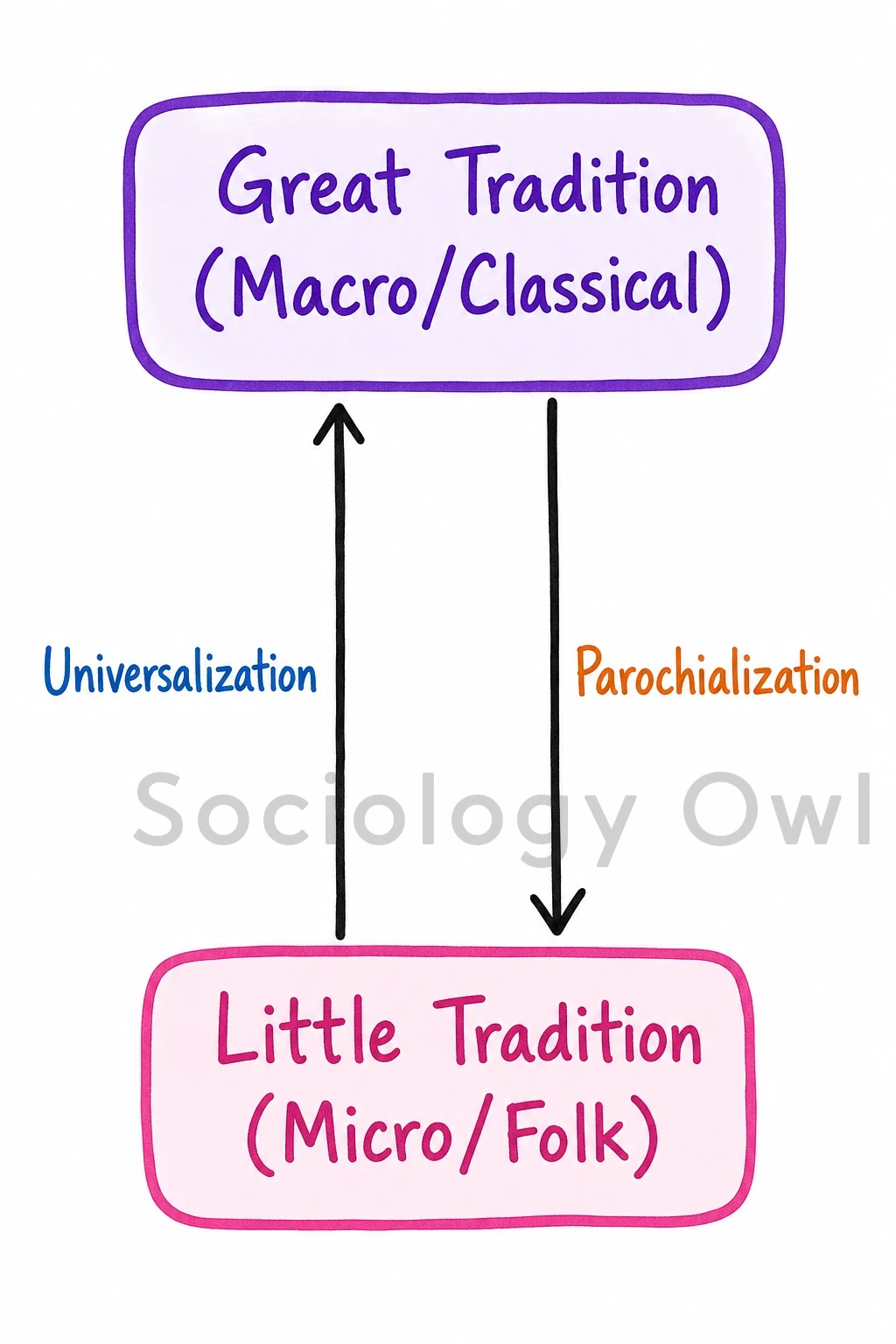
Coined by Robert Redfield, the interaction between classical/textual (Great Tradition) and folk/local practices (Little Tradition) was applied to Indian society by Milton Singer and McKim Marriott.
Mechanisms of Coexistence
McKim Marriott explains this coexistence through twin processes:
- Universalization: Elements of the Little Tradition elevate to the Great Tradition (e.g., Odisha’s tribal deity Jagannath integrating as Lord Vishnu’s avatar).
- Parochialization: Elements of the Great Tradition filter down and localize (e.g., classical Sanskrit epics adapted into regional oral myths).
- Sanskritization: M.N. Srinivas notes how lower castes adopt upper-caste rituals, demonstrating active negotiation for social mobility between the traditions.
Subaltern Critique
Coexistence is not always harmonious. Thinkers like B.R. Ambedkar and Kancha Ilaiah argue this masks cultural hegemony, where Brahmanical practices dominate and appropriate Dalit-Bahujan Little Traditions.
Globalization and media accelerate this interplay. Local village deities now utilize digital platforms (YouTube) to reach global diasporas, while localized folk festivals like Chhath Puja are commercialized into national urban culture.
Conclusion
As Yogendra Singh argues in Modernization of Indian Tradition, contemporary Indian society reflects an adaptive synthesis, seamlessly digesting both traditions without losing its fundamental cultural diversity.