Model Answer:
Variables in Sociology
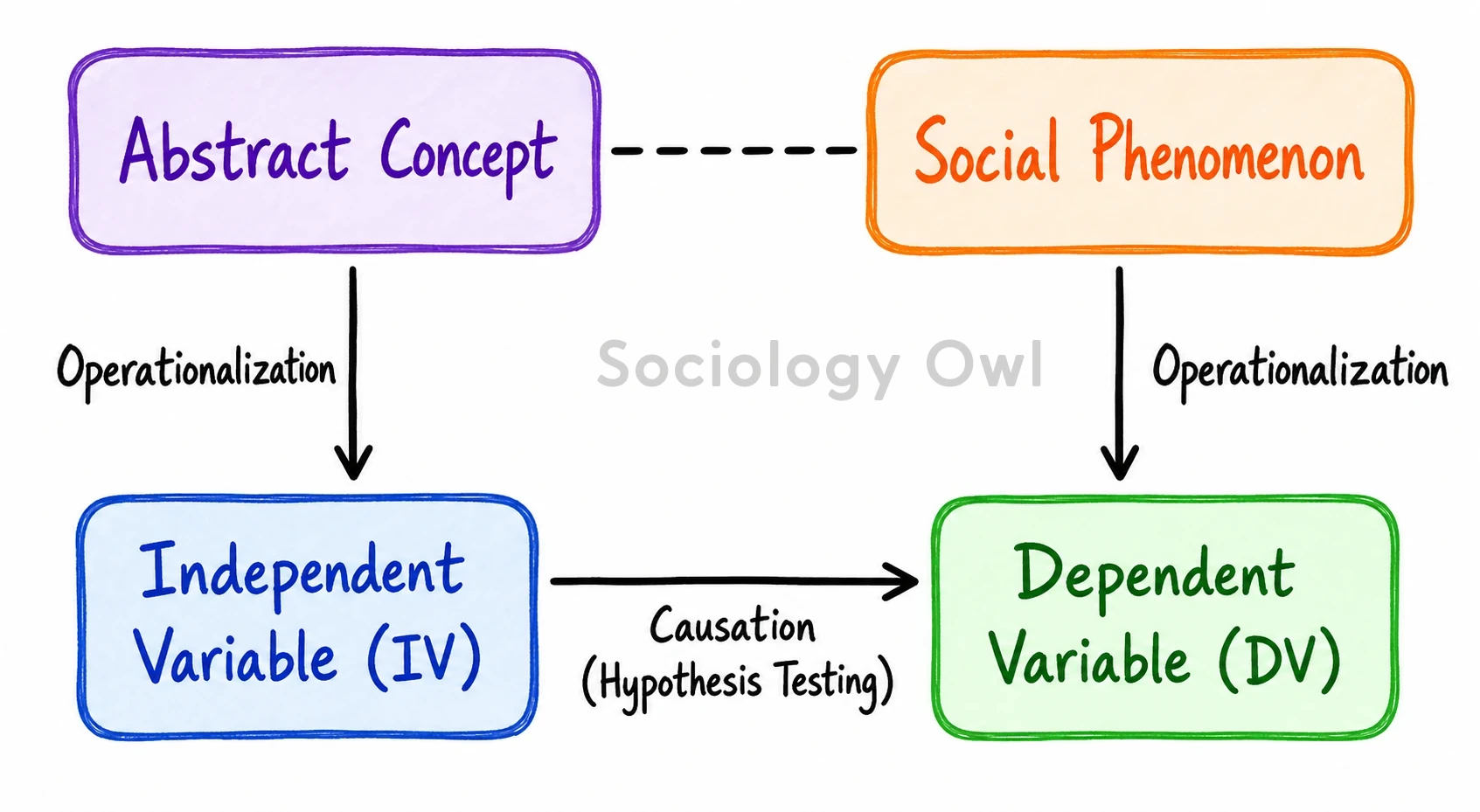
According to Earl Babbie, a variable is a “logical grouping of attributes” taking different values. Through Operationalization, sociologists translate abstract concepts (e.g., social class) into measurable empirical variables (e.g., income levels).
Facilitating Sociological Research
- Empirical Measurement: Variables make abstract phenomena tangible, enabling Positivists to systematically identify trends and compare societies.
- Hypothesis Testing: Researchers establish causal relationships by observing how an Independent Variable (IV) affects a Dependent Variable (DV). In Suicide, Emile Durkheim explicitly correlated the degree of social integration (IV) with societal suicide rates (DV).
- Interpretivist Critique: Phenomenologists and sociologists like Max Weber argue that strictly quantifying human behavior into variables risks Reductionism, often missing the deeper, subjective meanings (Verstehen) behind social actions.
Variables frame modern global studies, such as analyzing the impact of the “algorithm-driven gig economy” (IV) on “worker alienation” (DV).
Conclusion
Despite interpretivist critiques, variables remain the methodological bedrock of objective, replicable research, effectively bridging theoretical sociological constructs with observable empirical realities.