UPSC Mains 2023 GS4 Model Answer

Q. Differentiate ‘moral intuition from ‘moral reasoning’ with suitable examples.

Q. Differentiate ‘moral intuition from ‘moral reasoning’ with suitable examples.

Question from UPSC Mains 2023 GS4 Paper

Model Answer: 

Moral intuition and moral reasoning represent Daniel Kahneman’s “System 1” and “System 2” cognitive processes, both playing distinct but complementary roles in resolving ethical dilemmas.
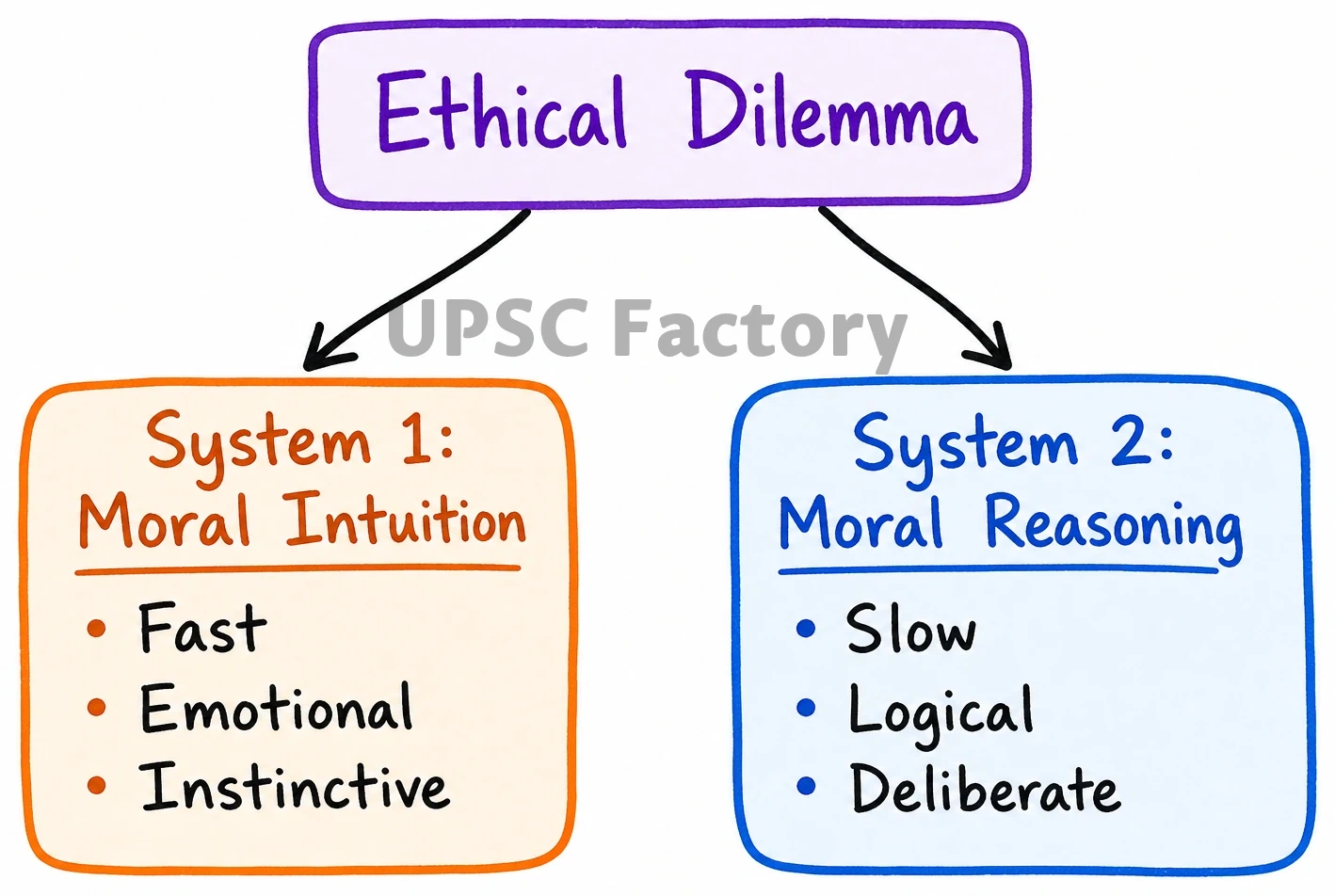
1. Differences: Moral Intuition vs. Moral Reasoning

  • Nature and Speed: Intuition is fast, automatic, and subconscious (affective domain). Reasoning is slow, deliberate, and conscious (cognitive domain).
  • Basis of Action: Intuition relies on ingrained emotions, heuristics, and instincts (Haidt’s Social Intuitionist Model). Reasoning relies on logical principles and ethical frameworks (Utilitarianism, Deontology).
  • Cognitive Load: Intuition demands minimal effort, triggering immediate affective reactions. Reasoning requires high analytical effort to evaluate alternatives and long-term consequences.
  • Susceptibility to Bias: Intuition is highly prone to unconscious prejudices (e.g., in-group favoritism). Reasoning actively mitigates these biases through objective, evidence-based scrutiny.

2. Contextual Examples

  • Moral Intuition: A bystander instantly jumping into a turbulent river to save a drowning child without calculating personal risk (spontaneous, empathetic altruism).
  • Moral Reasoning: A public administrator designing equitable COVID-19 vaccine triage protocols by rationally weighing socio-economic vulnerabilities against resource constraints (analytical policy-making).

While moral intuition provides the immediate empathetic compass for human action, moral reasoning serves as the essential rational anchor, ensuring decisions remain universally just, objective, and ethically sound.

Q. Differentiate ‘moral intuition from ‘moral reasoning’ with suitable examples. Read More »
Q. What really matters for success, character, happiness and lifelong achievements is a definite set of emotional skills – your EQ- not just purely cognitive abilities that are measured by conventional IQ tests.” Do you agree with this view ? Give reasons in support of your answer

Q. What really matters for success, character, happiness and lifelong achievements is a definite set of emotional skills – your EQ- not just purely cognitive abilities that are measured by conventional IQ tests.” Do you agree with this view ? Give reasons in support of your answer

Question from UPSC Mains 2023 GS4 Paper

Model Answer: 

I completely agree with Daniel Goleman’s assertion. While IQ provides baseline cognitive competence, Emotional Intelligence (EQ) dictates holistic, lifelong success.

1. Reasons EQ Outperforms IQ in Life Outcomes

  • Professional Success: Enables empathetic leadership, teamwork, and crisis management (e.g., MS Dhoni’s renowned composure under extreme pressure).
  • Character Building: High self-awareness and self-regulation align daily actions with ethical values, fostering integrity (e.g., accepting moral accountability).
  • Happiness & Well-being: Better social skills build stronger interpersonal relationships, resolve conflicts, and ensure emotional resilience against stress.
  • Lifelong Achievements: Drives purposeful social contribution through affective empathy (e.g., IAS Armstrong Pame’s empathy-driven, citizen-funded ‘People’s Road’).

2. The Synergy: IQ as Foundation, EQ as Driver

  • Door Opener vs. Sustainer: Conventional IQ gets a person hired, but EQ gets them trusted, promoted, and respected.
  • Ethical Execution: IQ designs efficient strategies, but EQ ensures humane, citizen-centric, and inclusive delivery.

Ultimately, conventional IQ measures a person’s cognitive horsepower, but EQ provides the steering wheel—ensuring a resilient, ethical, and fulfilling life journey.

Q. What really matters for success, character, happiness and lifelong achievements is a definite set of emotional skills – your EQ- not just purely cognitive abilities that are measured by conventional IQ tests.” Do you agree with this view ? Give reasons in support of your answer Read More »

Q. Do not hate anybody, because that hatred that comes out from you must, in the long run, come back to you. If you love, that love will come back to you, completing the circle.” – Swami Vivekanand.

Q. Do not hate anybody, because that hatred that comes out from you must, in the long run, come back to you. If you love, that love will come back to you, completing the circle.” – Swami Vivekanand.

Question from UPSC Mains 2023 GS4 Paper

Model Answer: 

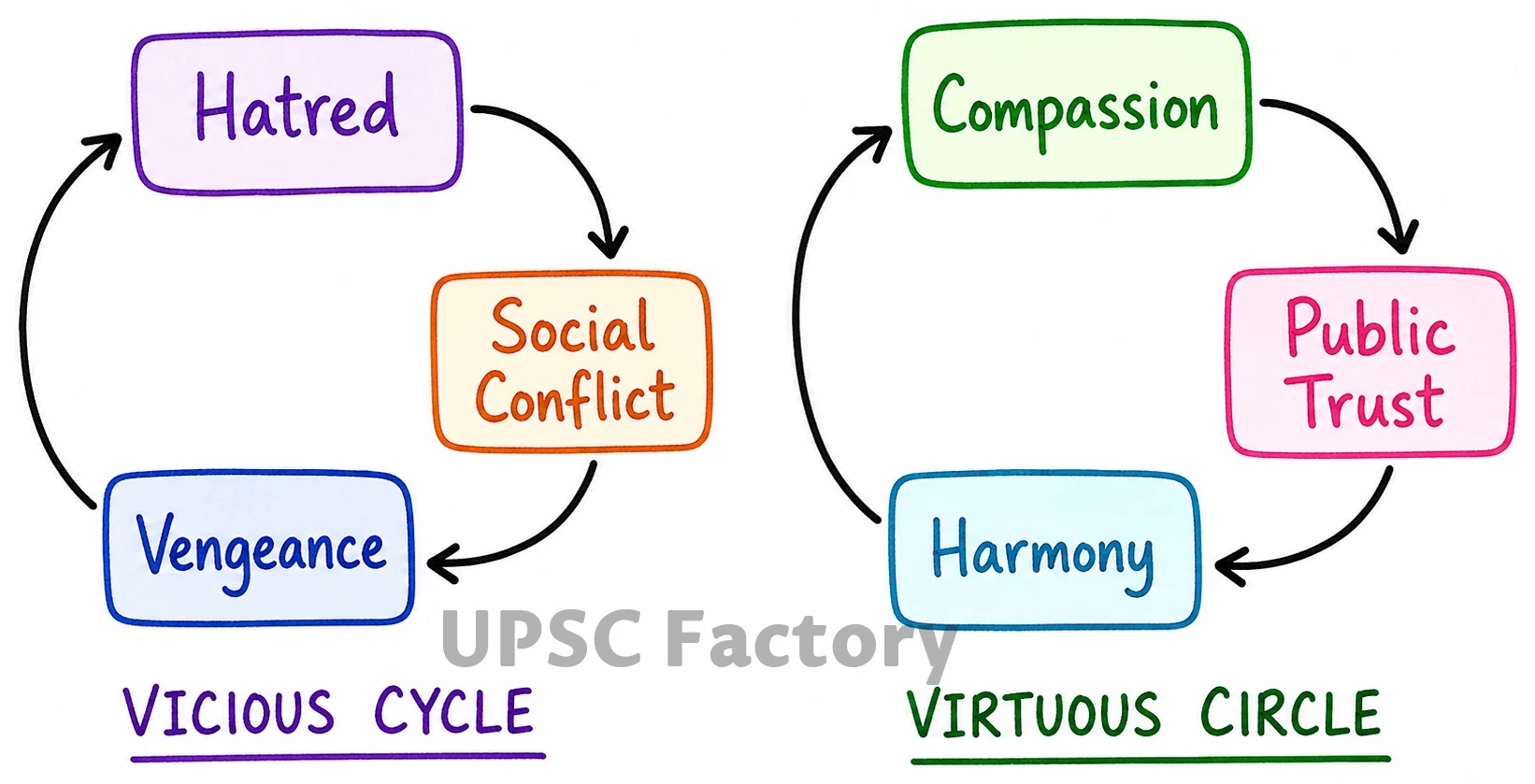
Swami Vivekananda’s quote underscores the universal Law of Reciprocity, emphasizing that our emotions and actions inevitably return to us, shaping our moral reality.

1. Philosophical Essence: The Cycle of Karma

  • Law of Cause and Effect: Emotions act as seeds producing identical fruits, ensuring a cyclical return of energy (Karma).
  • The Golden Rule: Aligns with Kant’s Categorical Imperative, advocating that we must treat others exactly as we wish to be treated.
  • Psychological Impact: Hatred acts as a self-consuming emotional poison, whereas radiating love cultivates inner peace and moral elevation.

2. Contemporary Relevance in Governance and Society

  • Restorative Justice: Compassion and forgiveness break generational chains of vengeance (e.g., Nelson Mandela’s Truth and Reconciliation Commission).
  • Communal Harmony: Countering social polarization with active fraternity builds resilient, united communities (e.g., peace-building via Mohalla Committees).
  • Empathetic Administration: Civil servants projecting empathy generate reciprocal public trust, enhancing cooperative governance and social capital.
  • Emotional Intelligence: Consciously regulating destructive emotions like anger or hatred ensures objective, citizen-centric decision-making.

Embracing this philosophy transforms human interactions from vicious cycles of retaliation into virtuous circles of compassion, laying the foundation for an ethical, peaceful society.

Q. Do not hate anybody, because that hatred that comes out from you must, in the long run, come back to you. If you love, that love will come back to you, completing the circle.” – Swami Vivekanand. Read More »

Q. “To awaken the people, it is the women who must be awakened. Ones she is on the move, the family moves, the village moves, the nation moves.” – Jawaharlal Nehru

Q. “To awaken the people, it is the women who must be awakened. Ones she is on the move, the family moves, the village moves, the nation moves.” – Jawaharlal Nehru

Question from UPSC Mains 2023 GS4 Paper

Model Answer: 

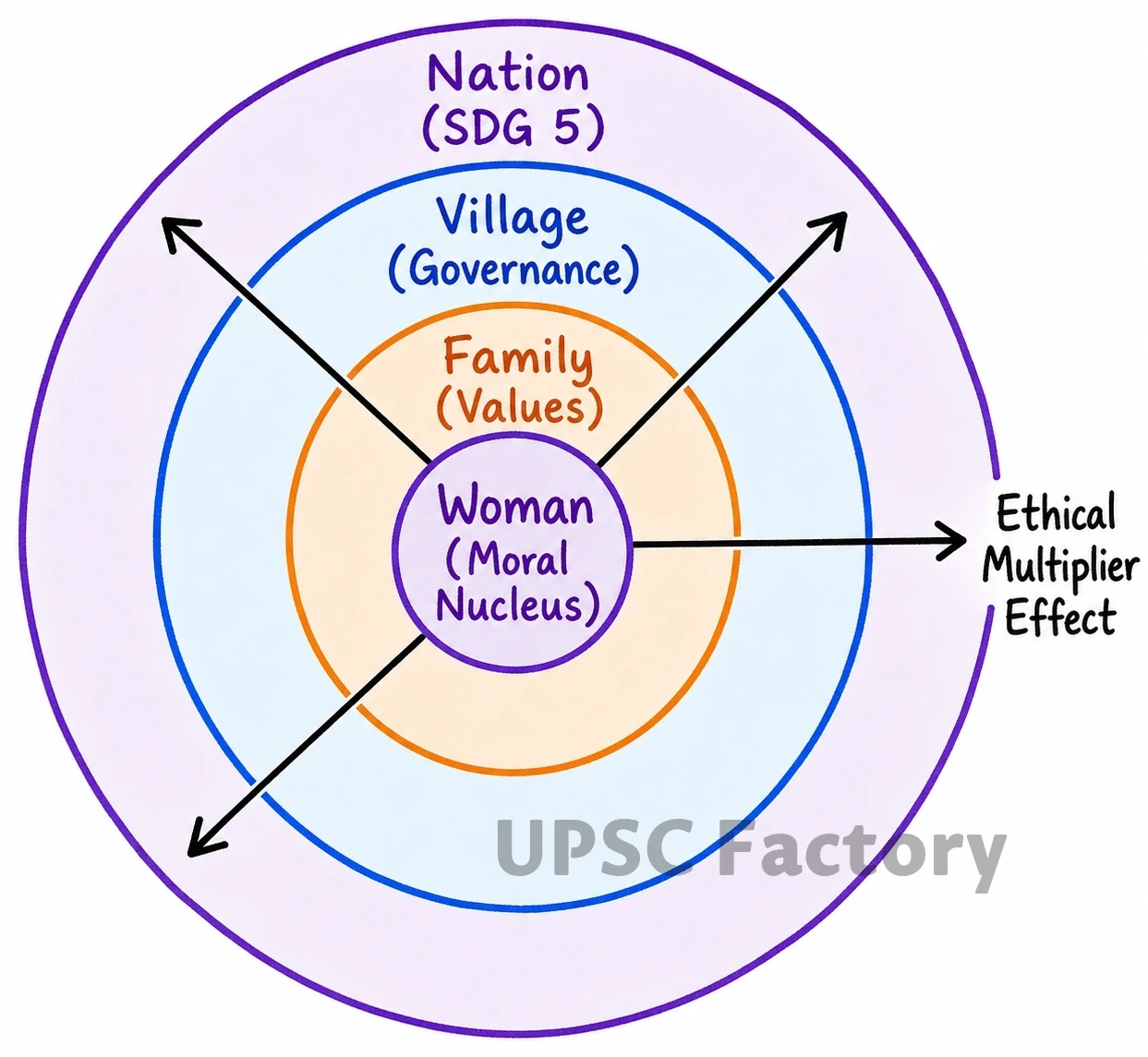
Nehru’s quote highlights the “multiplier effect” of women’s empowerment, framing them not merely as welfare beneficiaries, but as primary catalysts for socio-ethical transformation (Amartya Sen’s ‘Women’s Agency’).

1. Women as the Nucleus of Ethical Awakening

  • Moral Socialization: Act as primary socializers, inculcating foundational civic values like compassion and integrity in the next generation (Jijabai shaping Shivaji).
  • Resource Allocation: Financial and social independence translates directly into better familial health and education, breaking intergenerational poverty cycles.

2. The Cascading Transformation (Village to Nation)

  • Grassroots Governance: Political empowerment at the village level ensures inclusive, ethics-driven, and transparent public policy (Panchayati Raj, Article 15(3)).
  • Economic Resilience: Driving local sustainable economies and rural upliftment through cooperative micro-entrepreneurship (Ela Bhatt’s SEWA model).
  • Social Capital: Collective female mobilization acts as a bulwark against systemic social evils and deep-rooted deprivation (Kerala’s Kudumbashree poverty eradication).

Realizing SDG 5 (Gender Equality) is an absolute ethical imperative, serving as the foundational bedrock for building a just, resilient, and prosperous “New India”.

Q. “To awaken the people, it is the women who must be awakened. Ones she is on the move, the family moves, the village moves, the nation moves.” – Jawaharlal Nehru Read More »

Q. “The simplest acts of kindness are by far more powerful than a thousand heads bowing in prayer.” – Mahatma Gandhi

Q. “The simplest acts of kindness are by far more powerful than a thousand heads bowing in prayer.” – Mahatma Gandhi

Question from UPSC Mains 2023 GS4 Paper

Model Answer:

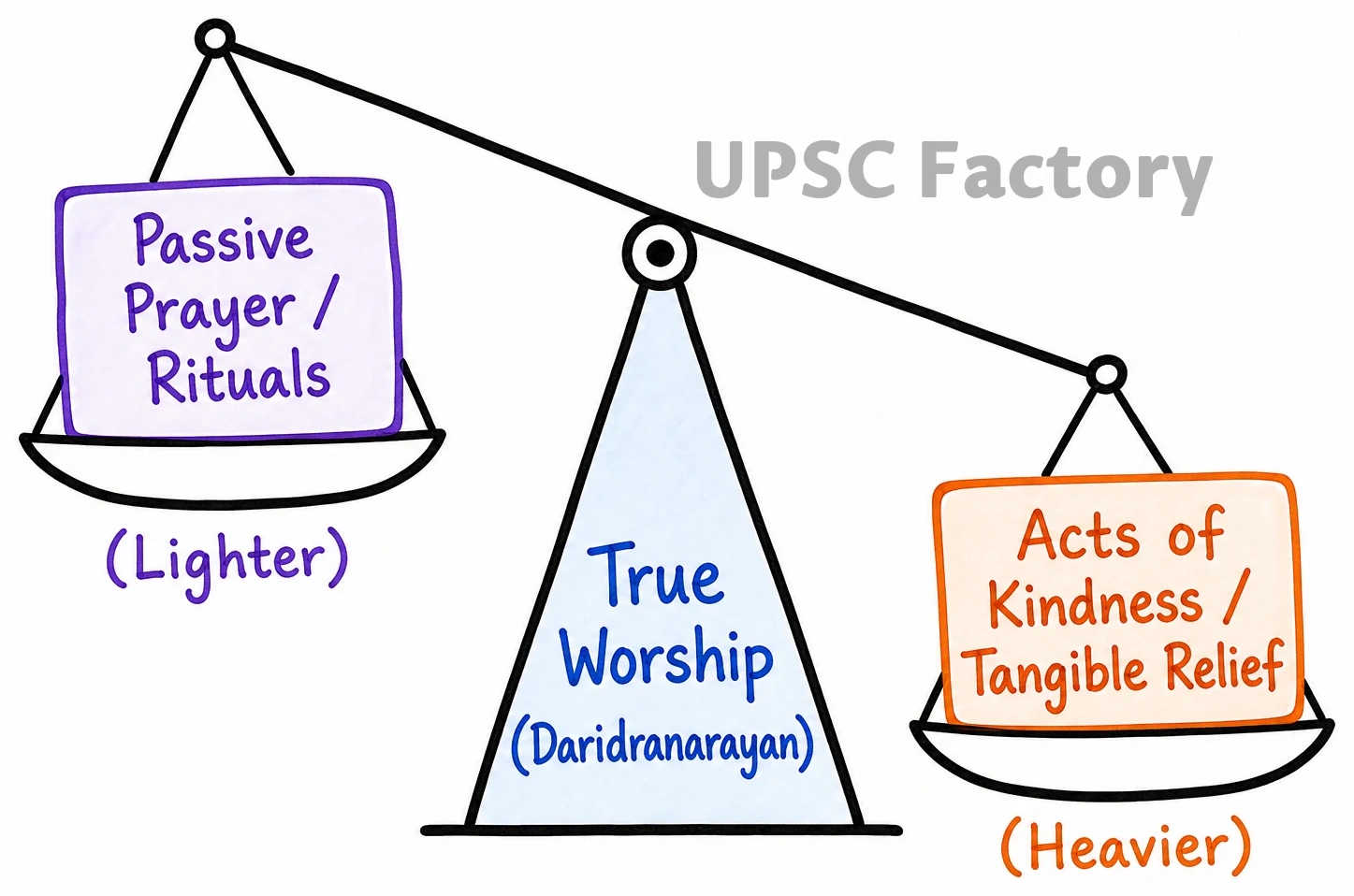
Gandhi’s quote emphasizes that true ethics lies in tangible altruism rather than mere ritualistic devotion, equating human service to divine worship (Daridranarayan).

1. Action-Oriented Morality over Ritualism

  • Tangible Relief: Acts of kindness directly alleviate human suffering, whereas passive prayer offers only psychological solace.
  • Secular Altruism: Compassionate action transcends religious dogmas, promoting universal, inclusive humanism.
  • Empathy in Action: True devotion requires actively uplifting the vulnerable (e.g., Mother Teresa serving the destitute as true worship).
  • Nishkama Karma: Selfless, practical service validates moral integrity far better than theoretical or performative piety.

2. Relevance in Public Administration

  • Humanizing Bureaucracy: Shifting from rigid administrative apathy to compassionate, citizen-centric problem-solving.
  • Proactive Welfare: Prioritizing tangible last-mile delivery over mere policy drafting (e.g., IAS Armstrong Pame crowd-funding the ‘People’s Road’ in Manipur).
  • Restoring Dignity: Small acts of administrative kindness build immense public trust and democratic social capital.
  • Ethical Leadership: Inspiring collective societal change through visible, empathetic actions rather than mere bureaucratic rhetoric.

Ultimately, “ethics in action” is the highest form of spiritual and moral duty. Embedding active compassion in governance remains essential for building a truly just and empathetic society.

Q. “The simplest acts of kindness are by far more powerful than a thousand heads bowing in prayer.” – Mahatma Gandhi Read More »

Q. In the context of work environment, differentiate between ‘coercion’ and ‘undue influence’ with suitable examples.

Q. In the context of work environment, differentiate between ‘coercion’ and ‘undue influence’ with suitable examples.

Question from UPSC Mains 2023 GS4 Paper

Model Answer: 

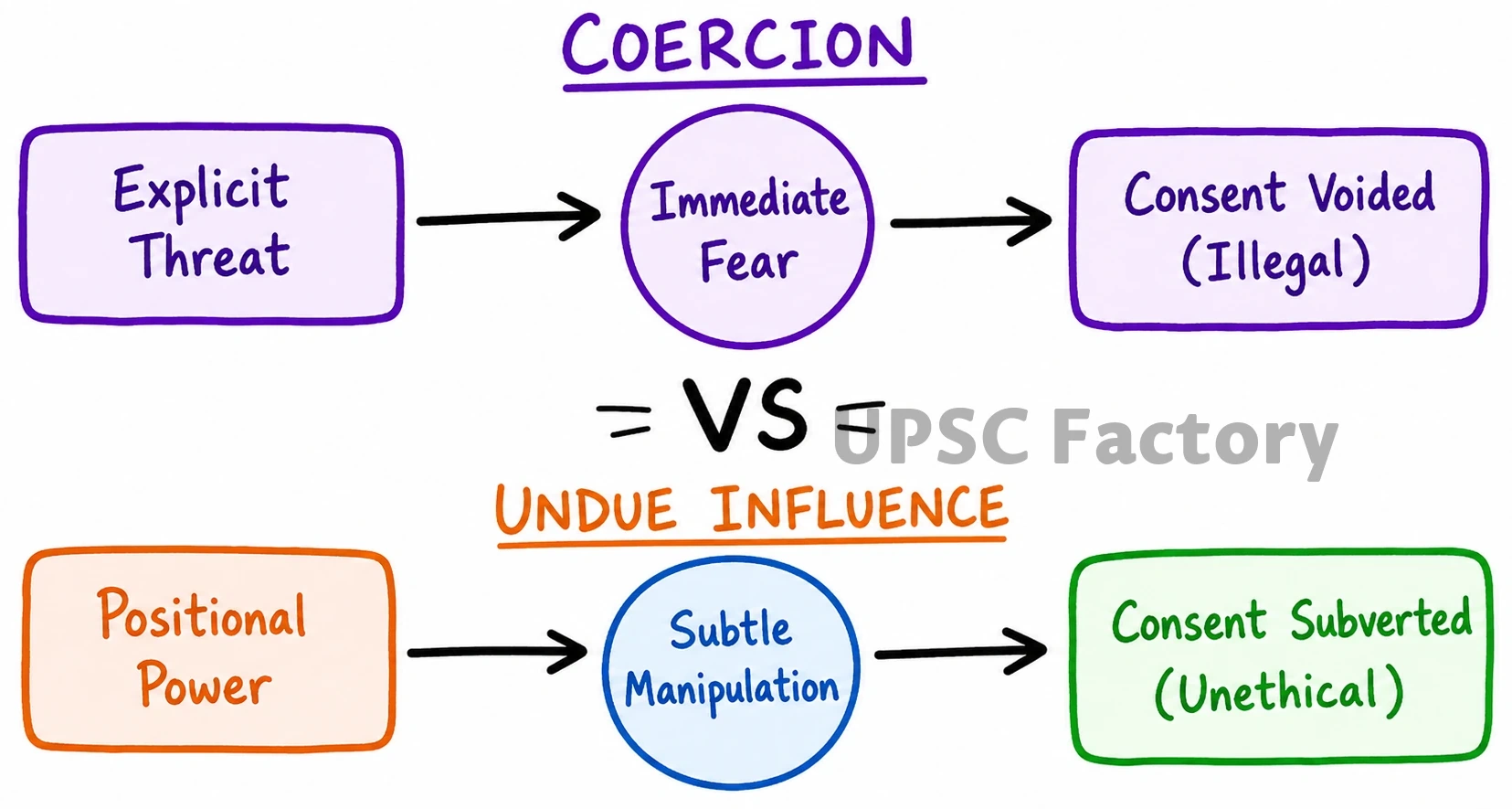
Coercion and undue influence both violate an employee’s free will, but differ substantially in their legal nature and psychological execution within organizational ethics.

1. Key Differences in the Workplace

  • Nature of Force: Coercion uses explicit threats or penal actions (Sec 15, Indian Contract Act). Undue influence leverages psychological or moral manipulation (Sec 16, ICA).
  • Relationship Dependency: Coercion requires no specific relationship (can occur between peers). Undue influence strictly exploits a pre-existing hierarchical or fiduciary dynamic (manager-subordinate).
  • Consent Subversion: Coercion wholly obliterates consent through immediate fear. Undue influence subtly overrides independent judgment by exploiting trust or career anxiety.
  • Legality & Action: Coercion typically involves explicitly illegal acts (e.g., criminal intimidation). Undue influence relies on unethical exploitation of authority (e.g., emotional blackmail).

2. Contextual Workplace Examples

  • Coercion: A manager threatening an accountant with immediate, unjustified termination or physical harm unless they doctor corporate tax reports.
  • Undue Influence: A senior director subtly manipulating a junior executive’s promotion aspirations to steal sole credit for a presentation, implicitly conditioning future mentorship on compliance.

Fostering psychological safety, enforcing stringent POSH Act guidelines, and establishing anonymous whistleblowing mechanisms are essential to eliminate both malpractices and ensure ethical corporate governance.

Q. In the context of work environment, differentiate between ‘coercion’ and ‘undue influence’ with suitable examples. Read More »
Q. “Corruption is the manifestation of the failure of core values in the society.” In your opinion, what measures can be adopted to uplift the core values in the society?

Q. “Corruption is the manifestation of the failure of core values in the society.” In your opinion, what measures can be adopted to uplift the core values in the society?

Question from UPSC Mains 2023 GS4 Paper

Model Answer: 

Corruption stems from an internal ethical deficit, where greed and nepotism overpower integrity, reflecting a broader moral decay within society.

Corruption as a Manifestation of Value Failure

  1. Materialism over Morality: Societal success is increasingly measured by wealth, ignoring the ethical means of acquisition (Gandhian ‘Wealth without Work’).
  2. Erosion of Public Duty: Lack of selflessness transforms public office from a service platform into a tool for personal aggrandizement.

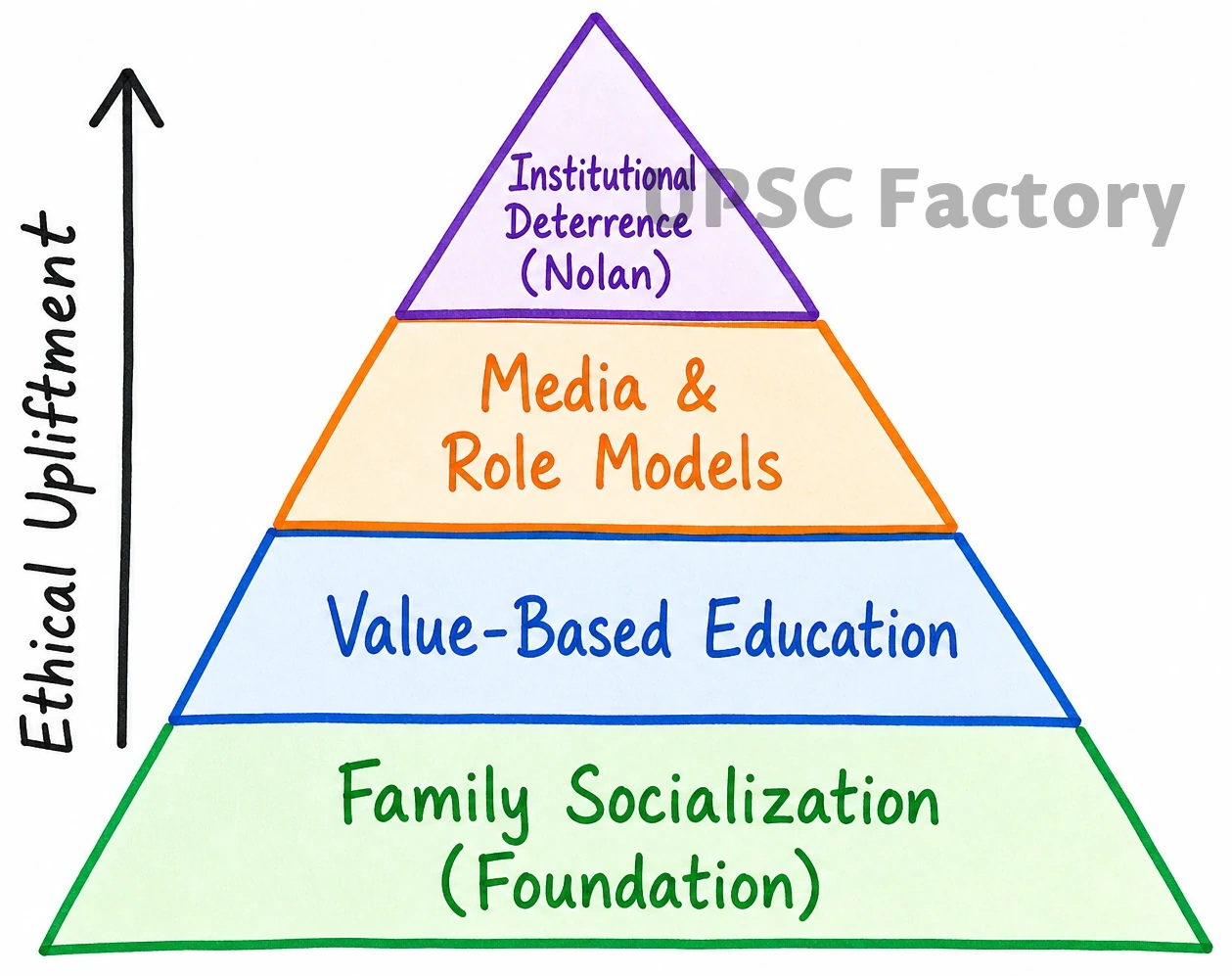
Measures to Uplift Core Societal Values

  1. Family Socialization: Parents must actively model integrity and reject consumerism to build strong early moral compasses.
  2. Value-Based Education: Integrate experiential ethics and civic duties into early school pedagogy (e.g., Japan’s Tokkatsu system).
  3. Social Influence & Persuasion: Shift societal prestige from financial wealth to ethical character by celebrating moral icons (e.g., E. Sreedharan).
  4. Institutionalizing Nolan Principles: Enforce objectivity, accountability, and honesty in governance through structural deterrence (e.g., 2nd ARC recommendations).
  5. Media & Cultural Realignment: Media must de-glorify unethical accumulation of wealth and actively promote community-centric virtues.

Rebuilding core values demands a synergistic blend of foundational ethical socialization and strict institutional deterrence to achieve a corruption-free Surajya.

Q. “Corruption is the manifestation of the failure of core values in the society.” In your opinion, what measures can be adopted to uplift the core values in the society? Read More »

Q. What do you understand by ‘moral integrity’ and ‘professional efficiency in the context of corporate governance in India ? Illustrate with suitable examples.

Q. What do you understand by ‘moral integrity’ and ‘professional efficiency in the context of corporate governance in India ? Illustrate with suitable examples.

Question from UPSC Mains 2023 GS4 Paper

Model Answer: 

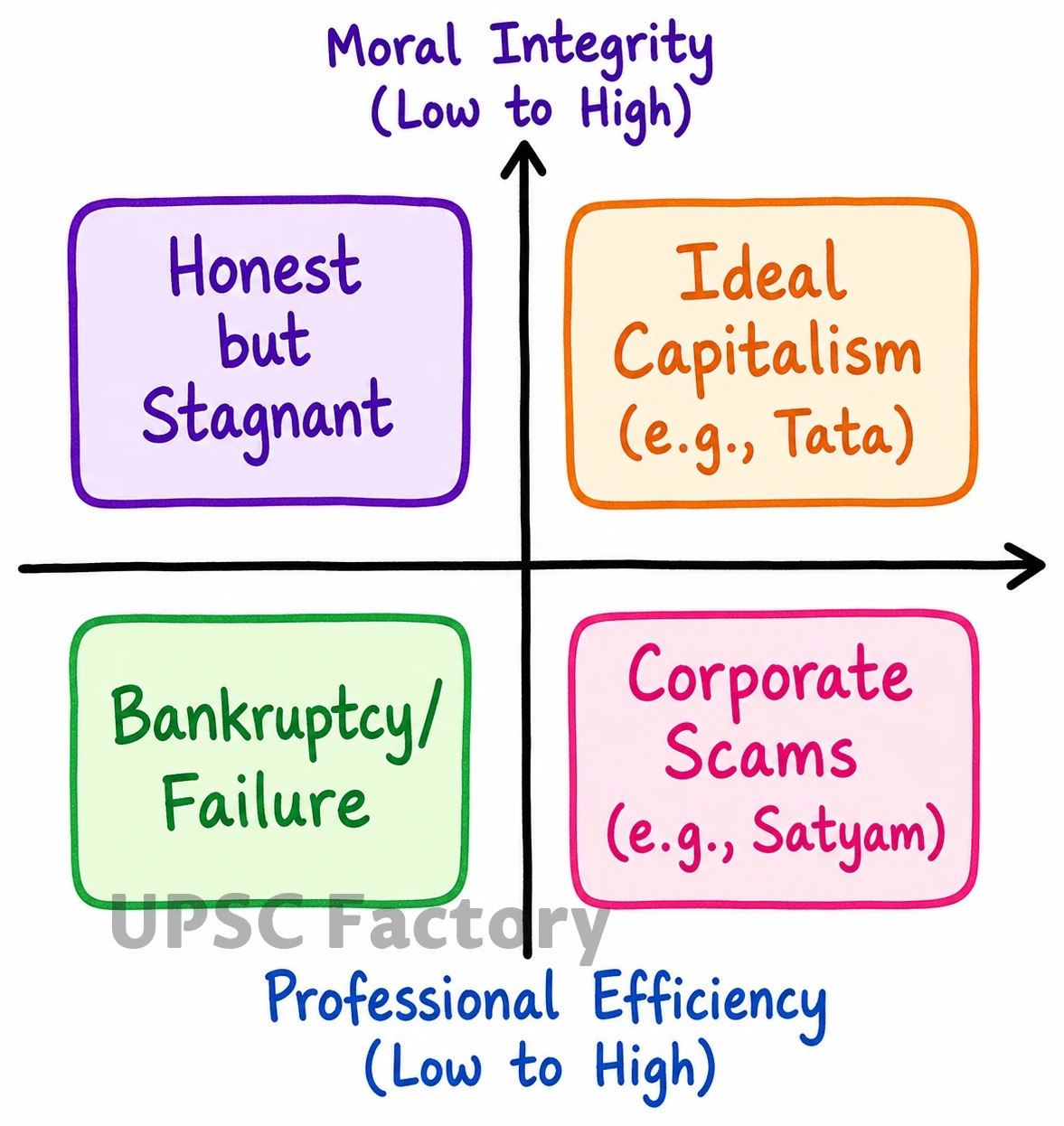
Corporate governance balances stakeholder trust and business viability through the twin pillars of ethical conduct and operational competence.

1. Moral Integrity in Corporate Governance

It signifies adherence to ethical principles, unyielding honesty, and prioritizing fiduciary duties over personal gains.

  • Fiduciary Accountability: Safeguarding minority shareholders against promoter malfeasance (Satyam scam highlights the disastrous absence of this).
  • Zero Conflict of Interest: Unbiased decision-making and objective oversight by Independent Directors (Uday Kotak Committee norms).
  • Truthful Disclosures: Honest financial reporting and stringent ESG compliance (Infosys’s historic benchmarks in proactive transparency).
  • Value-Based Leadership: Sustaining societal trust by consistently doing the right thing (Tata Group’s enduring ethical legacy and philanthropy).

2. Professional Efficiency in Corporate Governance

It involves the optimal utilization of corporate resources to maximize profitability, innovation, and long-term shareholder value.

  • Resource Optimization: Achieving high output with minimal cost and waste (L&T’s timely and cost-effective infrastructure execution).
  • Risk Management: Pre-empting market volatilities to ensure stable returns (HDFC Bank’s robust credit-risk protocols).
  • Statutory Competence: Executing legal and operational mandates purposefully (Duties of Directors under Section 166, Companies Act 2013).
  • Agility & Adaptability: Swift, competent responses to systemic disruptions (TCS’s operational resilience and pivot during COVID-19).

Moral integrity ensures organizational legitimacy, while professional efficiency ensures market survival. Together, they foster responsible capitalism, echoing Gandhi’s philosophy of Trusteeship in the modern Indian corporate sector.

Q. What do you understand by ‘moral integrity’ and ‘professional efficiency in the context of corporate governance in India ? Illustrate with suitable examples. Read More »
Q. ‘International aid’ is an accepted form of helping ‘resource-challenged’ nations. Comment on ‘ethics in contemporary international aid’.  Support your answer with suitable examples.

Q. ‘International aid’ is an accepted form of helping ‘resource-challenged’ nations. Comment on ‘ethics in contemporary international aid’.  Support your answer with suitable examples.

Question from UPSC Mains 2023 GS4 Paper

Model Answer: 

International aid is ethically rooted in cosmopolitanism and global solidarity, aiming to rectify historical inequalities and uphold universal human dignity.

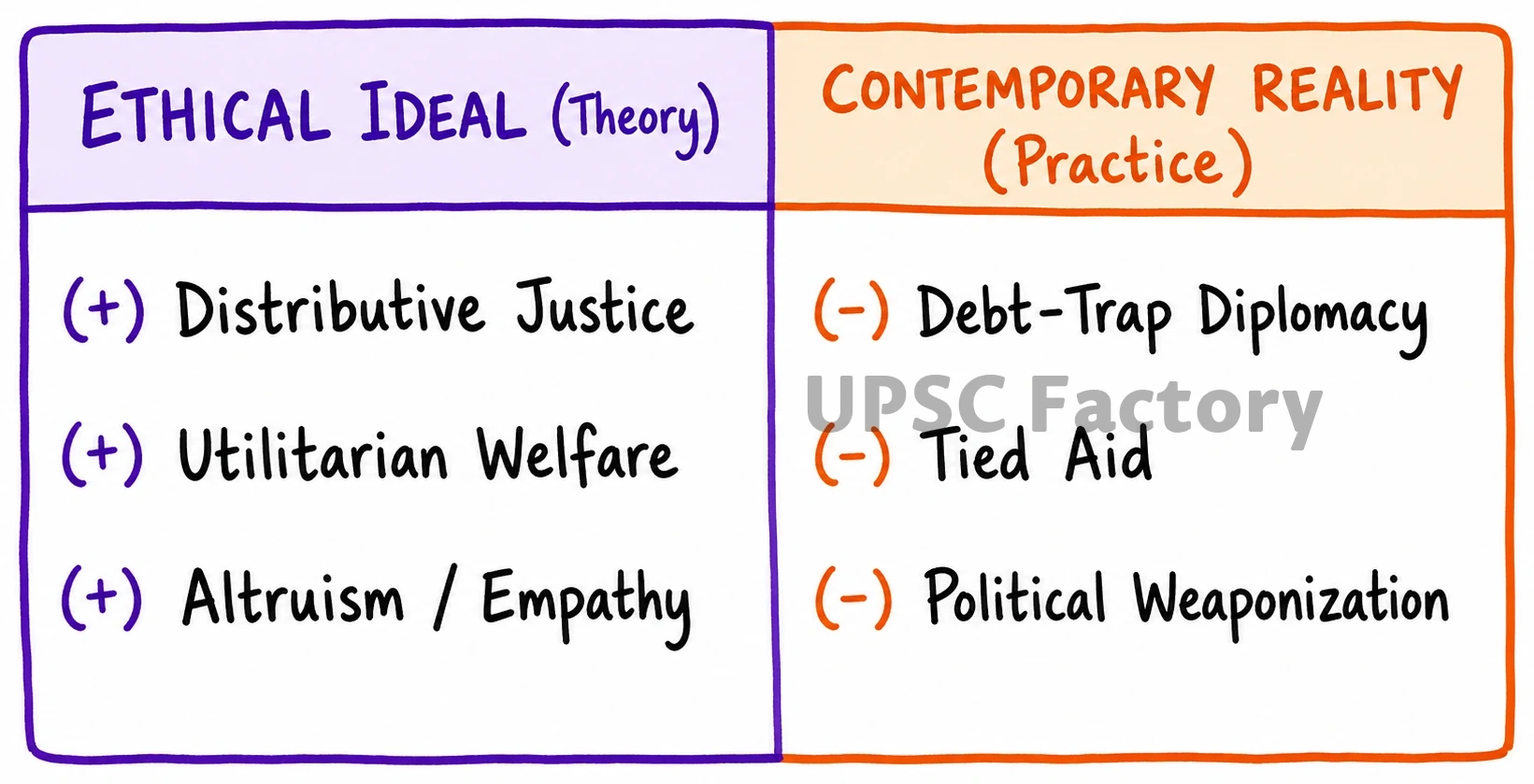
1. Ethical Foundations of Aid (The Ideal)

  • Distributive Justice: Fulfilling the moral obligation to assist globally disadvantaged populations (Rawlsian theory applied internationally).
  • Utilitarian Welfare: Maximizing global happiness by eradicating extreme poverty, malnutrition, and disease.
  • Altruism & Empathy: Selfless assistance prioritizing human life over strategic geopolitical gains (India’s unconditional ‘Vaccine Maitri’ during COVID-19).

2. Ethical Deficits in Contemporary Aid (The Reality)

  • Debt-Trap Diplomacy: Predatory lending designed to eventually extract recipient sovereignty or strategic assets (China’s Hambantota Port in Sri Lanka).
  • Tied Aid: Forcing recipients to procure goods exclusively from donor countries, severely undermining economic autonomy.
  • Political Weaponization: Utilizing critical humanitarian assistance to extort foreign policy alignments or favorable UN votes.
  • Cultural Imperialism: Imposing alien socio-economic or cultural paradigms through rigid aid conditionalities (IMF structural adjustment programs).

Ethical international aid must transition from transactional charity to transformative partnership, prioritizing genuine capacity-building, recipient autonomy, and unconditional global justice.

Q. ‘International aid’ is an accepted form of helping ‘resource-challenged’ nations. Comment on ‘ethics in contemporary international aid’.  Support your answer with suitable examples. Read More »