UPSC Mains 2026 GS4 Model Answer

Q. Usually schools, working in remote areas, do not fully comply with government regulations. However, if the rules are enforced strictly, it would lead to most schools closing down. How should an administrator strike a balance between enforcement of rules and educational rights of children?

Q. Usually schools, working in remote areas, do not fully comply with government regulations. However, if the rules are enforced strictly, it would lead to most schools closing down. How should an administrator strike a balance between enforcement of rules and educational rights of children?

Question from UPSC Mains 2026 GS4 Paper

Model Answer: 

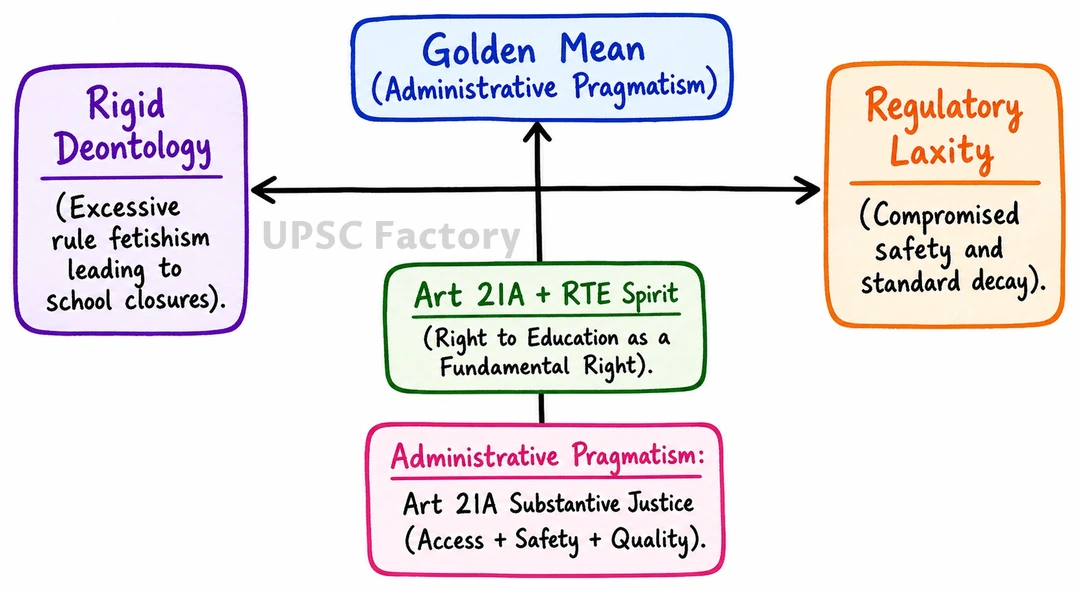
The administrator faces a dilemma between deontological legalism (strict RTE Act compliance) and teleological substantive justice (safeguarding the fundamental right to education under Article 21A).

Core Ethical Dilemma

  • Letter vs. Spirit of Law: Strict closure of non-compliant schools induces educational vacuums, risking child labour and dropouts.
  • Rule Fetishism vs. Pragmatism: Regulations are welfare instruments; enforcing them rigidly without enabling alternatives violates administrative ethics.
Pragmatic Administrative Strategy

  1. Graded Compliance Matrix: Prioritise non-negotiable safety and learning standards (child protection, basic pedagogy); provide provisional recognition with milestones for non-critical infrastructural norms.
  2. Resource Convergence: Upgrade school infrastructure by pooling funds from District Mineral Foundation (DMF), Border Area Development Programme (BADP), and CSR (Aspirational Districts model).
  3. Context-Specific Derogations: Recommend geographic exemptions for remote/hilly terrains under Section 20 of the RTE Act (e.g., relaxed land/playground requirements).
  4. Community Co-Management: Empower School Management Committees (SMCs) and Panchayats to mobilise local resources for low-cost, interim infrastructural compliance.
  5. Mobile & Shared Resource Hubs: Cluster non-compliant satellite schools around central model schools for shared laboratories, sports, and specialized teaching resources.

Administrative pragmatism requires enforcing rules as scaffolding for welfare, harmonising statutory mandates with the non-negotiable right to education.
Q. Usually schools, working in remote areas, do not fully comply with government regulations. However, if the rules are enforced strictly, it would lead to most schools closing down. How should an administrator strike a balance between enforcement of rules and educational rights of children? Read More »

Q. Efficiency is doing things right, while effectiveness is doing the right thing. How do you strike a balance between the two to enhance productivity?

Q. Efficiency is doing things right, while effectiveness is doing the right thing. How do you strike a balance between the two to enhance productivity?

Question from UPSC Mains 2026 GS4 Paper

Model Answer: 

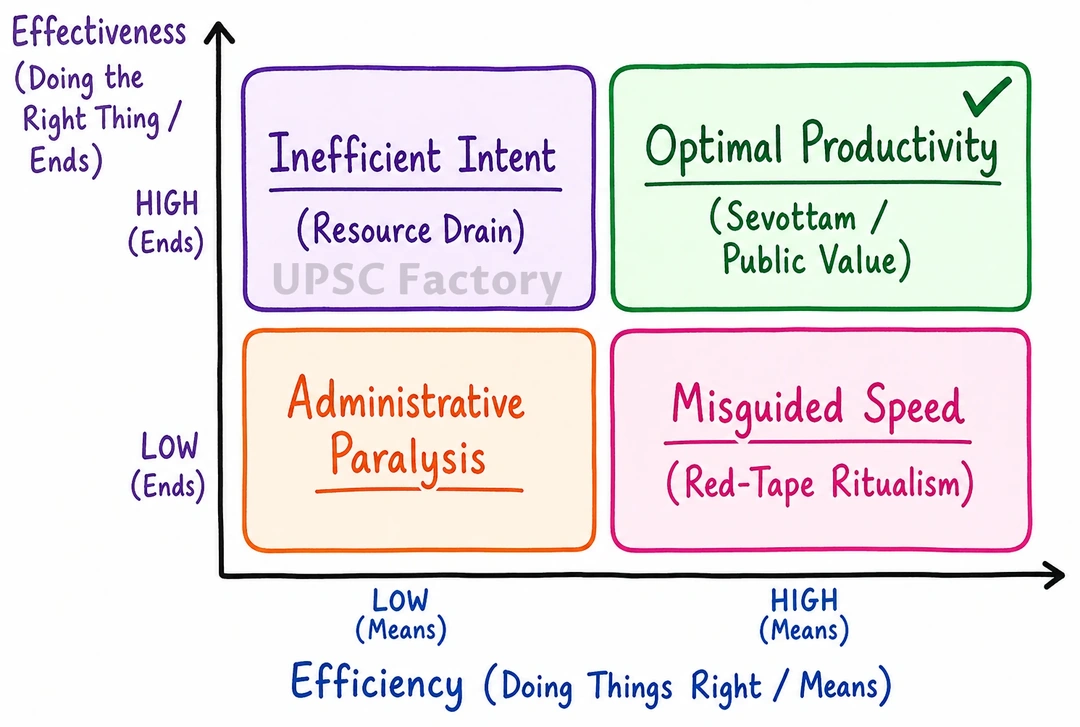
Peter Drucker’s maxim underscores that efficiency optimizes resource utilization (means), while effectiveness fulfills substantive public value and ethical objectives (ends). Administrative productivity requires harmonizing both procedural precision and outcome-oriented goal attainment.

Efficiency vs. Effectiveness in Public Administration

  • Efficiency (Procedural Means): Focuses on input-output ratios, cost minimization, and speed (e.g., rapid file clearance).
  • Effectiveness (Substantive Ends): Focuses on equity, qualitative impact, and public satisfaction (e.g., zero exclusion in welfare schemes).

Strategies to Strike a Balance for Enhanced Productivity

  1. Adopt Citizen-Centric Charters: Implement the Sevottam Model to standardize process timelines without compromising service quality (2nd ARC).
  2. Leverage Targeted Technology: Deploy Direct Benefit Transfer (DBT) via Aadhaar-enabled systems to minimize leakages (efficiency) while reaching the last mile (effectiveness).
  3. Institutionalize Outcome Budgets: Shift evaluation metrics from mere fiscal expenditure to the Output-Outcome Monitoring Framework (OOMF) (NITI Aayog).
  4. Competency-Driven Administration: Upgrade civil service skills under Mission Karmayogi to balance rule-bound compliance with empathetic discretion.
  5. Continuous Social Audits: Institutionalize participatory feedback mechanisms to prevent procedural rigidities from distorting intended policy outcomes (e.g., MGNREGA audits).

Synthesizing operational efficiency with ethical effectiveness bridges Weberian procedural rationality and Gandhian public service ethos, ensuring high-integrity, productive governance.

Q. Efficiency is doing things right, while effectiveness is doing the right thing. How do you strike a balance between the two to enhance productivity? Read More »

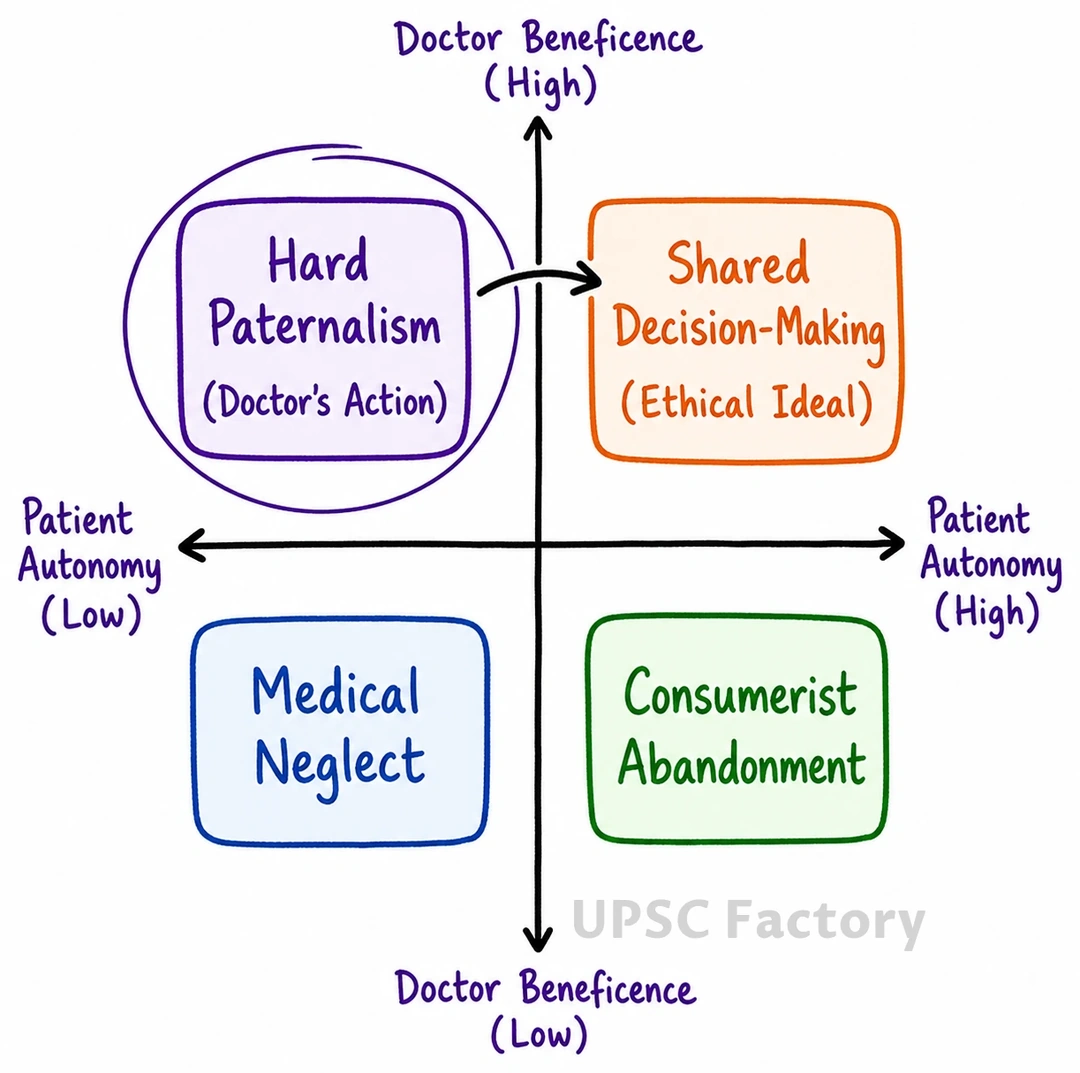
Q. Citing the serious adverse effects of long-term medication, a doctor convinces the family of a female patient for surgery. This led the patient to reluctantly consent for the surgery, though her original choice was to opt for medication. Explain the concepts of paternalism and beneficence by analysing the doctor’s action.

Q. Citing the serious adverse effects of long-term medication, a doctor convinces the family of a female patient for surgery. This led the patient to reluctantly consent for the surgery, though her original choice was to opt for medication. Explain the concepts of paternalism and beneficence by analysing the doctor’s action.

Question from UPSC Mains 2026 GS4 Paper

Model Answer: 

The quote reflects the doctrine of Jus ad bellum—asserting that the state’s coercive power (“arms”) derives moral legitimacy solely when anchored in public interest and righteous purpose (“just intent”).

1. Moral Legitimacy of State Authority

  • Upholding Public Interest: State coercion is ethically justified only when deployed to protect rights and welfare (Article 21, Disaster Management Act).
  • Doctrine of Proportionality: Restricts state force to the minimum necessary degree to achieve justice (Puttaswamy test).
  • Enforcing Raja Dharma: Legitimizes affirmative state intervention to eliminate systemic exploitation and protect the vulnerable (PDS anti-hoarding drives).

2. Safeguards Against the Abuse of Coercion

  • Preventing Weaponization: Barring the misuse of enforcement agencies for political vendetta or administrative overreach (Prakash Singh police reforms).
  • Substantive Due Process: Mandates that just intent must be matched by fair, non-arbitrary procedures (Maneka Gandhi case).
  • Gandhian Means-Ends Purity: Warns that noble administrative goals cannot justify unethical, heavy-handed enforcement measures.

Power detached from justice degrades into tyranny. In democratic governance, state authority remains fair only when disciplined by constitutional morality and human dignity.

Q. Citing the serious adverse effects of long-term medication, a doctor convinces the family of a female patient for surgery. This led the patient to reluctantly consent for the surgery, though her original choice was to opt for medication. Explain the concepts of paternalism and beneficence by analysing the doctor’s action. Read More »

Q. In what ways can an Indian Administrative Officer apply Gandhi’s notion of ‘trusteeship’ to ensure fairness in governance?

Q. In what ways can an Indian Administrative Officer apply Gandhi’s notion of ‘trusteeship’ to ensure fairness in governance?

Question from UPSC Mains 2026 GS4 Paper

Model Answer: 

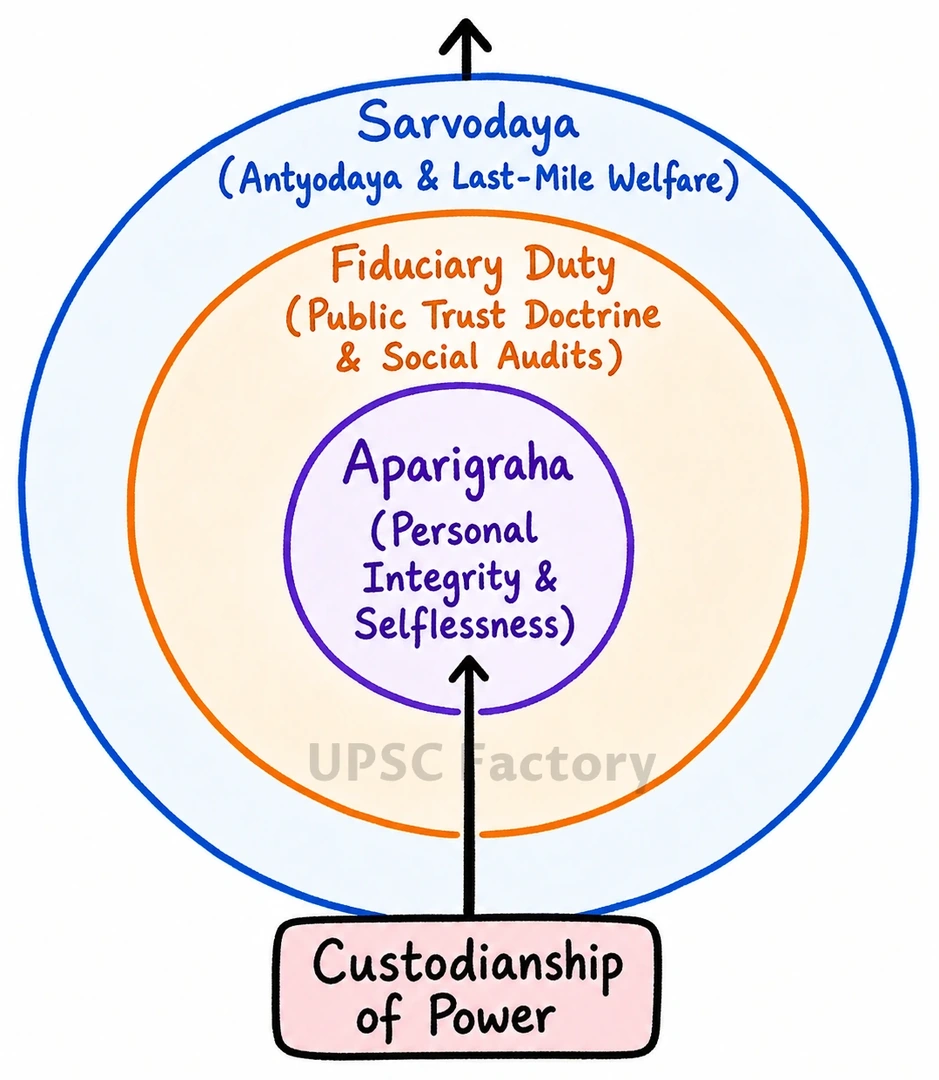
Mahatma Gandhi’s Trusteeship principle posits that authority and resources are held in moral trust for societal welfare, transforming bureaucratic power from dominion into ethical custodianship.

Pathways to Apply Trusteeship for Fair Governance

  1. Fiduciary Resource Allocation: Prioritizing the last person in fiscal and welfare delivery, operationalizing the Gandhian Talisman (e.g., Antyodaya-focused PDS delivery).
  2. Power-Sharing via Co-Governance: Devolving decision-making to local communities and enabling institutional transparency (e.g., Social Audits in MGNREGA).
  3. Stewardship of Common Goods: Protecting public natural resources from elite capture as an intergenerational trustee (e.g., Public Trust Doctrine in water bodies).
  4. Compassionate Administrative Discretion: Exercising procedural flexibilities to prevent denial of entitlements to marginalized citizens (e.g., NFSA inclusion drives without biometrics).
  5. Ethical Selflessness (Aparigraha): Renouncing bureaucratic rent-seeking and elitism to preserve institutional credibility (e.g., Armstrong Pame crowdsourcing the “People’s Road”).


Internalizing trusteeship bridges the ruler–ruled divide, institutionalizing constitutional morality, selflessness (Nolan Principles), and Sarvodaya (universal upliftment) in public administration.

Q. In what ways can an Indian Administrative Officer apply Gandhi’s notion of ‘trusteeship’ to ensure fairness in governance? Read More »

Q. Dr. B. R. Ambedkar had cautioned that employing civil disobedience within a constitutional democracy equates to endorsing ‘anarchy’. How should modern democracies navigate the ethical dilemmas posed by civil disobedience movements that aim to promote social justice against policies that may raise genuine concerns?

Q. Dr. B. R. Ambedkar had cautioned that employing civil disobedience within a constitutional democracy equates to endorsing ‘anarchy’. How should modern democracies navigate the ethical dilemmas posed by civil disobedience movements that aim to promote social justice against policies that may raise genuine concerns?

Question from UPSC Mains 2026 GS4 Paper

Model Answer: 

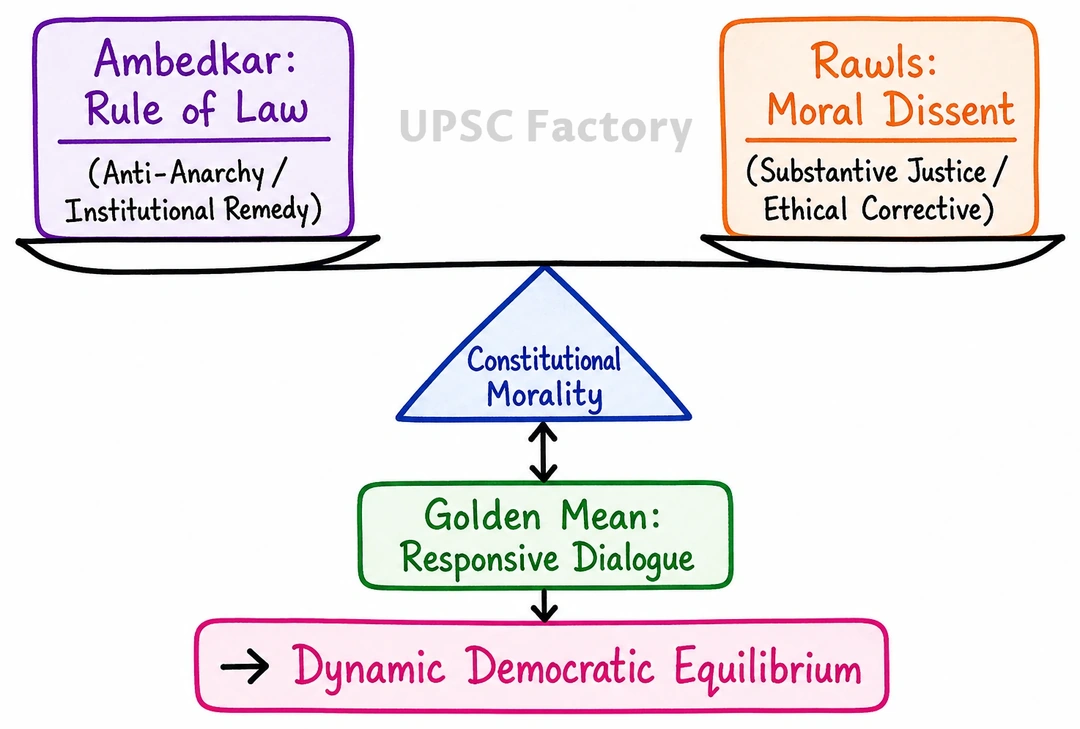
Dr. Ambedkar cautioned that extra-constitutional protests become the “grammar of anarchy,” whereas John Rawls defended civil disobedience as an ethical corrective against unjust laws.

1. Ethical Tension: Constitutional Order vs. Substantive Justice

  • Ambedkar’s Legalism: Extra-constitutional agitations risk institutional decay when legitimate constitutional remedies exist for grievance redressal.
  • Conscientious Objection: Peaceful dissent exposes moral blindspots within formally valid legislation (e.g., Chipko Movement).

2. Ethical Roadmap to Navigate Civil Disobedience

  1. Deliberative Preemption: Institutionalize Rawlsian “public reason” through robust pre-legislative consultations to address ethical concerns early.
  2. Proportional Engagement: Uphold peaceful assembly (Article 19(1)(b)) while checking violent disruption through graded, non-coercive policing (Amit Sahni Case).
  3. Institutional Mediation: Utilize judicial committees and statutory bodies as dialogic bridges rather than deploying immediate executive force (e.g., Supreme Court mediation panels).
  4. Responsive Constitutionalism: Treat peaceful civil disobedience as an ethical diagnostic tool for legislative reform rather than subversion.

Balancing constitutional discipline with empathetic dialogue prevents democracies from devolving into either authoritarian rigidity or lawless anarchy.

Q. Dr. B. R. Ambedkar had cautioned that employing civil disobedience within a constitutional democracy equates to endorsing ‘anarchy’. How should modern democracies navigate the ethical dilemmas posed by civil disobedience movements that aim to promote social justice against policies that may raise genuine concerns? Read More »

Q. Discuss how national security can be balanced with concerns of human rights.

Q. Discuss how national security can be balanced with concerns of human rights.

Question from UPSC Mains 2026 GS4 Paper

Model Answer: 

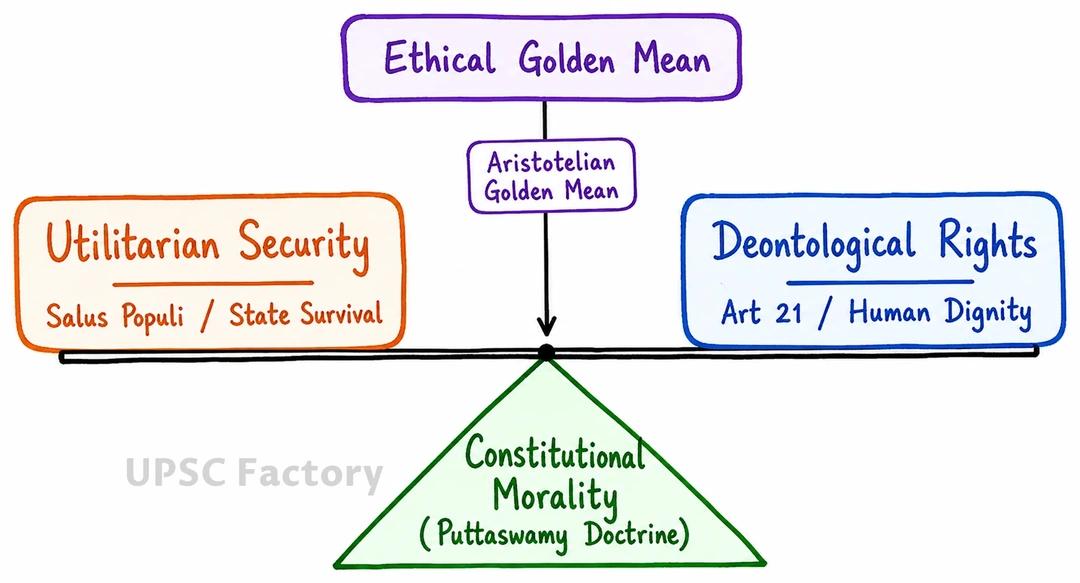
Balancing national security (utilitarian state preservation) with human rights (deontological individual dignity) is essential to uphold constitutional morality (Salus populi suprema lex vs. Article 21).

Ethical Dimensions of the Conflict

  • Utilitarianism vs. Rights-Based Ethics: Prioritizing collective security over fundamental freedoms risks state overreach and the erosion of human dignity.
  • Rule of Law vs. State Exception: State preservation cannot justify unchecked executive discretion or the permanent suspension of civil liberties.

Frameworks to Institutionalize the Balance

  • Puttaswamy Proportionality Doctrine: Mandate the four-fold test—legality, legitimate state aim, suitability, and strict necessity (e.g., Digital surveillance safeguards).
  • Adherence to Siracusa Principles: Ensure rights restrictions in emergencies are temporary, non-discriminatory, and subject to challenge.
  • Independent Institutional Oversight: Establish judicial and parliamentary scrutiny over security laws and intelligence bodies (e.g., Periodic review of UAPA/AFSPA).
  • Internalizing Humanitarian Law: Train security forces in minimum force protocols and human rights ethics (e.g., Counter-insurgency SOPs).

True national security must protect not merely territorial borders, but the intrinsic human rights and constitutional freedoms of its citizens.

Q. Discuss how national security can be balanced with concerns of human rights. Read More »

Q. An endangered tribe has developed a severe skeletal deformity. A university research has identified a mineral supplement as a possible remedy, though clinical trials are yet to be conducted. Should the District Magistrate (DM) use this research on the tribe? Discuss from the perspective of medical and administrative ethics.

Q. An endangered tribe has developed a severe skeletal deformity. A university research has identified a mineral supplement as a possible remedy, though clinical trials are yet to be conducted. Should the District Magistrate (DM) use this research on the tribe? Discuss from the perspective of medical and administrative ethics.

Question from UPSC Mains 2026 GS4 Paper

Model Answer: 

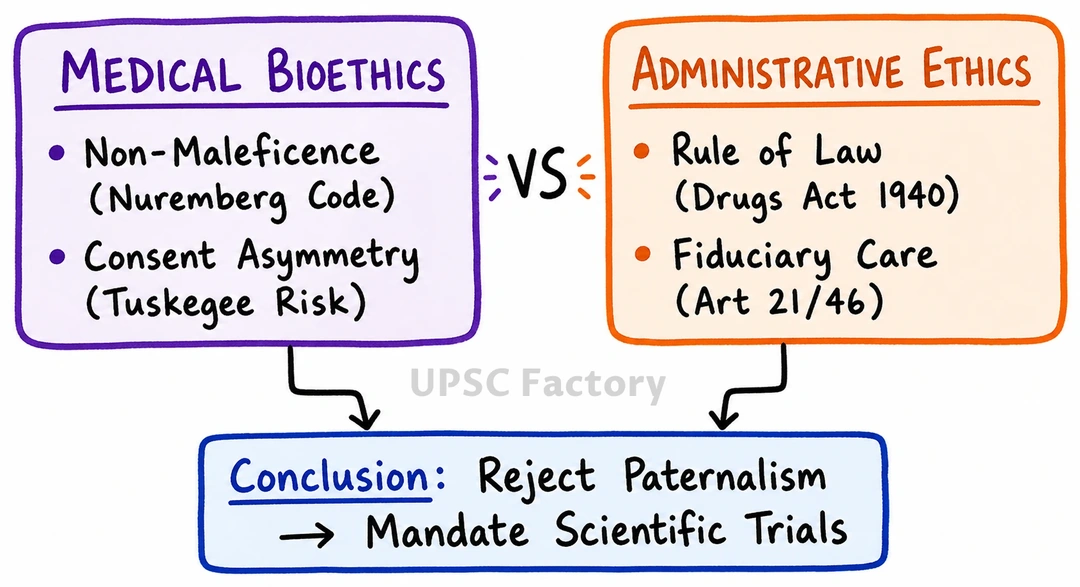
The DM faces a conflict between administrative urgency (Articles 21 & 46) and bioethical non-maleficence (Primum non nocere). The DM should not administer the untested supplement directly.

Ethical Dilemmas: Medical vs. Administrative

  • Medical Bioethics:
    • Non-Maleficence: Untested supplements risk toxicity, violating the Nuremberg Code and ICMR Bioethics Guidelines (2017).
    • Informed Consent: Cultural vulnerability and information asymmetry compromise autonomous consent, risking exploitation (Tuskegee study cautionary parallel).
  • Administrative Ethics:
    • Rule of Law vs. Paternalism: Benevolent intent cannot bypass statutory validation mandates (Drugs and Cosmetics Act, 1940).
    • Fiduciary Duty of Care: Protecting endangered tribes requires evidence-based welfare over speculative administrative gambles.

Ethically Justified Course of Action

  1. Provide Validated Relief: Deploy immediate palliative care and approved nutritional support to manage symptoms.
  2. Fast-Track Approvals: Coordinate with ICMR and CDSCO for expedited clinical trials (New Drugs and Clinical Trials Rules, 2019).
  3. Regulated Compassionate Access: Explore legal “Compassionate Use” provisions only after basic clinical safety is established.

Administrative empathy must harmonize with scientific rigor, ensuring tribal welfare without compromising constitutional morality and medical ethics.

Q. An endangered tribe has developed a severe skeletal deformity. A university research has identified a mineral supplement as a possible remedy, though clinical trials are yet to be conducted. Should the District Magistrate (DM) use this research on the tribe? Discuss from the perspective of medical and administrative ethics. Read More »

Q. A business house is working on a project that could displace a forest community from their habitat. As the administrative officer of that district, what ethical challenges are you likely to face?

Q. A business house is working on a project that could displace a forest community from their habitat. As the administrative officer of that district, what ethical challenges are you likely to face?

Question from UPSC Mains 2026 GS4 Paper

Model Answer: 

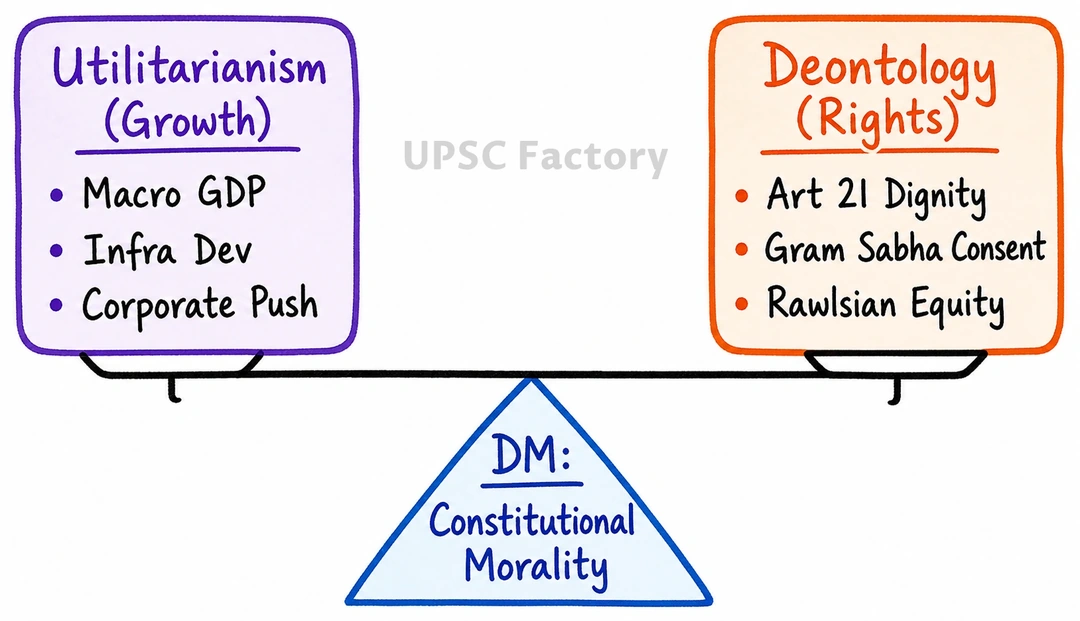
Balancing industrial-led economic growth with indigenous welfare presents a profound ethical conflict between utilitarian progress and constitutional morality (Article 21).

Socio-Ethical Dilemmas: Rights vs. Growth

  • Utilitarianism vs. Deontology: Balancing aggregated macroeconomic gains against the inalienable human rights of vulnerable tribal communities (Rawls’ Difference Principle).
  • Cultural Preservation vs. Modernity: Risking irreplaceable indigenous heritage, sacred ecologies, and traditional knowledge for capital-intensive infrastructure (Niyamgiri Dongria Kondh case).
  • Procedural Justice vs. Tokenism: Ensuring genuine, informed Gram Sabha consent versus coerced, procedural approvals under administrative momentum (FRA 2006, PESA).

Administrative Integrity & Governance Challenges

  • Impartiality vs. External Pressures: Resisting corporate-political lobbying to neutrally uphold statutory environmental and rehabilitation mandates.
  • Eminent Domain vs. Compassion: Reconciling the state’s legal right of land acquisition with administrative empathy toward marginalized forest dwellers.
  • Distributive Justice in R&R: Preventing displacement-induced pauperization by ensuring holistic socio-economic restitution over superficial cash compensation.

An administrator must act as an ethical trustee (Gandhian Trusteeship), ensuring sustainable development never compromises indigenous dignity or constitutional safeguards.

Q. A business house is working on a project that could displace a forest community from their habitat. As the administrative officer of that district, what ethical challenges are you likely to face? Read More »

Q. Owing to paucity of time, a university professor generates a Ph.D. evaluation report using Artificial Intelligence and submits it with some modifications. Discuss this from the perspective of accountability and integrity.

Q. Owing to paucity of time, a university professor generates a Ph.D. evaluation report using Artificial Intelligence and submits it with some modifications. Discuss this from the perspective of accountability and integrity.

Question from UPSC Mains 2026 GS4 Paper

Model Answer: 

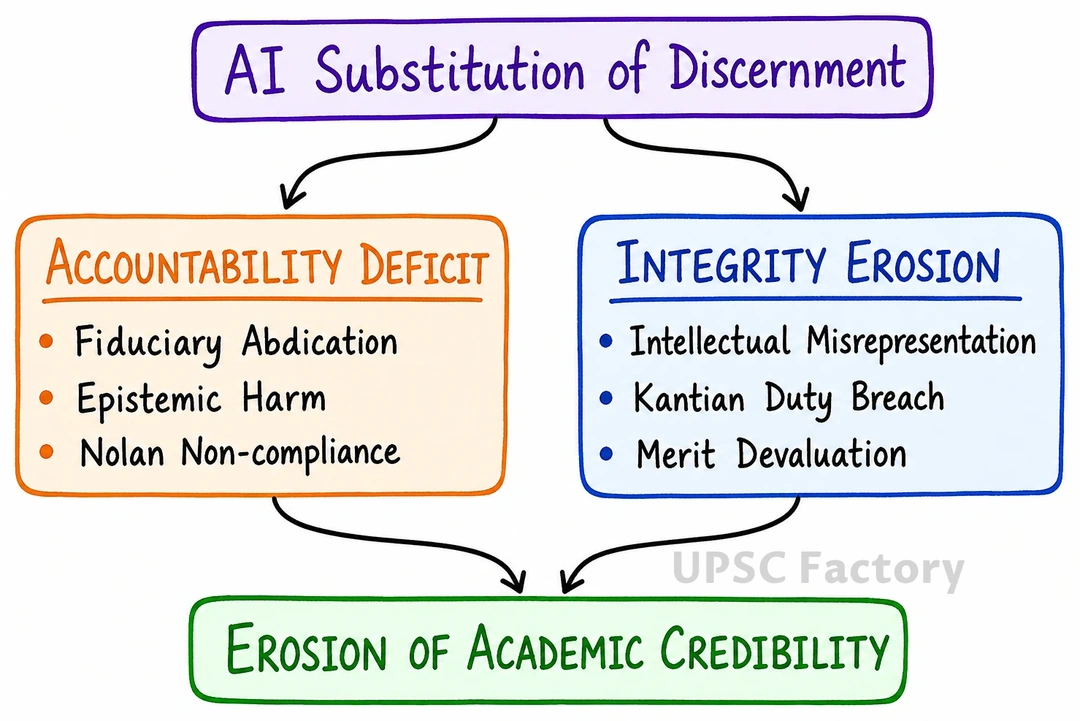
Delegating doctoral evaluation to generative AI under time constraints breaches professional fiduciary duty, substituting rigorous scholarly discernment with automated synthesis.

Deficit of Accountability

  • Abdication of Duty: Outsourcing core evaluative judgment violates the personal responsibility owed to the candidate and institution (Nolan Principles).
  • Epistemic Injustice: Unverified AI outputs risk algorithmic bias and hallucinated critiques, potentially damaging the scholar’s career (Mata v. Avianca).
  • Institutional Default: Violates UGC Academic Integrity Regulations (2018), eroding public trust in the university’s statutory degree-awarding mechanisms.

Erosion of Integrity

  • Intellectual Misrepresentation: Submitting machine-generated assessment with cosmetic modifications is academic dishonesty, passing synthetic text as expert appraisal.
  • Devaluation of Merit: Treats years of original research as a trivial administrative formality, violating ethical fairness (Kant’s Categorical Imperative).
  • Failure of Moral Leadership: Prioritizes personal convenience over professional rectitude, normalizing corner-cutting in higher education.

AI must only assist administrative workflows; human critical judgment remains non-negotiable for preserving academic integrity and professional ethics.

Q. Owing to paucity of time, a university professor generates a Ph.D. evaluation report using Artificial Intelligence and submits it with some modifications. Discuss this from the perspective of accountability and integrity. Read More »