UPSC Mains 2026 GS4 Model Answer

Q. Ajit has been recently promoted as the Head of the Department of Weapon Sales (DWS) in the Ministry of Defence Production (MDP). His charter of duties includes international sales of weapons produced domestically by MDP.

Q. Ajit has been recently promoted as the Head of the Department of Weapon Sales (DWS) in the Ministry of Defence Production (MDP). His charter of duties includes international sales of weapons produced domestically by MDP.

In two recent wars, MDP weapons have performed admirably, resulting in many countries showing interest in buying them, particularly long-range artillery and missiles. Country A and country B have asked for these weapons. However, production constraints restrict DWS to accept only one purchase order.

Country A is a developing nation with a sound technology base. MDP is planning R&D collaboration with it for the next generation of weapons. It is not part of any security alliance and needs weapons for protection from a troublesome neighbour. It seeks a large acquisition on a long-term loan.

Country B is also a developing nation. Military strength is its priority, with the military budget often ingressing into allocations for human resources and infrastructure development. It is in security alliance with a superpower who has a large military base there and periodically allots it financial grants. It is a member of an economic bloc with which the government is currently negotiating a free trade agreement. It is not a signatory of NPT but possesses smaller nuclear weapons and delivery systems. It supports some guerrilla forces abroad. It has sought a smaller acquisition and is prepared to make some advance payment. It is currently negotiating arms purchases from another nation too.

Ajit discussed this case with his counterparts in the related departments. Therein, the significant economic benefits, employment generation and stronger diplomatic relations arising from this sale were highlighted. It was also emphasized that refusing the deal could result in country B purchasing weapons from some other supplier.

Ajit was aware that in arms sales, due diligence at each stage was pivotal to ensure conformity to national policy and international treaties.

(a) Discuss the options available to Ajit. Which option should he select and why?
(b) How can Ajit balance nation’s economic and strategic interests with ethical considerations?

Question from UPSC Mains 2026 GS4 Paper

Model Answer: 

The dilemma pits short-term mercantilist realpolitik against ethical statecraft, governed by non-proliferation norms, human rights obligations, and long-term strategic autonomy.

1. Options Evaluation and Justified Selection

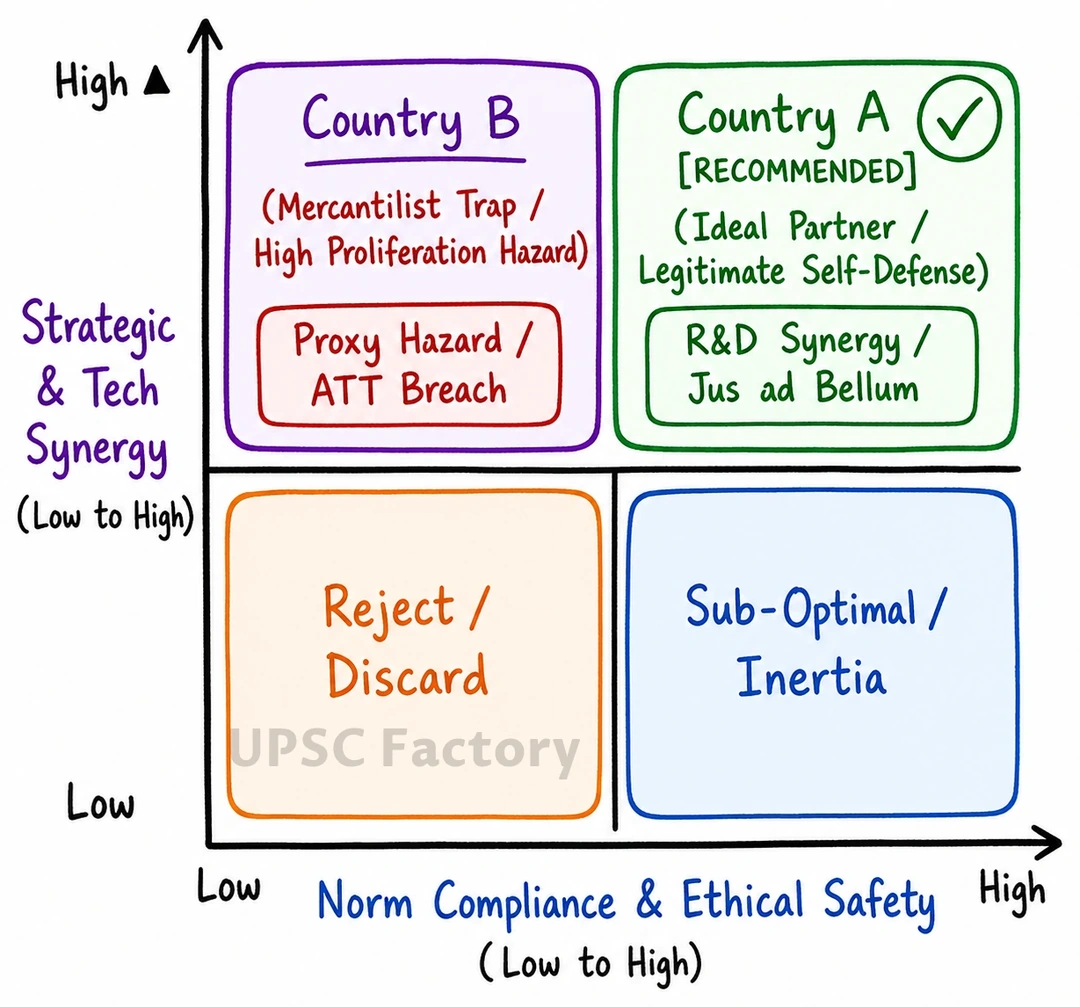
  1. Option 1: Award Contract to Country B
    • Merits: Immediate cash flow via advance payments; diplomatic leverage in ongoing FTA negotiations.
    • Ethical/Strategic Demerits: Non-NPT status, nuclear ambiguity, and proxy guerrilla funding violate international arms control norms (ATT Articles 6 & 7); deepens regional instability.
  2. Option 2: Award Contract to Country A (Recommended)
    • Merits: Legitimate self-defence needs (Jus ad Bellum); enables co-development and R&D tech-transfers; zero history of guerrilla support or non-state proliferation.
    • Challenges: Deferred revenue due to long-term loan structure.

Selection & Justification: Ajit must choose Country A. Long-term security co-development outweighs Country B’s immediate liquidity, preventing complicity in proxy warfare and upholding the Wassenaar Arrangement guidelines on regional stability (e.g., India’s defensive BrahMos export model).
2. Framework to Harmonize Strategic Interests with Ethics
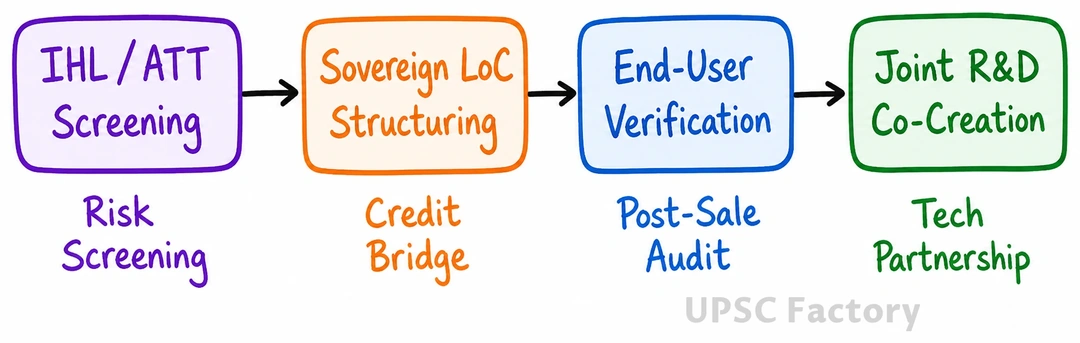
  • Norm-Based Due Diligence: Institutionalize risk-assessment matrices screening buyers against international humanitarian law, illicit diversion risks, and internal repression track records (SIPRI Arms Transfer Framework).
  • Creative Financial Structuring: Offset Country A’s delayed liquidity by backing the sale through Government-backed Lines of Credit (LoC), securing domestic production jobs while ensuring financial sustainability.
  • Non-Diversion & End-User Monitoring: Mandate legally binding End-User Certificates (EUCs) with post-delivery inspection clauses to prevent horizontal proliferation.
  • Technology Co-Creation: Pivot from transactional sales to joint R&D with responsible partners, securing domestic technological sovereignty without fueling aggressive militarism.

Adhering to ethical statecraft ensures MDP acts as a responsible global security partner, demonstrating that national defence exports must advance rules-based international peace rather than unprincipled commercial opportunism.
Q. Ajit has been recently promoted as the Head of the Department of Weapon Sales (DWS) in the Ministry of Defence Production (MDP). His charter of duties includes international sales of weapons produced domestically by MDP. Read More »

Q. Rajapuram is a border district. Jhara and Biru, its two major communities are in continual conflict with each other. The social fabric is fractured and demands mending.

Q. Rajapuram is a border district. Jhara and Biru, its two major communities are in continual conflict with each other. The social fabric is fractured and demands mending.

Ethnic tensions between the two communities have erupted into violence resulting in a large number of deaths. The stated causes are conflicting land claims, uneven resource allocation and inadequate political representation in government bodies. Separate relief camps had to be created for the two communities. The situation is volatile and appears to be getting out of control.

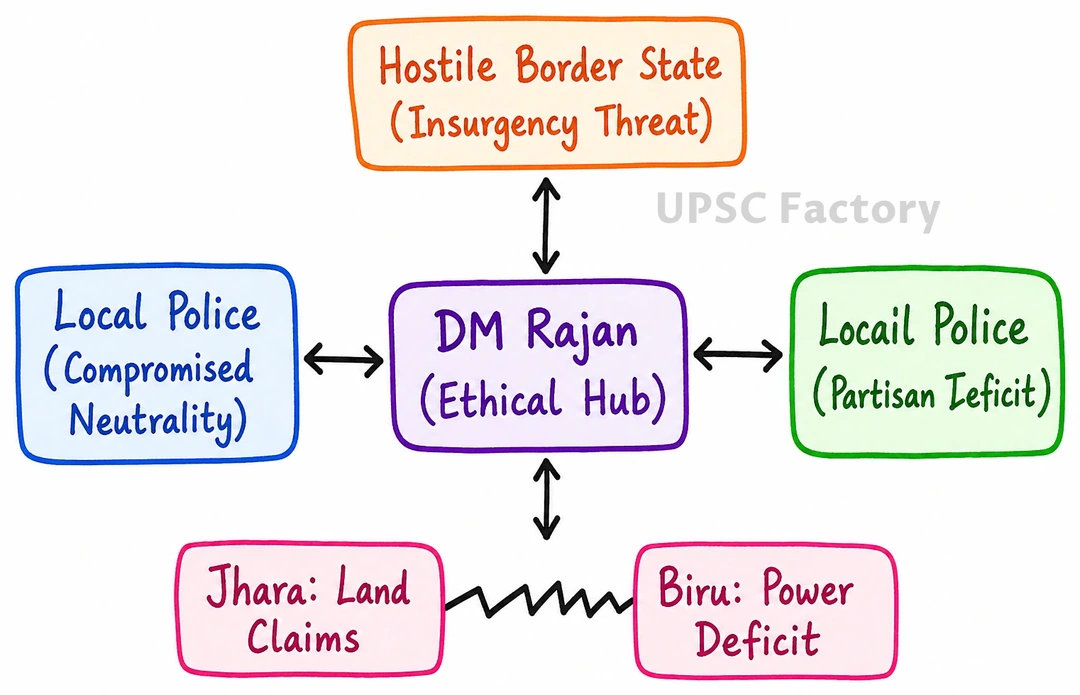
Rajan has been appointed the District Magistrate (DM) of Rajapuram and tasked to quickly get the situation under control. His immediate tasks include restoring administrative authority, reopening the highway and initiating peace talks. On taking over his appointment, Rajan realized that the inter-community rivalry had even seeped into the local administration and police. With functional neutrality being the immediate casualty, it had made both communities distrustful of the government. The neighbouring country could utilize the opportunity to spur insurgent activity and further aggravate the situation. Rajan favoured a controlled approach starting with opening the highway to restore food and medical supplies. He toyed with the idea of requisitioning CRPF units to help restore administrative control.

(a) Discuss the ethical issues that need to be addressed in this case.
(b) What are the options open to Rajan? Which option would ensure protection of his non-partisan image without compromising ethics?

Question from UPSC Mains 2026 GS4 Paper

Model Answer: 

This case presents a volatile intersection of ethnic conflict, institutional bias, humanitarian crisis, and external security vulnerabilities, requiring an administrative response anchored in impartiality, constitutional morality, and restorative justice.

1. Ethical Issues in the Crisis

  • Erosion of Administrative Neutrality: Partisan conduct of local police violates the Nolan Principles of Objectivity and Impartiality, destroying public trust.
  • Denial of Basic Human Rights: Highway blockades and segregated camps jeopardize access to food, healthcare, and life (Article 21).
  • National Security vs. Democratic Policing: Risk of foreign-backed insurgency necessitates firm state authority while avoiding disproportionate civilian repression.
  • Distributive Injustice: Perceived historical inequities in land, representation, and resource allocation fueling deep moral alienation.
  • Utilitarian Dilemma in Restoring Order: Balancing the immediate risk of collateral harm during highway clearance against the broader public good of life-saving supply restoration.

2. Evaluation of Options Open to Rajan

OptionMeritsDemerits / Ethical Risks
1. Rely solely on local police & immediate political mediationAvoids external friction; utilizes local knowledge.Compromised neutrality fuels bias; high risk of failure.
2. Total coercive clampdown via exclusive CRPF deploymentSwift deterrence; secures border & highway immediately.Deepens alienation; fails to resolve structural roots.
3. Tripartite Strategy: Neutral CAPF + Institutional Purge + DialogueRestores public trust; clears supplies; ensures fair peace.Demands high coordination and sustained engagement.

3. Optimal Course of Action to Ensure Non-Partisanship

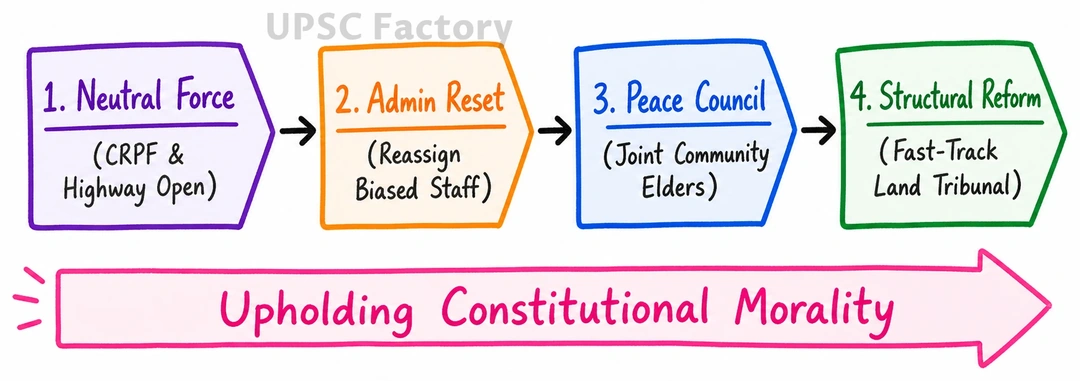
  1. Immediate Neutral Enforcement & Logistics:
    • Deploy CRPF/CAPF units to secure the highway and sensitive zones (Section 163 BNSS), projecting visible institutional neutrality.
    • Temporarily reassign biased local personnel to non-sensitive administrative roles to eliminate operational partiality.
  2. Equitable Relief Administration:
    • Establish joint, transparent supply corridors with standard operating procedures to deliver aid equally across all camps.
    • Deploy neutral third-party observers (e.g., Red Cross, central officers) to oversee resource distribution.
  3. Institutionalized Peace-Building:
    • Constitute a District Peace Council comprising neutral civil society elders, women representatives, and youth leaders from both Jhara and Biru communities (e.g., Kiphire Peace Model).
    • Lead direct negotiations personally to eliminate political intermediaries and demonstrate administrative objectivity.
  4. Structural & Long-Term Grievance Redressal:
    • Form an independent Fast-Track Land Dispute Tribunal to adjudicate claims objectively.
    • Institute a transparent, algorithmic framework for local resource allocation and welfare delivery.

By decoupling enforcement from partisan local machinery and addressing structural grievances through institutional objectivity, Rajan upholds constitutional morality, repairs the fractured social fabric, and neutralizes border vulnerabilities.

Q. Rajapuram is a border district. Jhara and Biru, its two major communities are in continual conflict with each other. The social fabric is fractured and demands mending. Read More »

Q. Vikas is a government officer with over a decade of service in public administration. He has recently moved as the District Collector (DC) of Nainipura, a remote hilly district bordering a forest

Q. Vikas is a government officer with over a decade of service in public administration. He has recently moved as the District Collector (DC) of Nainipura, a remote hilly district bordering a forest.

Due to Nainipura’s low levels of economic development, one of his major duties is to ensure proper functioning of the public distribution system (PDS) amongst the economically weaker sections (EWS).

During his on-site visits, Vikas was apprised of a typical administrative challenge in operating the PDS. To prevent leakages, all distributors were required to carry out real-time biometric identification of the beneficiaries, whose fingerprints were tallied with identity card records. This was creating problems as the operating system sometimes rejected fingerprint matching in the cases of growing children, manual labourers and senior citizens. The problem was further compounded in periods of low WiFi connectivity. The distributors, in such cases, resorted to personal discretion when they could identify the recipient.

Vikas had to address this problem on priority. Strictly adhering to government regulations would ensure fiscal probity but would greatly trouble the proposed beneficiary, i.e., EWS. It may even impinge on their fundamental right to life as per Article 21 of the Constitution. Conversely, leaving the resolution solely to the discretion of the distributors could lead to misuse and leakages.

(a) What are the options open to Vikas? How should he balance fiscal probity with empathy towards the designated beneficiaries?
(b) Discuss the ethics of using technology as a gatekeeper for welfare schemes.

Question from UPSC Mains 2026 GS4 Paper

Model Answer: 

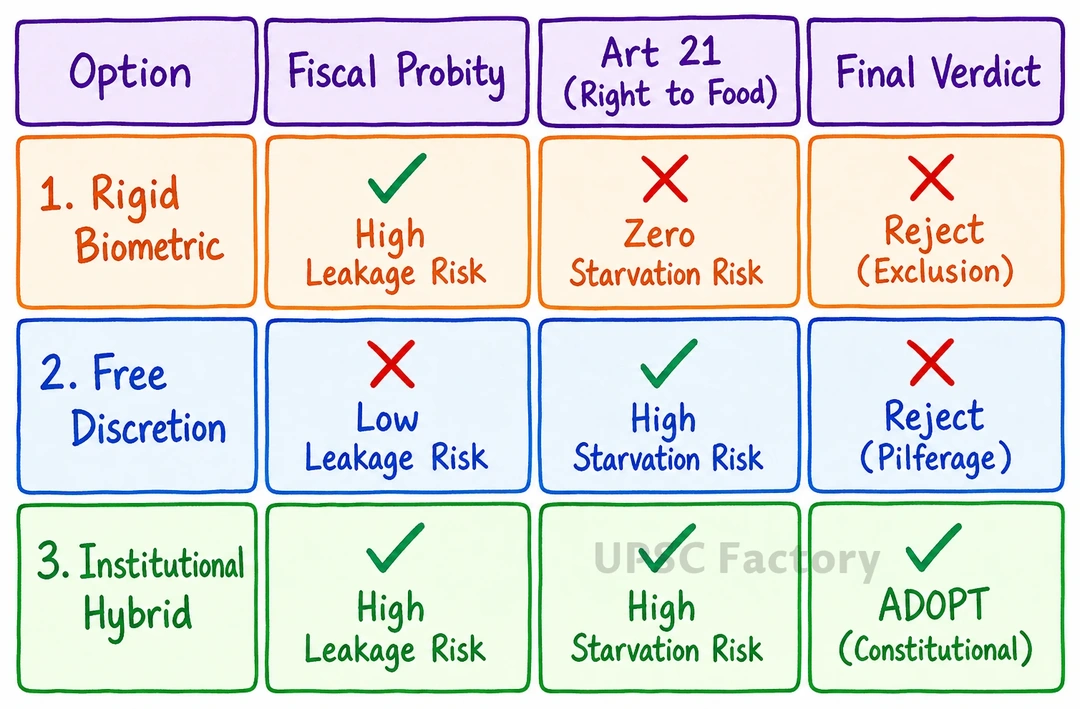
The dilemma tests administrative acumen in harmonising substantive justice (Article 21 – Right to Food) with fiscal integrity, ensuring procedural safeguards do not cause wrongful exclusion.

1. Options Available to Vikas & Balancing Probity with Empathy

  • Option 1: Rigid Biometric Adherence: Maximises fiscal probity; causes severe exclusion errors, starvation risks, and constitutional breach.
  • Option 2: Unchecked Manual Discretion: Maximises immediate access; risks leakages, ghost beneficiaries, and moral hazard.
  • Option 3: Balanced Institutional Mechanism (Recommended):
    1. Multi-Modal Authentication: Deploy Iris scans and facial recognition for worn fingerprints (Chhattisgarh PDS model).
    2. Offline-Sync PoS Devices: Enable local batch authentication during network downtime with automatic cloud sync upon reconnection.
    3. Statutory Exception Register: Authorise physical delivery via OTP/Panchayat verification on biometric failure (NFSA 2013 Exception Protocol).
    4. Post-Distribution Social Audits: Institutionalise monthly Gram Sabha reviews and surprise inspections to curb distributor discretion (NFSA Section 28).

2. Ethics of Technology as a Gatekeeper in Welfare Delivery

  • Ethical Merits:
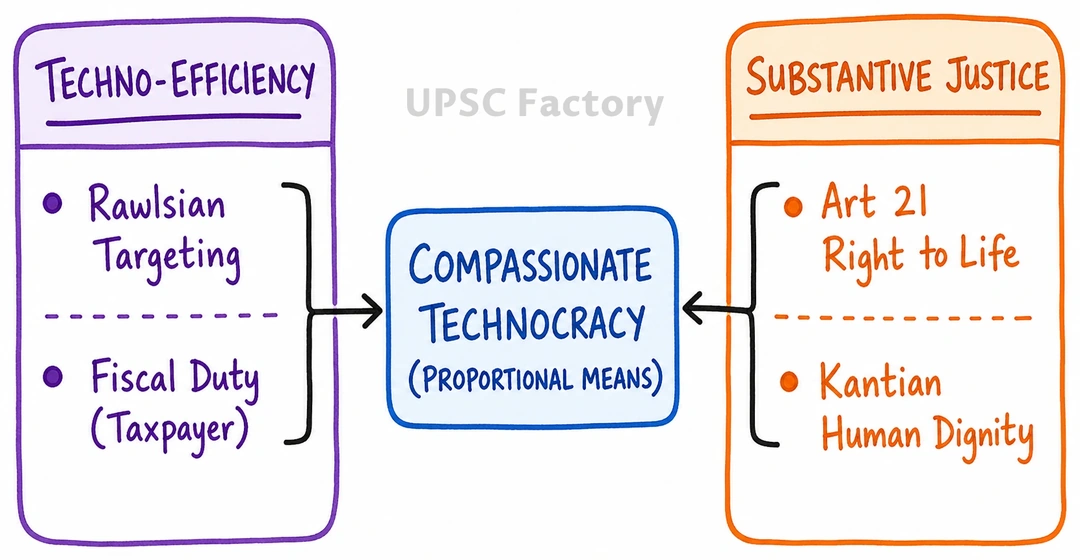
    • Targeted Distributive Justice: Eliminates elite capture and ghost beneficiaries, directing public resources to the poorest (Rawlsian Difference Principle).
    • Fiduciary Accountability: Upholds the administrator’s duty to protect taxpayer funds from systemic pilferage.
  • Ethical Concerns:
    • Algorithmic Exclusion (Type-I Error): Denies life-saving entitlements due to systemic glitches, infringing human dignity (Article 21).
    • Treating Citizens as Means: Subordinates fundamental welfare rights to technical efficiency (Kant’s Categorical Imperative).
    • Structural Asymmetry: Shifts the administrative burden of poor infrastructure onto vulnerable citizens without real-time grievance redressal (Puttaswamy Proportionality Standard).

Administrative ethics requires “compassionate technocracy,” where technology acts as an empowering enabler rather than an exclusionary barrier to constitutional welfare.

Q. Vikas is a government officer with over a decade of service in public administration. He has recently moved as the District Collector (DC) of Nainipura, a remote hilly district bordering a forest Read More »

Q. Seema is a senior bureaucrat with a reputation of honesty and professional efficiency. She has recently been posted as the District Collector (DC) to Surinder Nagar, where a large industrial area is being established

Q. Seema is a senior bureaucrat with a reputation of honesty and professional efficiency. She has recently been posted as the District Collector (DC) to Surinder Nagar, where a large industrial area is being established

The new industrial area had caused many farmers to submit applications for change of land use (CLU) to convert their farmlands into residential areas. There is an unusually large backlog of these applications awaiting processing. Seema noticed that some applications had been approved selectively with no visible chronological pattern. The case files showed a few complaints of some approvals being subject to receipt of large bribes from the applicants.

On further fact-finding, Seema realized that a small group of touts was controlling this illegal activity through some subordinate officials in the Collectorate. This had created a fear in the other employees who were reluctant to process any application. The resultant backlog has been piling up thereby hindering local economic progress and causing public dissatisfaction.

Seema was faced with a major moral and administrative challenge of dismantling this corruption network without hampering daily administrative operations. An aggressive internal investigation would result in institutional resistance and, possibly, a backlash from labour unions. Conversely, ignoring this situation would encourage the wrongdoers and unnecessarily continue this avoidable harassment to the populace.

(a) What are the ethical issues involved in this case?
(b) Discuss the options open to Seema. Identify the recommended option and justify it.

Question from UPSC Mains 2026 GS4 Paper

Model Answer: 

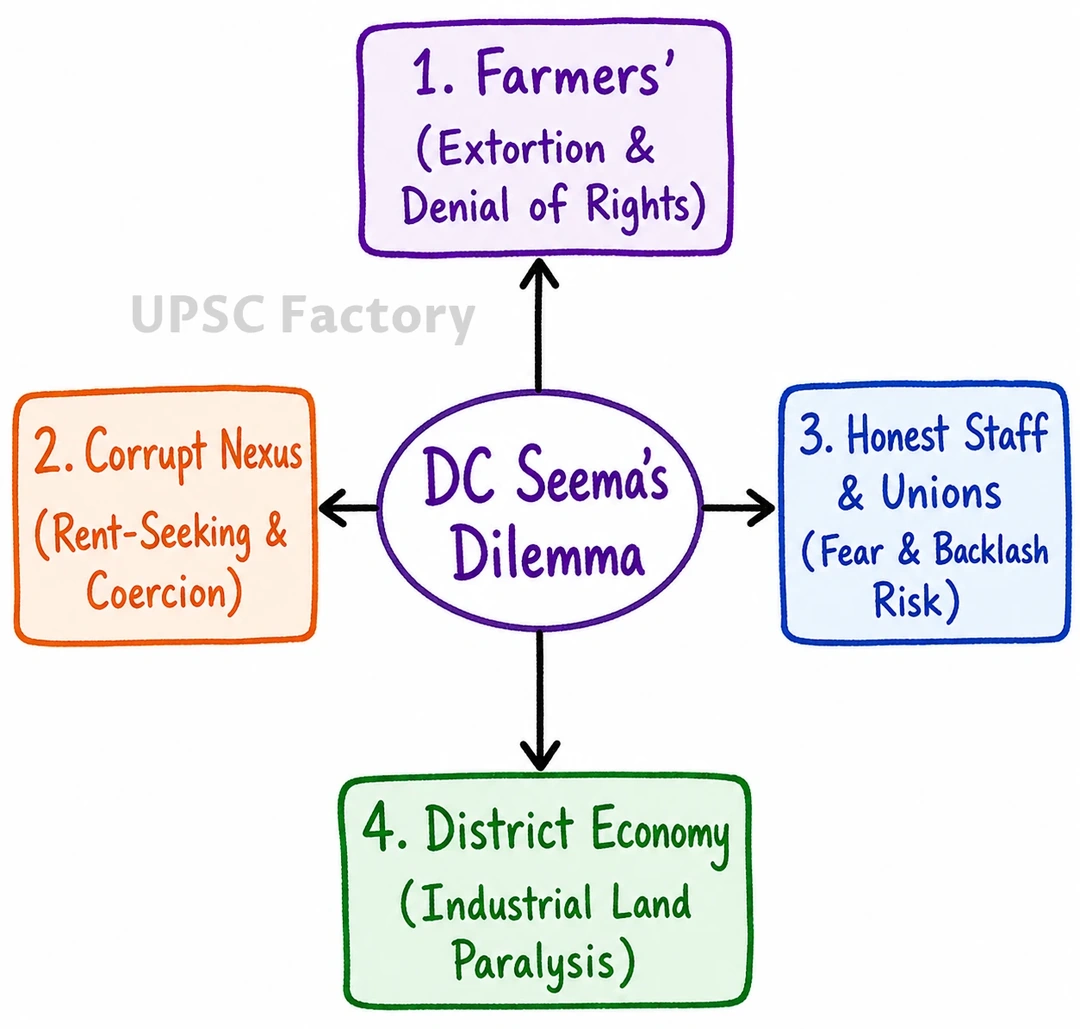
The case presents a crisis of public trust, pitting bureaucratic integrity and lawful enforcement against institutional paralysis, administrative inertia, and fear of union backlash.

1. Ethical Issues Involved

  1. Breach of Public Trust & Probity: Exploitation of regulatory authority for rent-seeking, violating Nolan’s principle of Integrity and the Prevention of Corruption Act, 1988.
  2. Administrative Inertia vs. Duty: Honest officials paralyzed by fear reflects moral cowardice and neglect of official duty.
  3. Denial of Distributive Justice: Selective approvals penalize honest farmers, violating fairness and equality before law (Article 14).
  4. Institutional Decay: Collusion between touts and officials erodes state legitimacy, undermining regional economic development.

2. Evaluation of Options

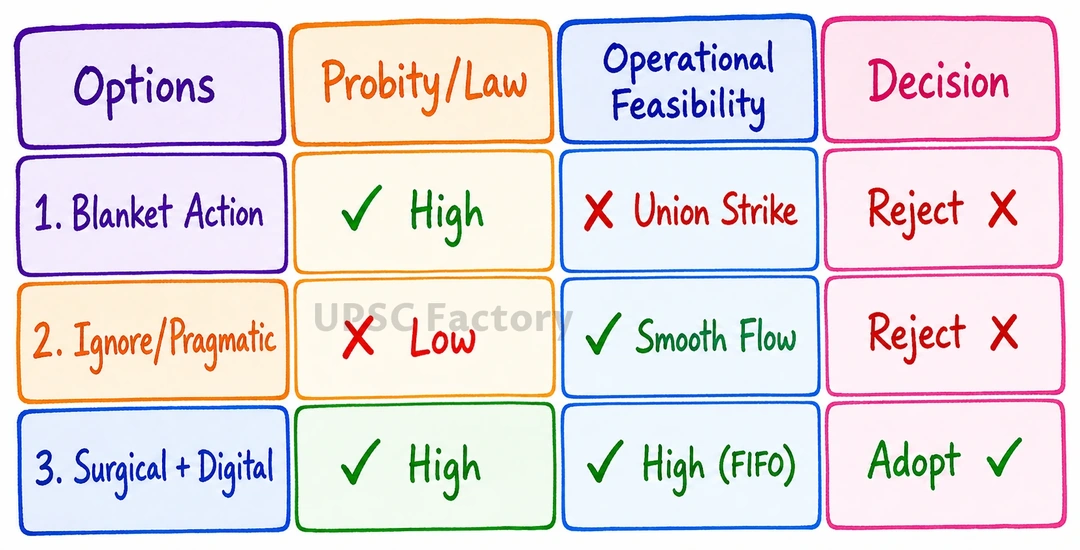
  • Option 1: Mass vigilance enquiry and immediate blanket suspensions
    • Merit: Sends an unyielding signal against corruption.
    • Demerit: Triggers union backlash, stalls routine administration, and victimizes intimidated staff.
  • Option 2: Clear the backlog pragmatically without penal action
    • Merit: Restores immediate administrative output and avoids conflict.
    • Demerit: Institutionalizes impunity and compromises professional ethics.
  • Option 3: Targeted surgical deterrence coupled with digital process re-engineering (Recommended)
    • Merit: Dismantles the corrupt nexus without halting public service delivery.

3. Recommended Course of Action and Justification

  1. Surgical Legal Deterrence: Deploy anti-corruption agencies for evidence-led action against ringleader touts and compromised staff (PC Act, 1988), preventing collective victimisation.
  2. Process Automation (Disintermediation): Digitize the CLU system via a transparent First-In, First-Out (FIFO) dashboard (e.g., Karnataka’s Bhoomi portal) to eliminate discretionary human touchpoints.
  3. Enforcing Accountability: Implement strict service timelines with deemed approval clauses under the Right to Service Act.
  4. Staff Reassurance & Protection: Issue written assurances protecting compliant staff, institute whistleblower safeguards, and engage union leaders openly on zero-tolerance norms.

Marrying surgical punitive deterrence with structural digital reforms restores institutional probity, eliminates tout networks, and upholds citizen-centric, accountable governance.

Q. Seema is a senior bureaucrat with a reputation of honesty and professional efficiency. She has recently been posted as the District Collector (DC) to Surinder Nagar, where a large industrial area is being established Read More »

Q. Ravi is a senior police officer with vast experience in riot control and cyber-policing. Since one year, he has been the Superintendent of Police (SP) of a district with a history of frequent rioting.

Q. Ravi is a senior police officer with vast experience in riot control and cyber-policing. Since one year, he has been the Superintendent of Police (SP) of a district with a history of frequent rioting.

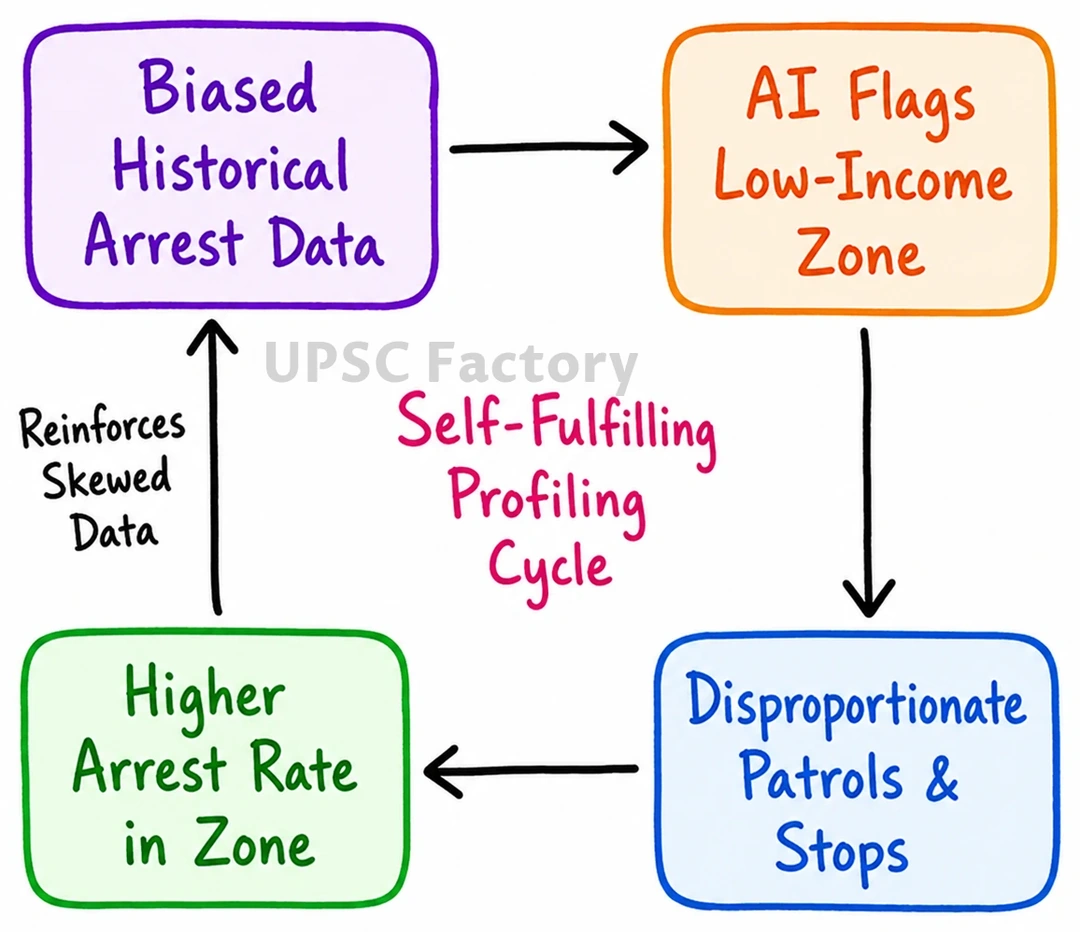
Last year, Ravi had sought installation of an AI enabled software for predictive policing. This system has been operational for approximately six months. This new system employs advanced algorithms for capturing the biometric data of persons in a crowd and swiftly relating it to a data library. This has enabled the police to identify the persons involved in various crimes.

The system has identified an immigrant and low-income neighbourhood as a centre for gang violence and drug trafficking. Aided by this AI analysis, the local police has focused its patrolling, preventive detentions and establishing checkpoints. Consequently, public order and law enforcement has visibly improved.

Last week, some community leaders, civil rights lawyers and human rights activists visited Ravi’s office. They submitted a memorandum that the new system is faulty as it is based on incorrect historical data caused by social biases and discriminatory policing. The memorandum also alleges that the increased surveillance has created a climate of tension amongst residents. This feeling is aggravated by the fact that the residents are not aware of the data noted against their names.

(a) What are the ethical issues including biases involved in the use of AI in data-driven policing?
(b) Place yourself in Ravi’s role and discuss the alternatives available. Justify the action that optimises compliance with ethics.

Question from UPSC Mains 2026 GS4 Paper

Model Answer: 

The dilemma pits technological efficiency in crime control against algorithmic discrimination, civil liberties (Art. 14, 21), and the erosion of police-community trust.

1. Ethical Issues & Biases in AI-Driven Policing

  • Reinforcement of Historical Bias: AI models trained on skewed arrest records institutionalize systemic discrimination against marginalized groups (e.g., US COMPAS bias).
  • Feedback Loop of Over-Policing: Disproportionate patrol allocation in target zones creates higher arrests, artificially validating flawed algorithmic predictions.
  • Infringement of Privacy & Due Process: Mass biometric harvesting without informed consent breaches procedural fairness and data privacy (K.S. Puttaswamy; DPDP Act, 2023).
  • “Black-Box” Opacity & Non-Accountability: Lack of algorithmic explainability prevents citizens from knowing, verifying, or challenging criminal tagging against their names.
  • Chilling Effect & Collective Criminalization: Pervasive surveillance breeds psychological fear, stigmatizes entire neighbourhoods, and damages community-police relations.

2. Evaluation of Alternatives & Justified Action Plan

AlternativeMeritsDemerits
1. Unchanged AI DeploymentMaintains deterrence and low crime rates.Deepens alienation; risks legal challenge under Art. 14 & 21.
2. Complete Scrapping of AIRestores community trust; eliminates algorithmic bias.Sacrifices technological efficiency in riot-prone terrain.
3. Calibrated Ethical GovernanceBalances public order with constitutional morality.Requires administrative restructuring and resources.

Justified Course of Action (Alternative 3)

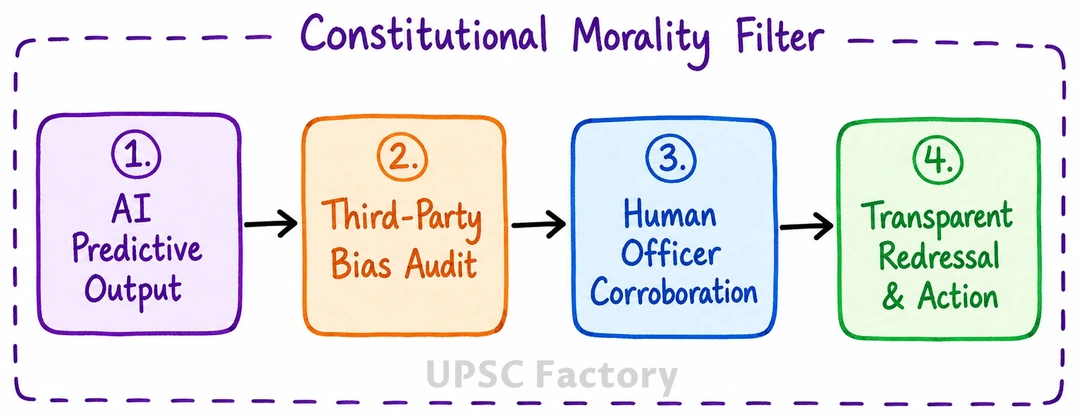
  1. Third-Party Algorithmic Audit: Temporarily halt automated predictive profiling to audit training datasets for socio-economic biases with independent technical experts.
  2. “Human-in-the-Loop” Protocol: Mandate that AI outputs serve only as secondary advisory inputs; prohibit automatic preventive detentions without independent evidentiary corroboration.
  3. Data Transparency & Redressal: Establish a standard operating procedure for data transparency, allowing citizens to contest incorrect records (Principles of Natural Justice).
  4. Community-Centric Policing: Re-channel police presence from hostile checkpoints to participatory community outreach (e.g., Janamaithri model) to heal civic trust.

Ethical policing demands that technological tools align with constitutional morality, ensuring crime prevention does not compromise human dignity, equity, and the rule of law.

Q. Ravi is a senior police officer with vast experience in riot control and cyber-policing. Since one year, he has been the Superintendent of Police (SP) of a district with a history of frequent rioting. Read More »

Q. Lata, a mother of two children, was admitted to a hospital for acute abdominal pain. Her sister-in-law, Sujatha, accompanied her.

Q. Lata, a mother of two children, was admitted to a hospital for acute abdominal pain.

Her sister-in-law, Sujatha, accompanied her. Dr. Mansi examined Lata and recommended a diagnostic laparoscopy. Lata’s consent was taken to conduct the medical procedure under general anesthesia.

During the laparoscopy, Dr. Mansi’s team discovered a tumor in Lata’s uterus. A closer examination suggested that the tumor could be malignant.

One option before Dr. Mansi was to extract a sample for biopsy. In that case, if the tumor was malignant, Lata would have to undergo another surgery for removal of the uterus. An alternative was to remove the uterus immediately. Dr. Mansi had to take a quick decision.

As Lata was under general anesthesia, Dr. Mansi explained the situation to Sujatha. Sujatha agreed with Dr. Mansi’s recommendations for a hysterectomy, wherein Lata’s uterus would be removed to avoid the risk and pain of undergoing another surgery. Dr. Mansi removed Lata’s uterus after receiving Sujatha’s consent in writing. Lata was informed of this the next day. She was very upset and felt betrayed as she had not consented to the removal of her uterus.

Lata complained to the police who tried to convince her that Dr. Mansi had acted with good intention to help a patient. Sujatha was of the same opinion, however Lata was not convinced and decided to approach the court.

(a) Discuss the ethical issues involved in this case.
(b) Discuss the moral conduct of the doctor in this situatio

Question from UPSC Mains 2026 GS4 Paper

Model Answer: 

This case highlights the fundamental conflict between medical paternalism (acting in perceived good faith) and patient autonomy (the absolute right to informed self-determination over one’s body).

(a) Ethical Issues Involved

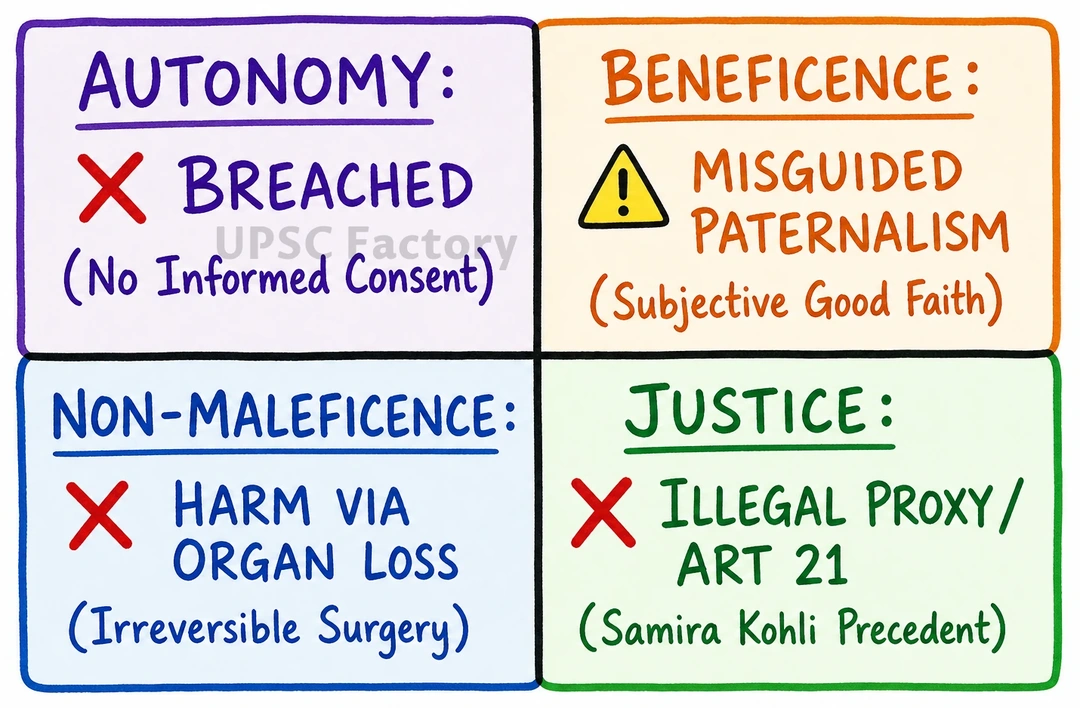
  1. Violation of Bodily Autonomy & Integrity: Performing an irreversible hysterectomy without Lata’s explicit, informed consent violates her fundamental reproductive autonomy (Article 21).
  2. Invalidity of Proxy Consent: Consent by a sister-in-law lacks legal standing, as Lata was an adult of sound mind and not in imminent, life-threatening danger (Samira Kohli v. Dr. Prabha Manchanda, 2008).
  3. Paternalism vs. Self-Determination: The medical team assumed decision-making authority, prioritizing physical convenience over the patient’s psychological and reproductive agency.
  4. Absence of Absolute Emergency: Since a biopsy was a viable alternative, immediate organ removal without confirmatory malignancy breached the bioethical principle of non-maleficence (Primum non nocere).
  5. Breach of Fiduciary Trust: The doctor-patient relationship is founded on trust; exceeding the agreed diagnostic scope causes psychological trauma and perceived betrayal.

(b) Moral Conduct of the Doctor

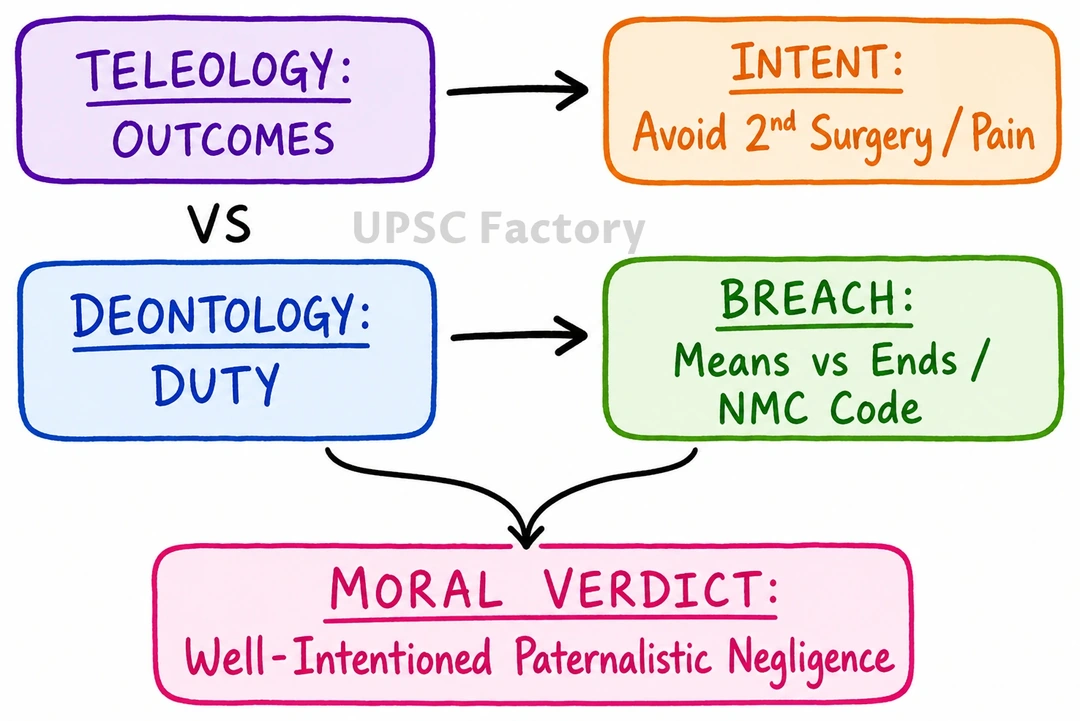
  1. Teleological View (Good Faith/Beneficence):
    • Intention: Dr. Mansi acted with benevolence, aiming to prevent repeated surgical trauma, anesthesia risks, and financial burdens.
    • Limitation: Good intentions do not justify bypassing ethical and legal protocols; utilitarian outcomes cannot override fundamental rights.
  2. Deontological View (Duty and Rights):
    • Duty Breach: The doctor violated the categorical imperative by treating Lata as a passive subject rather than an autonomous rational agent.
    • Professional Transgression: Failed the standard medical code of ethics (NMC Regulations) by expanding a diagnostic procedure into major surgery without prior consent.
  3. Moral Verdict: While Dr. Mansi’s actions were professionally negligent and legally untenable, they were driven by misguided paternalism rather than malice.

True medical beneficence must strictly operate within the boundaries of informed consent, ensuring that a patient’s dignity and bodily integrity remain inviolable.

Q. Lata, a mother of two children, was admitted to a hospital for acute abdominal pain. Her sister-in-law, Sujatha, accompanied her. Read More »

Q. Shakespeare in Henry IV says, “The arms are fair when the intent of bearing them is just”. What ethical implications does this have in governance?

Q. Shakespeare in Henry IV says, “The arms are fair when the intent of bearing them is just”. What ethical implications does this have in governance?

Question from UPSC Mains 2026 GS4 Paper

Model Answer: 

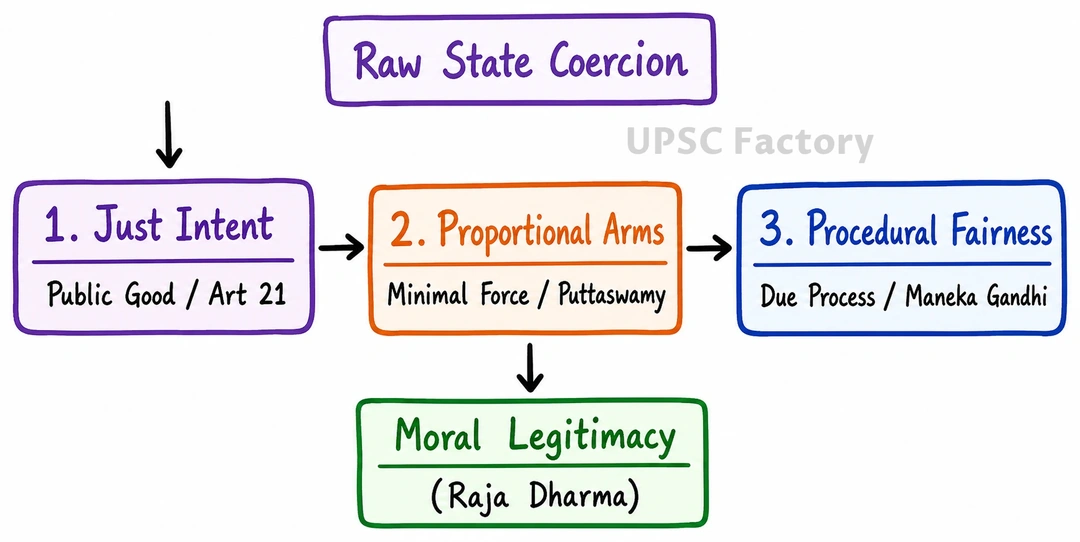
The quote reflects the doctrine of Jus ad bellum—asserting that the state’s coercive power (“arms”) derives moral legitimacy solely when anchored in public interest and righteous purpose (“just intent”).

1. Moral Legitimacy of State Authority

  • Upholding Public Interest: State coercion is ethically justified only when deployed to protect rights and welfare (Article 21, Disaster Management Act).
  • Doctrine of Proportionality: Restricts state force to the minimum necessary degree to achieve justice (Puttaswamy test).
  • Enforcing Raja Dharma: Legitimizes affirmative state intervention to eliminate systemic exploitation and protect the vulnerable (PDS anti-hoarding drives).

2. Safeguards Against the Abuse of Coercion

  • Preventing Weaponization: Barring the misuse of enforcement agencies for political vendetta or administrative overreach (Prakash Singh police reforms).
  • Substantive Due Process: Mandates that just intent must be matched by fair, non-arbitrary procedures (Maneka Gandhi case).
  • Gandhian Means-Ends Purity: Warns that noble administrative goals cannot justify unethical, heavy-handed enforcement measures.

Power detached from justice degrades into tyranny. In democratic governance, state authority remains fair only when disciplined by constitutional morality and human dignity.

Q. Shakespeare in Henry IV says, “The arms are fair when the intent of bearing them is just”. What ethical implications does this have in governance? Read More »

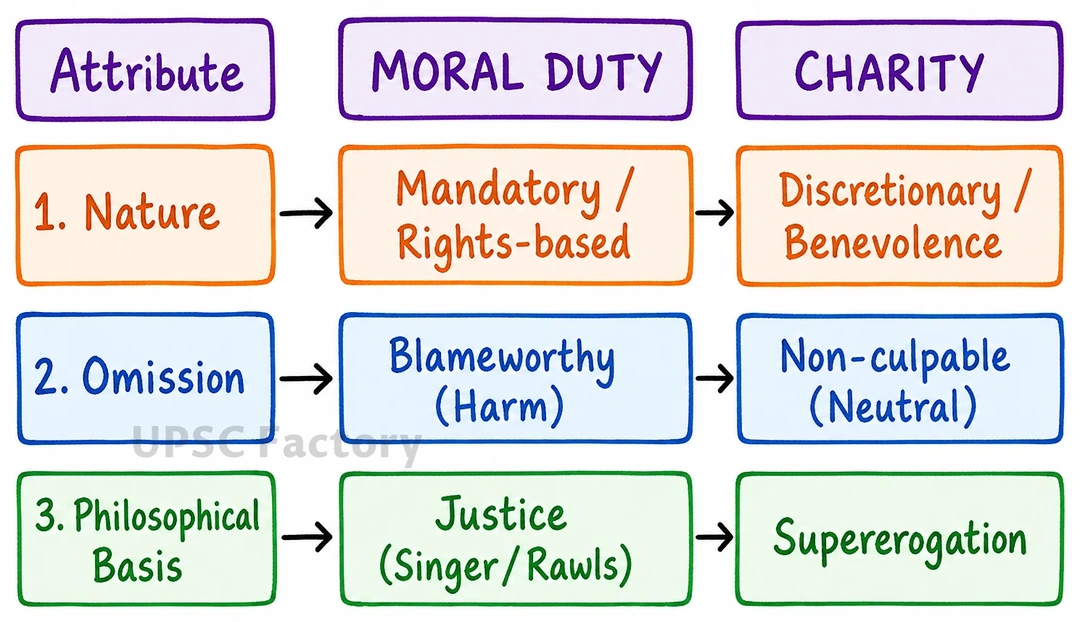
Q. Some moral philosophers argue that spending some of your resources—without significantly affecting your financial stability—to help other people who badly suffer is our moral duty and not merely a matter of charity. Justify this claim by explaining the distinction between duty and charity.

Q. Some moral philosophers argue that spending some of your resources—without significantly affecting your financial stability—to help other people who badly suffer is our moral duty and not merely a matter of charity. Justify this claim by explaining the distinction between duty and charity.

Question from UPSC Mains 2026 GS4 Paper

Model Answer: 

The administrator faces a dilemma between deontological legalism (strict RTE Act compliance) and teleological substantive justice (safeguarding the fundamental right to education under Article 21A).

Core Ethical Dilemma

  • Letter vs. Spirit of Law: Strict closure of non-compliant schools induces educational vacuums, risking child labour and dropouts.
  • Rule Fetishism vs. Pragmatism: Regulations are welfare instruments; enforcing them rigidly without enabling alternatives violates administrative ethics.

Pragmatic Administrative Strategy

  1. Graded Compliance Matrix: Prioritise non-negotiable safety and learning standards (child protection, basic pedagogy); provide provisional recognition with milestones for non-critical infrastructural norms.
  2. Resource Convergence: Upgrade school infrastructure by pooling funds from District Mineral Foundation (DMF), Border Area Development Programme (BADP), and CSR (Aspirational Districts model).
  3. Context-Specific Derogations: Recommend geographic exemptions for remote/hilly terrains under Section 20 of the RTE Act (e.g., relaxed land/playground requirements).
  4. Community Co-Management: Empower School Management Committees (SMCs) and Panchayats to mobilise local resources for low-cost, interim infrastructural compliance.
  5. Mobile & Shared Resource Hubs: Cluster non-compliant satellite schools around central model schools for shared laboratories, sports, and specialized teaching resources.

Administrative pragmatism requires enforcing rules as scaffolding for welfare, harmonising statutory mandates with the non-negotiable right to education.

Q. Some moral philosophers argue that spending some of your resources—without significantly affecting your financial stability—to help other people who badly suffer is our moral duty and not merely a matter of charity. Justify this claim by explaining the distinction between duty and charity. Read More »

Q. In international relations, ethical considerations are often subjugated to the strategic interests of nation-states. Discuss this from an ethical perspective.

Q. In international relations, ethical considerations are often subjugated to the strategic interests of nation-states. Discuss this from an ethical perspective.

Question from UPSC Mains 2026 GS4 Paper

Model Answer: 

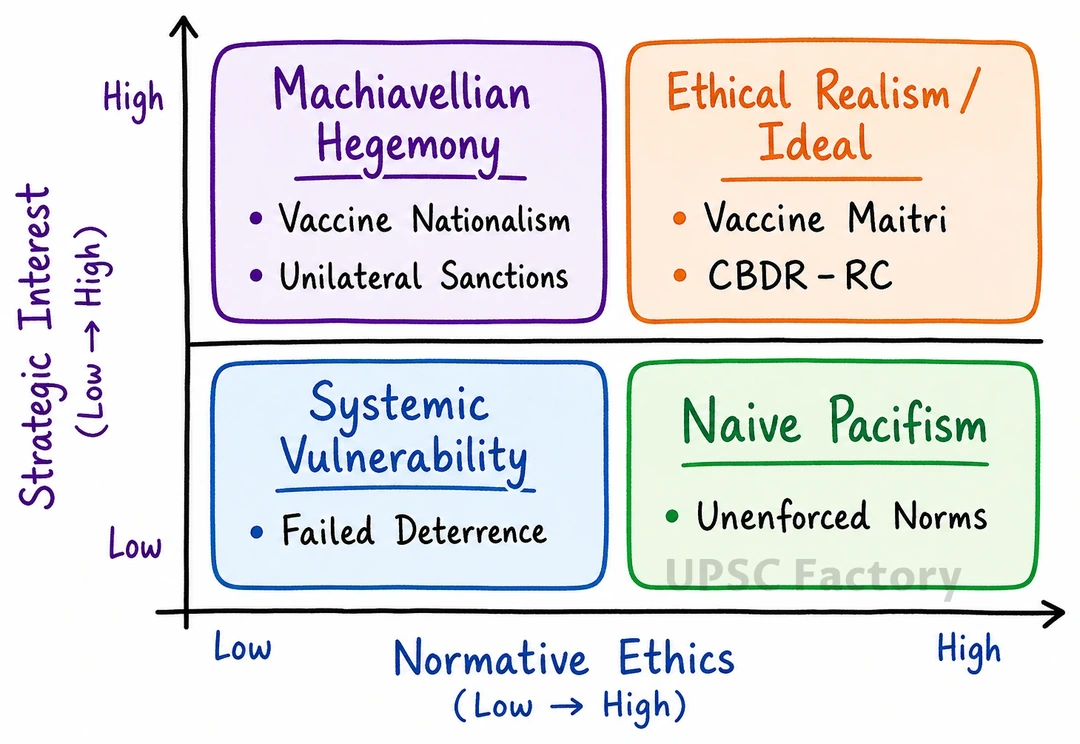
International relations frequently witnesses Morgenthau’s Realpolitik overriding normative obligations, prioritizing national survival, sovereignty, and state interests over universal ethical duties.

Manifestations of Strategic Subjugation over Ethics

  • Deontological Breaches: Sovereign security overrides non-aggression and human dignity, violating categorical moral duties (e.g., UN Charter Art. 2(4) violations in territorial incursions).
  • Distributive Injustice: Mercantilist self-interest undermines global equity and the collective good (e.g., Vaccine nationalism; climate finance evasion by the Global North).
  • Moral Double Standards: Strategic alignment causes selective human rights enforcement, prioritizing geopolitical leverage over universal moral consistency (e.g., instrumentalizing sanctions).

Pathways Toward Ethical Realism

  • Kantian Cosmopolitanism: Treating global citizens as ends in themselves rather than strategic means (e.g., India’s Vasudhaiva Kutumbakam and Vaccine Maitri).
  • Enlightened Self-Interest: Recognizing that planetary crises require moral solidarity and ethical burden-sharing (e.g., CBDR-RC framework in climate ethics).
  • Ethical Multilateralism: Strengthening rules-based frameworks and Just War (Jus ad bellum) principles to restrain unbridled unilateral power projection.

Sustainable national security is impossible without global moral order; statecraft must evolve from narrow, zero-sum Realpolitik toward an ethical, rules-based international trusteeship.

Q. In international relations, ethical considerations are often subjugated to the strategic interests of nation-states. Discuss this from an ethical perspective. Read More »

Q. On the request of his Personal Assistant (PA), the District Magistrate (DM) stops the transfer of a schoolteacher who takes private tuition for his daughter diagnosed with learning disability. In this context, discuss the aspects of empathy versus compliance with rules.

Q. On the request of his Personal Assistant (PA), the District Magistrate (DM) stops the transfer of a schoolteacher who takes private tuition for his daughter diagnosed with learning disability. In this context, discuss the aspects of empathy versus compliance with rules.

Question from UPSC Mains 2026 GS4 Paper

Model Answer: 

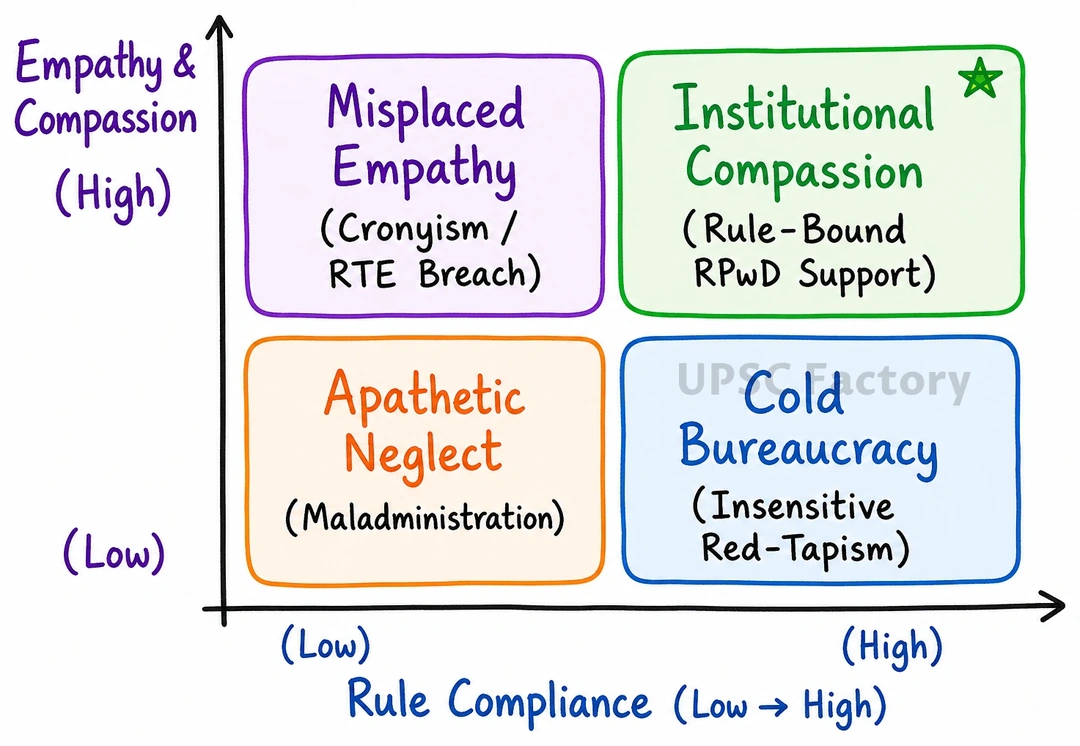
This scenario reflects the ethical tension between subjective compassion for a subordinate’s vulnerable child and an administrator’s duty to maintain procedural integrity and rational-legal authority.

Ethical & Administrative Fault Lines

  • Subversion of Law: Halting transfers to facilitate private tuition violates statutory prohibitions on private tutoring by government teachers (Section 28, RTE Act, 2009).
  • Abuse of Discretion: Granting personal favors to immediate staff breaches administrative neutrality, encouraging nepotism and cronyism (AIS Conduct Rules, 1968).
  • Misplaced Empathy: Prioritizing one child over institutional integrity deprives students at the transferee school of a teacher.
  • Valid Compassion: Empathy recognizes the severe developmental needs of a child with a learning disability (RPwD Act, 2016).

Harmonizing Compassion with Legality

  • Institutional Redress: Support the PA by providing access to certified resource persons and special educators (Samagra Shiksha Abhiyan).
  • Procedural Rectitude: Enforce the transfer objectively, preventing arbitrary exceptions while facilitating legitimate welfare assistance via transparent policy channels.

Empathy without integrity degenerates into favoritism; administrative compassion must always operate through rule-bound, institutional mechanisms rather than arbitrary personal discretion.

Q. On the request of his Personal Assistant (PA), the District Magistrate (DM) stops the transfer of a schoolteacher who takes private tuition for his daughter diagnosed with learning disability. In this context, discuss the aspects of empathy versus compliance with rules. Read More »