Prelims Solution

Q. A certain amount was distributed among X, Y and Z.

Q. A Question is given followed by two Statements I and II. Consider the Question and the Statements.

A certain amount was distributed among X, Y and Z.

Question: Who received the least amount?

Statement-1: X received 4/5 of what Y and Z together received.

Statement-II: Y received 2/7 of what X and Z together received.

Which one of the following is correct in respect of the above Question and the Statements?
a) The Question can be answered by using one of the Statements alone, but cannot be answered using the other Statement alone.
b) The Question can be answered by using either Statement alone.
c) The Question can be answered by using both the Statements together, but cannot be answered using either Statement alone.
d) The Question cannot be answered even by using both the Statements together.
Correct answer: c) The Question can be answered by using both the Statements together, but cannot be answered using either Statement alone.

Question from UPSC Prelims 2024 CSAT

Explanation : 

To determine who received the least amount among X, Y, and Z, let’s analyze the given statements:

Statement I: Given: X = 4/5(Y + Z)

Implication: The total amount distributed, T = X + Y + Z. Substituting from the statement:
T = 4/5(Y + Z) + Y + Z = 9/5(Y + Z)
Y + Z = 5/9T
X = 4/9T
Analysis: While we know X = 4/9T and Y + Z = 5/9T, we cannot determine the individual values of Y and Z. Without knowing how Y and Z are divided, we cannot conclusively identify who received the least.

Statement II: Given: Y = 2/7(X + Z)

Implication:
Let X + Z = a. Then, Y = 2/7a and T = a + 2/7a = 9/7a
Y = 2/9T
X + Z = 7/9T
Analysis: Even though we know Y = 2/9T, without the individual values of X and Z, it’s unclear whether Y is the least or if X or Z could be lesser based on their distribution.

Using Both Statements Together:

From Statement I: X = 4/9T
From Statement II: Y = 2/9T and X + Z = 7/9T
Substituting:
Y = 2/7(X + Z) = 2/7 × 7/9T = 2/9T
X = 4/9T
Z = 3/9T
Conclusion: The distribution ratios are X:Y:Z = 4:2:3. Clearly, Y receives the least amount.

Q. A certain amount was distributed among X, Y and Z. Read More »

Question: What are the unique values of x and y, where x, y are distinct natural numbers? Statement-I: x / y is odd. Statement-II: xy = 12

Q. A Question is given followed by two Statements I and II. Consider the Question and the Statements.

Question: What are the unique values of x and y, where x, y are distinct natural numbers?

Statement-I: x / y is odd.

Statement-II: xy = 12

Which one of the following is correct in respect of the above Question and the Statements?
a) The Question can be answered by using one of the Statements alone, but cannot be answered using the other Statement alone.
b) The Question can be answered by using either Statement alone.
c) The Question can be answered by using both the Statements together, but cannot be answered using either Statement alone.
d) The Question cannot be answered even by using both the Statements together.
Correct answer: c) The Question can be answered by using both the Statements together, but cannot be answered using either Statement alone.

Question from UPSC Prelims 2024 CSAT

Explanation : 

To determine the unique values of x and y (distinct natural numbers) that satisfy the given conditions, let’s analyze each statement individually and then consider them together.

Statement I: x/y is odd.

Interpretation: For x/y to be an odd integer, x must be an odd multiple of y. This implies that y must be a divisor of x, and the quotient x/y must be an odd number.

Limitations: Without additional information, there are multiple pairs (x, y) that can satisfy this condition. For example:
– x = 3, y = 1 (since 3/1 = 3 is odd)
– x = 9, y = 3 (since 9/3 = 3 is odd)

Conclusion: Statement I alone is insufficient to determine unique values of x and y.

Statement II: xy = 12.

Interpretation: The product of x and y is 12. Considering that x and y are distinct natural numbers, the possible pairs are:
– (1, 12)
– (2, 6)
– (3, 4)

Limitations: Multiple valid pairs satisfy this condition.

Conclusion: Statement II alone is insufficient to determine unique values of x and y.

Combining Statements I and II:

Now, let’s use both statements together.

1. From Statement II, the possible pairs are (1, 12), (2, 6), and (3, 4).

2. Applying Statement I (x/y is odd) to each pair:
– (1, 12): 1/12 is not an integer, so this pair is invalid.
– (2, 6): 2/6 = 1/3 is not an integer, so this pair is invalid.
– (3, 4): 3/4 is not an integer, so this pair appears invalid at first glance.

However, there’s a misunderstanding here. For x/y to be an odd integer, x must be a multiple of y, and the quotient must itself be odd.

Re-examining the possible pairs:
– (12, 1): 12/1 = 12 (Even)
– (6, 2): 6/2 = 3 (Odd)
– (4, 3): 4/3 is not an integer.

Valid Pair: (6, 2) since 6/2 = 3 is an odd integer.

Conclusion: Using both statements together, the unique values are x = 6 and y = 2.

Therefore, option c is the correct choice.

Question: What are the unique values of x and y, where x, y are distinct natural numbers? Statement-I: x / y is odd. Statement-II: xy = 12 Read More »

Q. A person walks 100 m Westward, then turns left and walks 100 m. He then takes a 225° turn clockwise. In which direction is he walking now?

Q. A person walks 100 m Westward, then turns left and walks 100 m. He then takes a 225° turn clockwise. In which direction is he walking now?

a) South-West
b) South-East
c) North-West
d) North-East
Correct answer: d) North-East

Question from UPSC Prelims 2024 CSAT

Explanation : 

Initial Movement:
Direction: West
Action: Walks 100 meters West.

First Turn:
Turn: Left
From West, turning left means facing South.
Action: Walks 100 meters South.

Second Turn:
Turn: 225° clockwise from South
Understanding the Turn:
– Starting Direction: South (which is 180° on a compass)
– Clockwise Turn: Adding 225° to the current direction.
– Calculation: 180° (South) + 225° = 405°
– Since 405° is equivalent to 45° (405° – 360°), the final direction is 45°, which corresponds to North-East on a compass.

Final Direction: North-East, Answer: d) North-East

A person walks 100 m Westward

Q. A person walks 100 m Westward, then turns left and walks 100 m. He then takes a 225° turn clockwise. In which direction is he walking now? Read More »

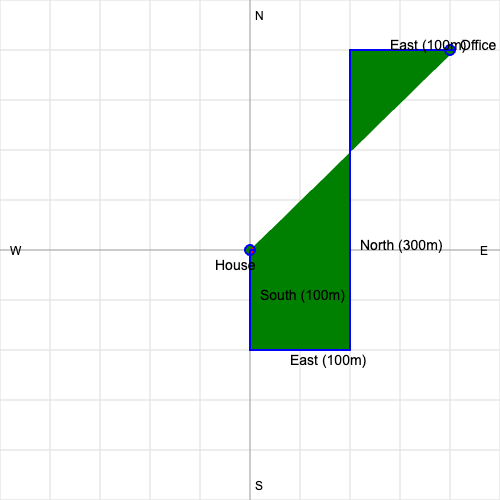
Q. A person walks 100 m straight from his house, turns left and walks 100 m

Q. A person walks 100 m straight from his house, turns left and walks 100 m,

again turns left and walks 300 m, then turns right and walks 100 m to reach his office. In which direction does he walk initially from his house if his office is exactly in the North-East direction?
a) North-West
b) West
c) South
d) South-West
Correct answer: c) South

Question from UPSC Prelims 2024 CSAT

Explanation : 

Let’s analyze the person’s movements step by step to determine the initial direction:

1. Initial Direction: Suppose the person starts by walking South.

2. First Movement:
– Walks 100 m South.
– Position: (0, -100).

3. First Turn (Left):
– From South, turning left means facing East.
– Walks 100 m East.
– Position: (100, -100).

4. Second Turn (Left):
– From East, turning left means facing North.
– Walks 300 m North.
– Position: (100, 200).

5. Third Turn (Right):
– From North, turning right means facing East again.
– Walks 100 m East.
– Final Position: (200, 200).

The final position (200, 200) places the office North-East of the house, which matches the given condition.

Answer: c) South

A person walks 100 m

Q. A person walks 100 m straight from his house, turns left and walks 100 m Read More »

Q. Let p and q be positive integers satisfying p

Q. Let p and q be positive integers satisfying p<q and p+q=k.

What is the smallest value of k that does not determine p and q uniquely?
a) 3
b) 4
c) 5
d) 6
Correct answer: c) 5

Question from UPSC Prelims 2024 CSAT

Explanation : 

Let p and q be positive integers

To determine the smallest value of k that does not uniquely determine the positive integers p and q (with p < q and p + q = k), let’s evaluate each option:

1. k = 3
– Possible pairs: (1, 2)
– Unique pair: Yes.

2. k = 4
– Possible pairs: (1, 3)
– Unique pair: Yes. (Note: (2, 2) is invalid since p < q.)

3. k = 5
– Possible pairs: (1, 4) and (2, 3)
– Unique pair: No. There are two distinct pairs.

4. k = 6
– Possible pairs: (1, 5) and (2, 4)
– Unique pair: No. There are two distinct pairs.

The smallest k where multiple pairs (p, q) satisfy the conditions is k = 5.

Q. Let p and q be positive integers satisfying p<q and p+q=k. Read More »

Q. 32^5 + 2^27 is divisible by a) 3 b) 7 c) 10 d) 11

Q. 32^5 + 2^27 is divisible by

a) 3
b) 7
c) 10
d) 11

Correct answer: c) 10

Question from UPSC Prelims 2024 CSAT

Explanation : 

32^5 + 2^27

To determine which of the given options divides 32^5 + 2^27, let’s simplify and analyze the expression step-by-step.

Simplify the Expression First, express everything in terms of powers of 2: 32 = 2^5 implies 32^5 = (2^5)^5 = 2^25

2^27 remains as is.

So, the expression becomes: 32^5 + 2^27 = 2^25 + 2^27 = 2^25(1 + 2^2) = 2^25 × 5

This shows that the expression is divisible by 2^25 and 5, and consequently by 2 × 5 = 10.

Q. 32^5 + 2^27 is divisible by a) 3 b) 7 c) 10 d) 11 Read More »

Q. The total cost of 4 oranges, 6 mangoes and 8 apples is equal to twice the total cost of 1 orange, 2 mangoes and 5 apples.

Q. The total cost of 4 oranges, 6 mangoes and 8 apples is equal to twice the total cost of 1 orange, 2 mangoes and 5 apples.

Consider the following statements:

1. The total cost of 3 oranges, 5 mangoes and 9 apples is equal to the total cost of 4 oranges, 6 mangoes and 8 apples.
2. The total cost of one orange and one mango is equal to the cost of one apple.
Which of the statements given above is/are correct?
a) 1 only
b) 2 only
c) Both 1 and 2
d) Neither 1 nor 2
Correct answer: c) Both 1 and 2

Question from UPSC Prelims 2024 CSAT

Explanation : 

Let’s analyze the problem step by step.

Let:
o = cost of one orange
m = cost of one mango
a = cost of one apple

Given:
The total cost of 4 oranges, 6 mangoes, and 8 apples is equal to twice the total cost of 1 orange, 2 mangoes, and 5 apples.

This can be written as:
4o + 6m + 8a = 2(1o + 2m + 5a)
4o + 6m + 8a = 2o + 4m + 10a

Simplifying:
Subtract 2o + 4m + 10a from both sides:
2o + 2m – 2a = 0
Divide by 2:
o + m = a
This confirms Statement 2: The total cost of one orange and one mango is equal to the cost of one apple.

Now, let’s evaluate Statement 1:
“The total cost of 3 oranges, 5 mangoes, and 9 apples is equal to the total cost of 4 oranges, 6 mangoes, and 8 apples.”

Expressed mathematically:
3o + 5m + 9a = 4o + 6m + 8a
Rearrange:
3o + 5m + 9a – 4o – 6m – 8a = 0
-o – m + a = 0
o + m = a

This is the same as what we derived earlier, hence Statement 1 is also correct.

Conclusion: Both statements 1 and 2 are correct.

Q. The total cost of 4 oranges, 6 mangoes and 8 apples is equal to twice the total cost of 1 orange, 2 mangoes and 5 apples. Read More »

Q. Three numbers x, y, z are selected from the set of the first seven natural numbers such that x > 2y > 3z. How many such distinct triplets (x, y, z) are possible?

Q. Three numbers x, y, z are selected from the set of the first seven natural numbers such that x > 2y > 3z. How many such distinct triplets (x, y, z) are possible?

a) One triplet
b) Two triplets
c) Three triplets
d) Four triplets

Correct answer: d) Four triplets

Question from UPSC Prelims 2024 CSAT

Explanation : 

Three numbers x, y, z…

To find the number of triplets (x, y, z) from the first seven natural numbers (1 to 7) satisfying the conditions x > 2y > 3z, we’ll systematically examine possible values of z, y, and x.

Consider z = 1:

– 3z = 3
– 2y > 3z => 2y > 3 => y > 1.5 => y >= 2
– Possible y values: 2, 3, 4, 5, 6, 7
– Compute 2y for each y and find x such that x > 2y within the set {1, 2, …, 7}:
– y = 2 => 2y = 4 => x > 4 => x = 5, 6, 7
– y = 3 => 2y = 6 => x > 6 => x = 7
– For y >= 4, 2y >= 8, but x cannot be greater than 7, so no valid x exists.
– Valid triplets for z = 1:
– (5, 2, 1)
– (6, 2, 1)
– (7, 2, 1)
– (7, 3, 1)

Consider z >= 2:

– For z = 2:
– 3z = 6
– 2y > 6 => y > 3
– Possible y values: 4, 5, 6, 7
– 2y >= 8, but x > 2y would require x > 8, which is beyond 7.
– No valid triplets.
– Similarly, for z = 3 to 7, the required y and x values exceed 7. No valid triplets exist.

Conclusion:
Only for z = 1 do we find valid triplets, and there are four such triplets.

Answer: Four triplets

Q. Three numbers x, y, z are selected from the set of the first seven natural numbers such that x > 2y > 3z. How many such distinct triplets (x, y, z) are possible? Read More »

Q. If the sum of the two-digit numbers AB and CD is the three-digit number 1CE, where the letters A, B, C, D, E denote distinct digits, then what is the value of A?

Q. If the sum of the two-digit numbers AB and CD is the three-digit number 1CE, where the letters A, B, C, D, E denote distinct digits, then what is the value of A?

a) 9
b) 8
c) 7
d) Cannot be determined due to insufficient data
Correct answer: a) 9

Question from UPSC Prelims 2024 CSAT

Explanation : 

We are given:
– Two two-digit numbers: AB and CD
– Their sum is a three-digit number: 1CE
– All letters represent distinct digits.

Step 1: Set Up the Addition

   A B
+ C D
———-
1 C E

Step 2: Analyze the Units Place (Rightmost Digit)

Adding the units digits:
– B + D = E (with possible carryover to the tens place)

Let k be the carryover from the units place addition (k can be 0 or 1 because the sum of two digits can’t produce a carryover greater than 1 in decimal addition).

So:
1. B + D = E + 10k
2. Equation (1): B + D = E + 10k

Step 3: Analyze the Tens Place

Adding the tens digits, plus any carryover from the units place:
– A + C + k = C + 10
(since the tens digit in the result is C, and there’s a carryover to make it the same C)

Simplify:
1. A + k = 10
2. Equation (2): A + k = 10

Step 4: Solve for A and k

From Equation (2):
– Since A is a single digit (0-9), and k is 0 or 1:
– If k = 0: A = 10 (invalid, as A must be a single digit)
– If k = 1: A = 9 (valid, as A is a single-digit number)

Therefore, A = 9 and k = 1.

Step 5: Conclusion

Using the carryover method simplifies the problem and directly leads us to the value of A:
– A = 9

Q. If the sum of the two-digit numbers AB and CD is the three-digit number 1CE, where the letters A, B, C, D, E denote distinct digits, then what is the value of A? Read More »

Q. A person buys three articles P, Q and R for ₹ 3,330. If P costs 25% more than R and R costs 20% more than Q, then what is the cost of P?

Q. A person buys three articles P, Q and R for ₹ 3,330. If P costs 25% more than R and R costs 20% more than Q, then what is the cost of P?

a) ₹ 1,000
b) ₹ 1,200
c) ₹ 1,250
d) ₹ 1,350
Correct answer: d) ₹ 1,350

Question from UPSC Prelims 2024 CSAT

Explanation : 

THE COST OF P

Given:
– R costs 20% more than Q
– P costs 25% more than R
– Total cost (P + Q + R) = ₹3,330

STEP 1: EXPRESS ALL COSTS IN TERMS OF Q
Cost of Q = Q
Cost of R = Q + 20% of Q = 1.20Q
Cost of P = R + 25% of R = 1.25 × 1.20Q = 1.50Q

STEP 2: FORM TOTAL COST EQUATION
P + Q + R = 3,330
1.50Q + Q + 1.20Q = 3,330
3.70Q = 3,330

STEP 3: SOLVE FOR Q
Q = 3,330 ÷ 3.70
Q = 900

STEP 4: CALCULATE P
P = 1.50 × Q
P = 1.50 × 900
P = 1,350

ANSWER: P costs ₹1,350

Q. A person buys three articles P, Q and R for ₹ 3,330. If P costs 25% more than R and R costs 20% more than Q, then what is the cost of P? Read More »