Sociology Notes

Emergence of Sociology: Origins and Development

Emergence of Sociology: Origins and Development

The Zeitgeist of the 19th Century

Sociology did not emerge in a vacuum; it was the intellectual offspring of a massive structural disruption in 19th-century Europe. As T.B. Bottomore rightly noted, “Sociology is the intellectual child of the French and Industrial Revolutions.”

Prior to this period, society was explained through the lens of religion, divine will, and theological hegemony. However, the advent of Modernity created a paradigm shift, breaking down the traditional feudal order and creating the need for a new, scientific discipline to understand the resultant chaos.

What is Modernity?

In sociological terms, modernity is not just a time period, but a set of structural and cultural shifts characterized by:

  • Secularization: Decline of religious authority.
  • Rationalization: Reason and science replacing blind faith.
  • Structural Differentiation: Separation of institutions (e.g., family and workplace separated).
  • Democratization: Rise of the nation-state and citizenship.

UPSC Easy Recall Equation:
Epistemological Shift (Ideas) + Economic Disruption (Capitalism) + Political Upheaval (Revolutions) = Crisis of Modernity → Emergence of Sociology.
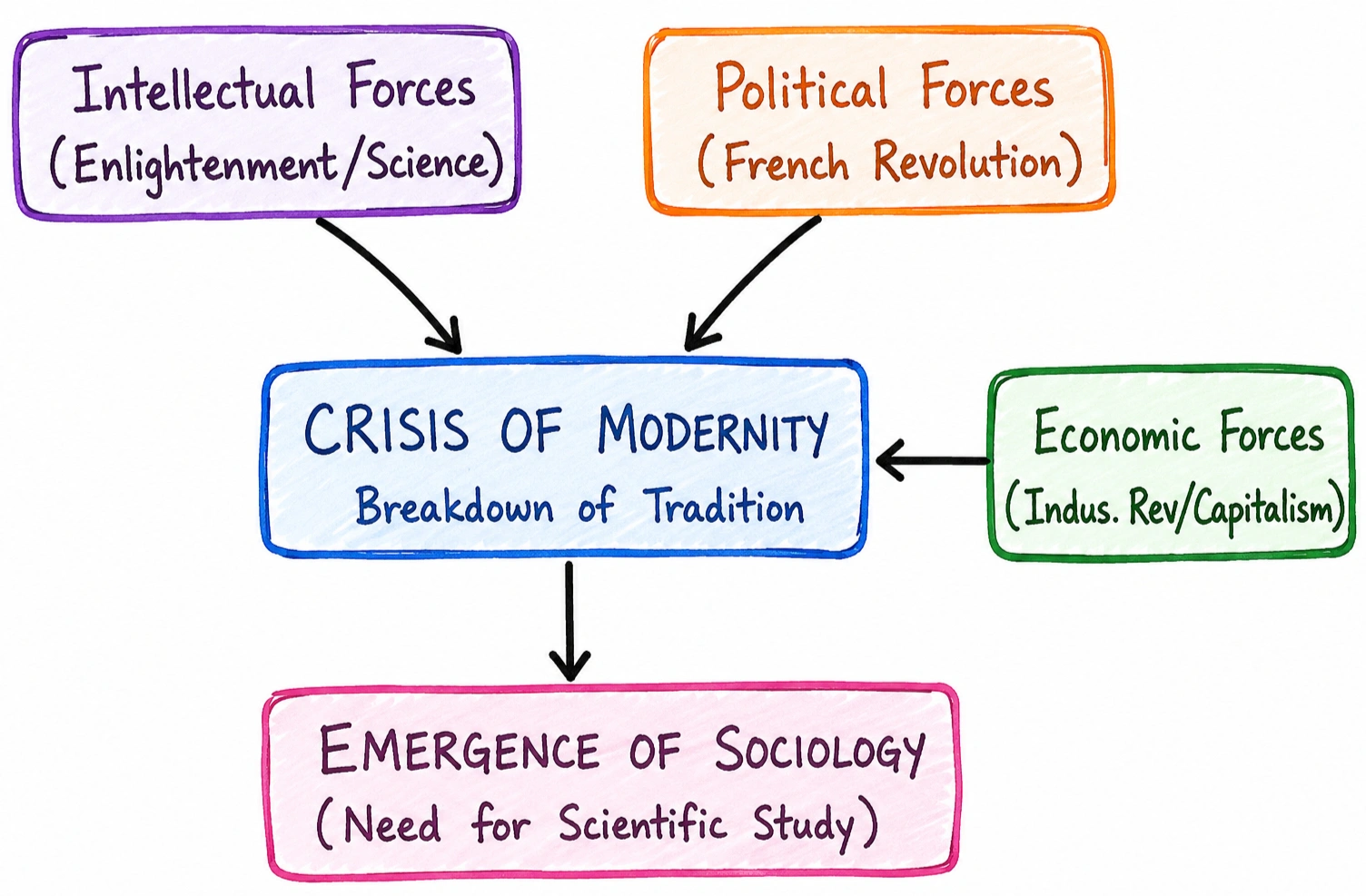
emergence_of_sociology_factors

1. Intellectual & Epistemological Forces

The intellectual foundation of sociology was laid by a shift in how humans acquired knowledge (epistemology), shaped by three major currents:

A. The Scientific Revolution & The Enlightenment

Thinkers like Copernicus and Newton proved that nature was governed by discoverable laws. Enlightenment thinkers (Locke, Rousseau, Kant) argued that if nature could be studied scientifically, so could society. They challenged orthodoxy, arguing that society is man-made and can be reformed through human reason.

B. The Conservative Reaction (Crucial for UPSC)

While the Enlightenment celebrated change and individualism, early sociology was deeply influenced by the Conservative Reaction to the chaos of the French Revolution. Thinkers like Louis de Bonald and Joseph de Maistre were horrified by the violence and moral breakdown of society. They wanted to restore social order and group solidarity.
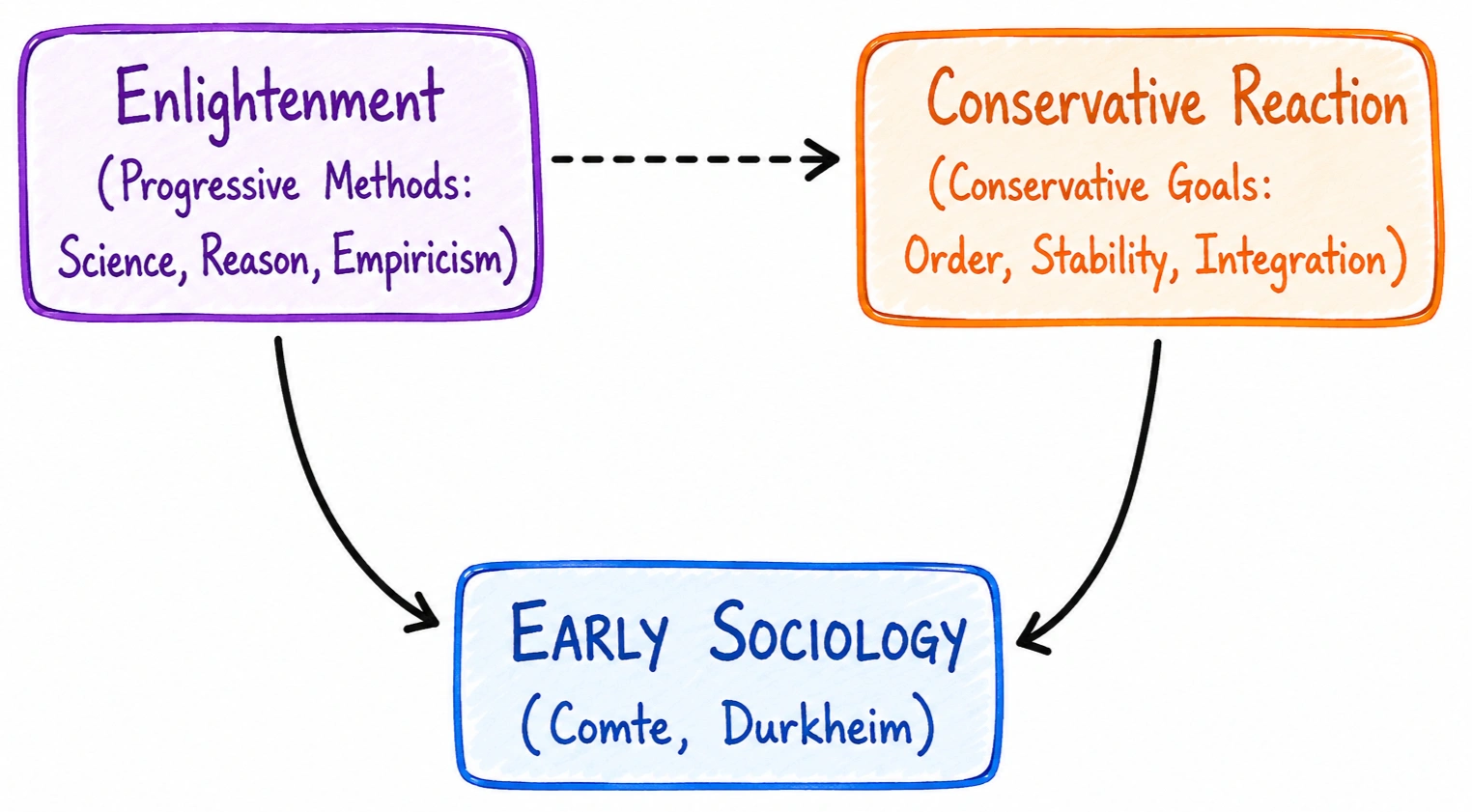
  • The Paradox of Sociology: Early sociology (Comte, Durkheim) was born out of a paradox—it used the progressive methods of the Enlightenment (science, empiricism) to achieve the conservative goals of the Counter-Enlightenment (restoring social order and stability).

C. Henri de Saint-Simon – The Bridge

Saint-Simon was a pivotal figure who bridged these two streams. He was the first to argue that society needed a science of social behavior to navigate industrialization. He deeply influenced both Auguste Comte (towards order and positivism) and Karl Marx (towards socialism and conflict).

2. Material & Economic Forces (Industrial Revolution)

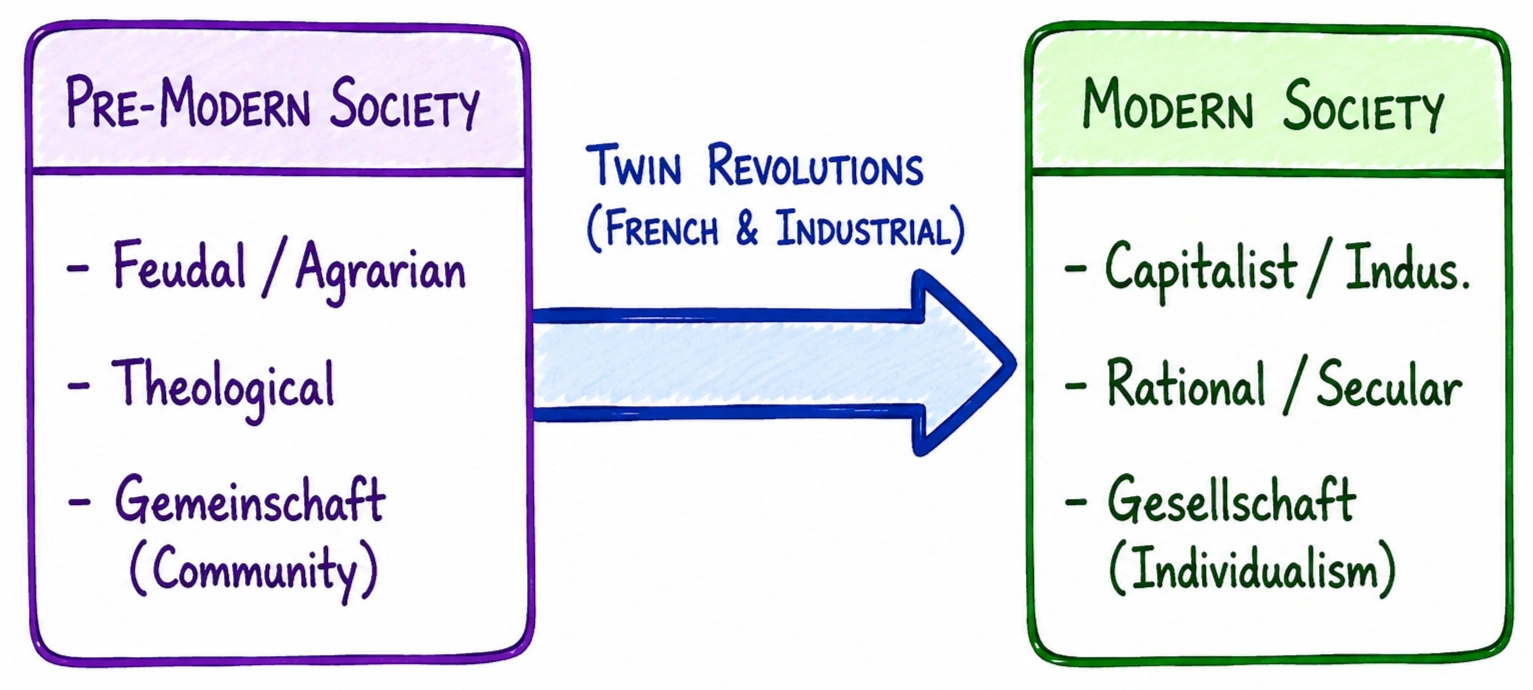
The Commercial Revolution (expansion of global trade and colonialism) and the Industrial Revolution (late 18th century) provided the subject matter for sociology. The transition from agrarian-feudalism to industrial-capitalism caused severe structural disruptions:

  • Rise of the Factory System: Labor was commodified. The workplace separated from the home, changing family structures.
  • Urbanization and Slums: Mass migration from villages to cities resulted in overcrowding, rising crime, and social isolation. Ferdinand Tönnies described this as the shift from Gemeinschaft (close-knit community) to Gesellschaft (impersonal, formal association).
  • New Stratification: The old feudal hierarchy was replaced by a new, antagonistic class system—the Bourgeoisie (capitalists) and the Proletariat (wage-workers).

These new, glaring social problems forced thinkers to study poverty, inequality, and urban disorganization scientifically.
3. Political & Social Forces (French Revolution – 1789)

The French Revolution destroyed the absolute monarchy and the traditional Estate system. It introduced radical modern ideals: Liberty, Equality, and Fraternity.

However, it also brought decades of terror, instability, and the rapid decline of traditional authority (the Church and the Monarchy). This raised the central sociological question: How can social order be maintained in a rapidly changing, increasingly individualistic society?

4. Responses of the Founding Fathers to Modernity

(Note: Focus here is only on how they reacted to the emergence of modernity, reserving deep theory for the Thinkers chapter.)

  • Auguste Comte: Coined the term “Sociology” (1838). Disturbed by post-revolution chaos, he proposed Positivism—applying natural science methods to society to discover laws of “social statics” (order) and “social dynamics” (progress).
  • Karl Marx: Viewed modernity through the lens of Conflict Theory. He argued that the new industrial-capitalist order was built on the exploitation and alienation of the proletariat, predicting that class struggle would lead to socialism.
  • Emile Durkheim: Viewed modernity as a crisis of moral integration. He studied how the complex division of labor weakened traditional bonds, leading to a state of normlessness or Anomie. He sought to establish sociology as an independent academic discipline through the study of “Social Facts.”
  • Max Weber: Moved beyond positivism using Verstehen (interpretive understanding). He was concerned with Rationalization—how modern capitalism and bureaucratic states were trapping individuals in an “Iron Cage” of rules and efficiency, stripping society of its magic and emotion.

5. Critical Evaluation (The “Dark Side” of Sociology’s Emergence)

While classical sociology was revolutionary, it had inherent biases:

  • Eurocentrism: Thinkers like Raewyn Connell argue that early sociology was a “science of empire.” It focused entirely on European problems and ignored the colonial exploitation that funded Europe’s industrialization.
  • Social Darwinism: Thinkers like Herbert Spencer used evolutionary theory to coin “survival of the fittest,” which was often misused to academically justify racism, imperialism, and inequality.
  • Gender Blindness: Early sociological thought was almost entirely dominated by white, male perspectives, ignoring the domestic labor and structural marginalization of women during the Industrial Revolution.

6. Syllabus Linkages

  • Link to Chapter 2 (Methodology): The urge to cure the “diseases” of modernity led to the birth of Positivism (treating sociology objectively, like physics).
  • Link to Chapter 3 (Research Methods): The extreme poverty of industrial cities forced governments to collect data. This led to early empirical research, such as Charles Booth’s quantitative surveys of London’s poor.
  • Link to Chapter 5 (Stratification): The economic revolution shifted the system of stratification from a closed Estate System based on birth to an open Class System based on wealth.

Conclusion

The emergence of sociology was an attempt to apply the Sociological Imagination (as coined by C. Wright Mills) to understand the massive historical transformations of 19th-century Europe. By connecting the “personal troubles” of the industrial worker to the “public issues” of capitalism and urbanization, early sociologists laid the foundation for a new science. Just as classical sociology emerged to understand the disruptions of the Industrial Revolution, contemporary sociology remains highly relevant today as it evolves to understand the modern disruptions of the Digital/AI Revolution, climate change, and globalization.
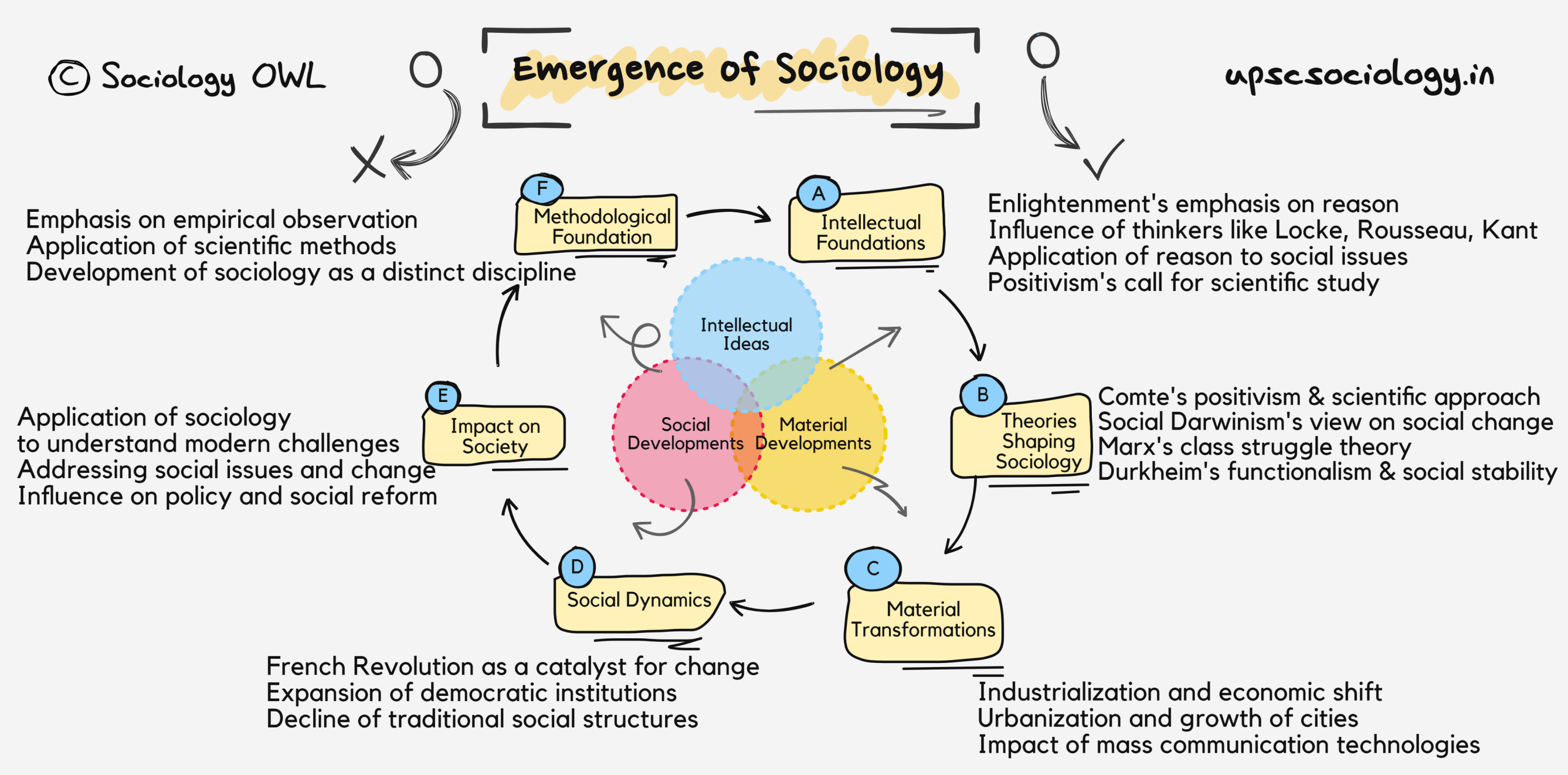
 

Emergence of Sociology: Origins and Development Read More »
Karl Marx’s Methodology: Unveiling His Materialistic Conception of History

Karl Marx's Methodology: Unveiling His Materialistic Conception of History

Karl Marx’s Methodology: Unveiling His Materialistic Conception of History

Karl Marx, a revolutionary thinker and philosopher, introduced a groundbreaking methodology to the social sciences during his time. His innovative concepts and hypotheses left an indelible mark on the fields of history, political science, and sociology. In this article, we will delve into Marx’s methodology, with a particular focus on his materialistic conception of history and his views on social conflict and change.

Marx’s Materialistic Conception of History

Marx’s methodology is anchored in his materialistic conception of history, which serves as the cornerstone of his social analysis. According to Marx, the driving force behind historical evolution is the manner in which human beings interact with nature to meet their fundamental survival needs. The production of material life is considered the first pivotal historical act in Marx’s framework. Even after satisfying their primary needs, humans continue to experience dissatisfaction because new, secondary needs emerge once the primary ones are met.

As individuals strive to fulfill these needs, they engage in social relationships with one another. In the process, as material life becomes increasingly complex, society undergoes a transformation. The division of labor emerges, leading to the formation of distinct classes within society—namely, the “haves” and the “have-nots.”

Marx emphasizes the economic “infrastructure” as the key shaping force for the rest of society. The specific mode of production dictates the relations of production, which, in turn, uphold the entire cultural superstructure. This holistic approach to society is a crucial methodological contribution by Marx, highlighting the interconnectedness of various social components. Social groups, institutions, beliefs, and doctrines are interrelated and should be studied as such. Nonetheless, the economic system ultimately holds the decisive role in shaping the features of the superstructure.

Marx applies his materialistic conception of history by examining human society’s history in distinct stages, each marked by a specific mode of production. From these modes of production stem unique relationships and class antagonisms that characterize each historical phase. His theory of “historical materialism” provides a detailed framework for understanding these stages and their dynamics. Marx is a relativizing historicist, rooting social relationships and ideas within specific historical contexts, and acknowledging the qualitative differences in class struggles across epochs.

Social Conflict and Social Change

Early sociology, notably influenced by the ideas of Auguste Comte and Herbert Spencer, leaned towards the doctrine of evolutionary change, emphasizing peaceful growth as the primary driver of societal progress. In this context, social order and harmony were considered the norm, while disorder and conflict were viewed as pathological.

Marx’s contributions to sociological thought stand in stark contrast to this prevailing perspective. He asserts that societies are inherently mutable systems, with change primarily propelled by internal contradictions and conflicts. Each historical stage is marked by its unique contradictions and tensions, which intensify over time, eventually leading to the breakdown of the existing system and the emergence of a new one. In essence, Marx sees conflict not as something detrimental but as a creative force, the engine of progress.

Marx’s Notion of ‘Praxis’

A distinctive aspect of Marx’s methodology is his concept of ‘praxis.’ Unlike many sociologists who sought to maintain a separation between sociological theory and political ideology, Marx unites theory and political activism in his work. He openly expresses his critique of capitalist society, which he views as an inhumane system of exploitation. Marx anticipates the system’s eventual collapse under the weight of its internal contradictions, paving the way for the birth of a classless, communist society free from such contradictions. Marx advocates ‘praxis,’ which involves using theory as a tool for practical political action. This methodology aims not only to understand society but also to anticipate and actively contribute to its transformation.

The concept of ‘praxis‘ is rooted in the Greek term for action or activity, which was further developed and refined in European philosophy, particularly by thinkers like Aristotle, Francis Bacon, and Immanuel Kant. Kant, for instance, distinguished between “pure” and “practical” reason, highlighting the primacy of practical philosophy. Marx’s ‘praxis‘ represents the unification of philosophy and revolutionary action, ultimately aimed at transforming the world. He views ‘praxis‘ as a means to eliminate alienation, turning labor into non-alienative, creative self-activity.

In conclusion, Karl Marx’s methodology has left an indelible mark on the social sciences, introducing novel concepts and hypotheses that continue to influence the fields of history, political science, and sociology. His materialistic conception of history, emphasis on the role of conflict in social change, and the concept of ‘praxis‘ have all contributed to a deeper understanding of society and its evolution. Marx’s holistic approach to studying society and his recognition of the distinctive features of each historical stage further enrich the social sciences, emphasizing the interconnectedness of various social components.

Karl Marx’s Methodology: Unveiling His Materialistic Conception of History Read More »

Karl Marx: Dialectical and Historical Materialism

Karl Marx: Dialectical and Historical Materialism

Karl Marx: Dialectical and Historical Materialism

Karl Marx’s historical materialism forms the scientific core of his sociological thought, providing a framework for analyzing social change and development. This theory recognizes the essentially social character of human life and seeks to explain how material conditions shape society and drive historical progress.

Philosophical Background:
In Marx’s time, two dominant philosophical approaches grappled with the nature of reality: idealism and materialism. Marx proposed a third way he termed “naturalism” or “humanism,” which considered humans as social animals whose consciousness is shaped by their material conditions.

Key aspects of Marx’s approach:
• Rejection of both extreme idealism and brute materialism
• Criticism of Hegel’s idealistic foundation
• Emphasis on humans as social beings
• Recognition of the interplay between material conditions and consciousness

The Concept of Dialectics:

Central to Marx’s thought is the concept of dialectics, a method of understanding reality as a process of constant change and development through contradictions. Marx applied dialectics to material conditions, arguing that social and economic contradictions drive historical change.

Principles of Marx’s dialectical materialism:
• Each stage of society contains seeds of its own transformation
• Conflicts between social classes or between forces and relations of production lead to new social formations
• Change is driven by the resolution of contradictions

Historical Materialism:

Historical materialism is built on several key postulates that emphasize the relationship between material conditions and social consciousness.

Core principles of historical materialism:
• Social being determines consciousness
• Human beings act collectively to establish means of physical and social reproduction
• Societies develop distinctive structures called modes of production
• Beyond subsistence, societies divide into antagonistic classes
• Productive forces of society tend to grow over time

Economic Structure and Superstructure:

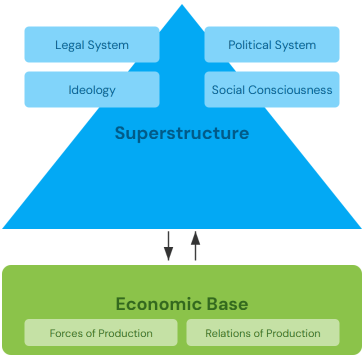
Marx argued that the economic structure of society forms the foundation upon which the political, legal, and cultural superstructure is built.

Key elements of this model:
• Economic base: Relations of production and forces of production
• Superstructure: Political, legal, and cultural institutions
• Changes in the economic base lead to transformations in the superstructure
• The mode of production conditions social, political, and intellectual life processes

Economic Structure and Superstructure

Historical Change and Social Revolution:

According to Marx, historical change occurs when new developments in productive forces conflict with existing relations of production.

The process of historical change:
• Contradictions arise between productive forces and relations of production
• People become conscious of the conflict, leading to a period of social revolution
• Resolution of the conflict results in new forces of production and relations
• This process drives the course of human history through various stages (e.g., primitive communism, feudalism, capitalism, socialism)

Capitalist Society and Class Structure:

Marx applied his theory to an analysis of capitalist society, characterized by a fundamental class divide between the bourgeoisie and the proletariat.

Marx’s predictions for capitalist development:
• Increasing concentration of capital in fewer hands
• Higher profits for the bourgeoisie and worsening conditions for the proletariat
• Disappearance of the middle classes
• Polarization of society into two main classes, eventually leading to revolutionary change

Critique and Contributions:
While emphasizing economic factors, Marx rejected simplistic economic determinism. Historical materialism has made significant contributions to sociological theory.

Key contributions:
• Provided a systematic framework for understanding social change
• Emphasized the importance of economic factors in social life
• Highlighted the role of conflict and contradiction in driving historical development
• Introduced the concept of class struggle as a motor of history

Conclusion:
Karl Marx’s theory of historical materialism represents a groundbreaking approach to understanding society and history. By emphasizing the role of material conditions and economic structures in shaping social life, Marx provided a powerful tool for analyzing social change and development. While subsequent scholars have critiqued and refined Marx’s ideas, historical materialism continues to be a significant influence in sociology, economics, and political theory.

Karl Marx: Dialectical and Historical Materialism Read More »

G.S. Ghurye: A Detailed Biography

G.S. Ghurye: A Detailed Biography

G.S. Ghurye: A Detailed Biography

This article provides a detailed biography of G.S. Ghurye, based on his own book “I and Other Explorations” from 1973. Ghurye was born on December 12, 1893, in the small town of Malvan on the west coast of India. He came from a prosperous Brahmin family known for their religious piety. Due to business losses and the death of his grandfather, Ghurye’s father had to take up a job to support the family. Ghurye had three siblings, including an elder brother whom he admired.

Ghurye began his education in Malvan and later joined an English school after completing his fifth standard examination. While his mother tongue was Marathi, he also learned Sanskrit as it was prevalent in his family. Ghurye’s upbringing in a religious and learned family deeply influenced his values and beliefs. He excelled academically and completed his matriculation from Junagad in Gujarat, where his eldest brother was already studying.

In 1912, Ghurye became a student at Bahauddin College and developed a strong proficiency in Sanskrit. He later joined Bombay University, where he secured fourth position in the entrance exam. Despite bouts of illness, Ghurye maintained his dedication to his studies and performed well. In 1916, after completing his B.A. examination and standing first in his class, he married a girl from a wealthy family in Vengurla, Maharashtra. Although her name was changed after marriage, Ghurye preferred to call her by her original name, Sajubai.

Ghurye continued his studies and completed his M.A. degree, specializing in English, Sanskrit, and later Pali. He also took a course on comparative philology, achieving first class in his M.A. Alongside his academic achievements, Ghurye won the Chancellor’s Gold Medal, the highest honor in the university. He then applied for a scholarship to study sociology abroad and impressed Professor Patrick Geddes with an essay on “Bombay as an Urban Centre,” which led to him receiving the scholarship.

Ghurye traveled to England and studied under L.T. Hobhouse. He also met renowned ethnologist Dr. A.C. Haddon and Dr. W.H.R. Rivers, whose influence on Ghurye was significant. Ghurye published several articles in sociology during this time and wrote his most important work, “Caste and Race in India,” in the 1930s. He obtained his Ph.D. from Cambridge University and returned to India after Rivers’ death.

In 1924, Ghurye and K.P. Chattopadhya were appointed as Readers in Sociology at Bombay University. Ghurye’s reputation and recognition from W.H.R. Rivers played a role in his appointment. He became a Professor of Sociology in 1934 and served as the Head of the Department of Sociology at Bombay University. Ghurye made significant contributions to the growth of sociology and social anthropology in India, guiding and inspiring numerous students who went on to become famous sociologists.

Throughout his career, Ghurye received numerous honors and accolades, including being elected President of the anthropological section of the Indian Science Congress in 1934 and President of the Bombay Anthropological Society from 1942 to 1948. He extensively studied various aspects of Indian society, including castes, tribes, rural-urbanization, Indian Sadhus, and Indian costumes. Ghurye’s knowledge of Sanskrit allowed him to analyze religious scriptures in the context of Indian society.

G.S. Ghurye became a renowned sociologist in India and internationally. He wrote several books and articles, and his expertise and contributions were widely recognized. He passed away in 1984, leaving a significant legacy in the field of sociology.

G.S. Ghurye: A Detailed Biography Read More »