Model Answer:
In The Elementary Forms of Religious Life, Emile Durkheim defines religion as a unified system of beliefs and practices relative to Sacred things, uniting adherents into a single moral community.
Relevance of Durkheim’s Views
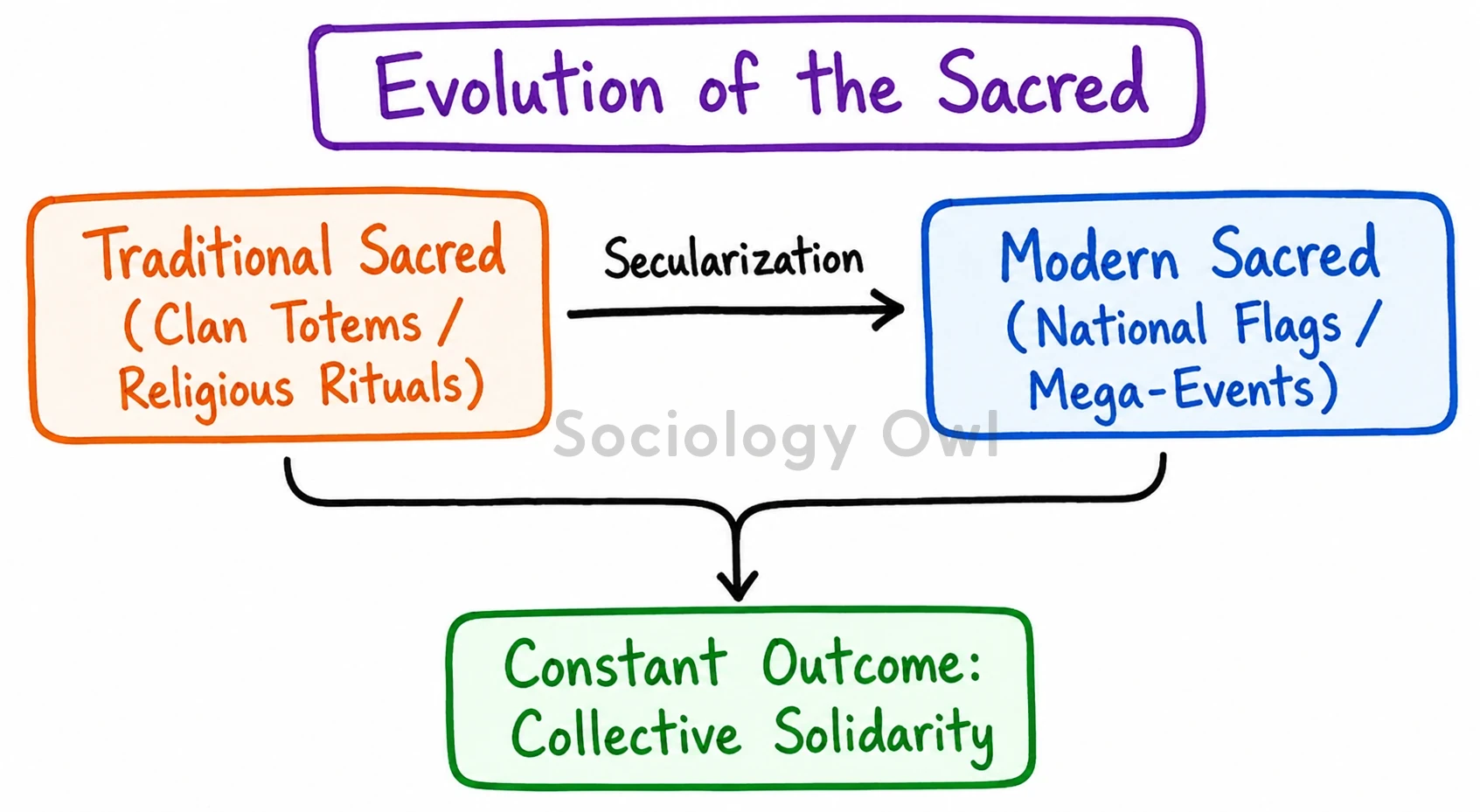
- Civil Religion: Robert Bellah shows how secular nationalism (e.g., constitutional reverence, Independence Day) fosters cohesion identically to traditional religion.
- Neo-Totemism: National flags and corporate logos function as modern totems, projecting collective identity.
- Collective Effervescence: Mega-events like the FIFA World Cup or Kumbh Mela generate unifying social energy, mimicking religious fervor.
Limitations in Contemporary Society
- Privatization: Grace Davie identifies “believing without belonging”, emphasizing individualized spirituality over collective ritual.
- Dysfunction: Religion frequently triggers sectarian violence globally, contradicting Durkheim’s integration thesis and supporting Karl Marx’s conflict perspective.
Regarding contemporary relevance, the global emergence of environmentalism as a moral duty proves Durkheim’s concept of the Sacred continuously adapts to secular, modern contexts. Conversely, the rise of religious “Nones” challenges the universality of a singular moral community.
Conclusion
Despite secularization weakening orthodox faith, Durkheim’s functional premise survives. Modern societies continuously reinvent Sacred symbols and rituals to maintain the collective solidarity essential for social integration.